Conventions.
- Category means $(\infty,1)$-category; $\mathsf{Cat}$ is the category of all categories.
- $2$-category means $(\infty,2)$-category; $\mathsf{Cat}_2$ is the $2$-category of all categories.
- $\mathsf{Pr}^L$ denotes presentable categories with left adjoints; $\mathsf{Pr}^L_{\mathrm{st}}$ is the stable version.
- $\mathsf{CAlg}(\mathcal M)$ denotes commutative algebra objects in a symmetric monoidal category $\mathcal M$.
- Given a geometric setup $(\mathcal C, E)$ — a category $\mathcal C$ with finite limits and a class of morphisms $E$ closed under base change, composition and diagonals — we write $\mathsf{Corr}(\mathcal C, E)$ for the span $(\infty, 2)$-category and $\mathsf{Span}_2(\mathcal C, E)_{I, P}$ for the CLL upgrade with biadjointability data.
- $\underline{\mathrm{Hom}}$ is internal hom; $\mathbf 1_{X}$ is the monoidal unit of $\mathsf D(X)$; $\mathbb 1$ is the terminal object of a slice $\mathcal C_{/Y}$.
Part I · Six-functor formalisms
1. From cohomology to six functors
A cohomology theory associates with every “space” $X$ a complex $\Gamma(X; \Lambda) \in \mathsf D(\Lambda)$ of $\Lambda$-modules — singular cohomology, étale cohomology, coherent cohomology, and many more. We then expect $\Gamma(X; \Lambda)$ to satisfy structural identities like the Künneth formula, Poincaré duality, proper base change, excision. Each is classically proved by hand, with most of the work intertwined with whatever specific sheaf-theoretic gadget produced $\Gamma(X; \Lambda)$.
The six-functor formalism flips the order: we fix a much richer object — a category $\mathsf D(X)$ of “sheaves on $X$” with six interrelated functors — and demand a small list of compatibilities. Cohomology becomes a derived quantity, and the structural identities fall out as formal consequences.
The data
Fix an $(\infty,1)$-category $\mathcal C$ of geometric objects with finite limits and terminal object $\ast$. A six-functor formalism $\mathsf D$ on $\mathcal C$ assigns:
- to each $X \in \mathcal C$, a closed symmetric monoidal category $\mathsf D(X)$ — sheaves on $X$ — with $\otimes$, $\underline{\mathrm{Hom}}$, and unit $\mathbf 1_{X}$;
- to each map $f\colon Y \to X$ in $\mathcal C$, an adjunction $f^{\ast} \dashv f_{\ast}$;
- to each map $f\colon Y \to X$ in a distinguished class $E$ (the exceptional morphisms — typically maps admitting a compactification), an adjunction $f_{!} \dashv f^{!}$.
For $\mathsf D \coloneqq \mathsf D(\ast)$ — usually $\mathsf D(\Lambda)$ — and $X$ with structure map $p\colon X \to \ast$, four (co)homology theories are immediate:
- Cohomology $\Gamma(X; \mathbf 1) \coloneqq p_{\ast} \mathbf 1_{X}$;
- Compactly-supported cohomology $\Gamma_{c}(X; \mathbf 1) \coloneqq p_{!} \mathbf 1_{X}$;
- Borel–Moore homology $\Gamma^{\mathrm{BM}}(X; \mathbf 1) \coloneqq p_{\ast} p^{!} \mathbf 1$;
- Homology $\Gamma^{\vee}(X; \mathbf 1) \coloneqq p_{!} p^{!} \mathbf 1$.
The compatibilities
For the formalism to do work, the functors are coupled by three axioms:
- Pullback is monoidal. $f^{\ast}$ is symmetric monoidal — in particular $f^{\ast}$ commutes with $\otimes$.
- Proper base change. For a cartesian square with $f \in E$, the natural map $g^{\ast} f_{!} \xrightarrow{\sim} f'_{!} g'^{\ast}$ is an equivalence.
- Projection formula. For $f \in E$, $M \otimes f_{!} N \xrightarrow{\sim} f_{!}(f^{\ast} M \otimes N)$ is an equivalence.
With just these, the classical theorems are one-line consequences.
For $X, Y \in \mathcal C$ with exceptional structure maps,
$$ \Gamma_{c}(X \times Y;\, \mathbf 1) \;\simeq\; \Gamma_{c}(X;\, \mathbf 1) \;\otimes\; \Gamma_{c}(Y;\, \mathbf 1). $$Proof.
Apply base change and projection to $X \xleftarrow{p_{X}} X \times Y \xrightarrow{p_{Y}} Y$ over $\ast$:
$$ \begin{aligned} \Gamma_{c}(X \times Y;\, \mathbf 1) &\;\simeq\; (p_{Y})_{!}\bigl( (p_{Y})^{\ast} (p_{X})_{!} \mathbf 1 \bigr) \quad \text{(base change)} \\ &\;\simeq\; (p_{X})_{!}\, \mathbf 1 \;\otimes\; (p_{Y})_{!}\, \mathbf 1 \quad \text{(projection)}. \end{aligned} $$ $\square$For $X \in \mathcal C$ “smooth” (precise notion in §6) with $\omega_{X} \coloneqq p^{!} \mathbf 1$,
$$ \Gamma(X;\, \omega_{X}) \;\simeq\; \underline{\mathrm{Hom}}\bigl( \Gamma_{c}(X;\, \mathbf 1),\, \mathbf 1 \bigr). $$Proof.
For any $M \in \mathsf D$, two adjunctions plus projection give
$$ \mathrm{Hom}(M, p_{\ast} p^{!} \mathbf 1) \simeq \mathrm{Hom}(p_{!} p^{\ast} M, \mathbf 1) \simeq \mathrm{Hom}(M \otimes \Gamma_{c}(X; \mathbf 1), \mathbf 1). $$Yoneda. For an oriented $n$-manifold $\omega_{X} \simeq \mathbf 1[n]$, and this becomes the classical $H^{i}(X; \Lambda) \simeq H_{c}^{n-i}(X; \Lambda)^{\vee}$.
$\square$Two short proofs, no bespoke analysis. The work has been shifted out of the cohomology theory and into the axioms — and that is what we now want to package efficiently.
2. The span picture
Three compatibilities is a small list, but each drags an $\infty$-dimensional web of higher coherences (associativity of $\otimes$, naturality of base change in two variables, projection formula compatible with the symmetric monoidal structure, …). Writing this down by hand is hopeless. The trick — initiated by Liu–Zheng [liu-zheng] and brought to its modern form by Mann [mann-rigid] and Scholze [scholze-six] — packages everything as a single lax symmetric monoidal functor out of a span category.
Fix a geometric setup $(\mathcal C, E)$. The span category $\mathsf{Corr}(\mathcal C, E)$ has:
- objects: those of $\mathcal C$;
- morphisms $X \to Y$: spans $X \xleftarrow{} W \xrightarrow{g} Y$ with $g \in E$;
- composition: pullback of spans.
When $\mathcal C$ has finite products, $\mathsf{Corr}(\mathcal C, E)$ is symmetric monoidal under $\times$.
A three-functor formalism on $(\mathcal C, E)$ is a lax symmetric monoidal functor
$$ \mathsf D\colon \mathsf{Corr}(\mathcal C, E) \longrightarrow \mathsf{Cat}. $$It is a six-functor formalism if $-\otimes A$, $f^{\ast}$ and $f_{!}$ admit right adjoints (i.e.\ $\underline{\mathrm{Hom}}$, $f_{\ast}$, $f^{!}$ exist). The right adjoints are a property, not extra data: adjoints come with all coherences automatically. ([scholze-six, Lecture II] ; [heyer-mann] .)
What a 3-functor formalism encodes:
- Pullback. $g\colon Y \to X$ gives the span $X \xleftarrow{g} Y \xrightarrow{\mathrm{id}} Y$ → $g^{\ast}$.
- Exceptional pushforward. $f\colon Y \to X$ in $E$ gives $Y \xleftarrow{\mathrm{id}} Y \xrightarrow{f} X$ → $f_{!}$.
- Tensor product. Lax symmetric monoidality gives $\mathsf D(X) \times \mathsf D(X) \to \mathsf D(X \times X)$; precomposing with $\Delta_{X}^{\ast}$ gives $\otimes$.
- General span. $X \xleftarrow{g} Z \xrightarrow{f} Y$ goes to $f_{!} g^{\ast}$.
Most of the magic: the two non-trivial compatibilities of §1 are consequences of the single statement “$\mathsf D$ is a lax symmetric monoidal functor”:
- proper base change = functoriality on composable spans;
- the projection formula = the lax-monoidal coherence on $X \times X$.
So three axioms plus one adjoint-existence property = six functors with all their coherences.
3. Construction via CLL universality
Producing a lax symmetric monoidal functor out of $\mathsf{Corr}(\mathcal C, E)$ from scratch is just as hopeless as spelling out the hexagonal compatibility web by hand. The standard idea: split exceptional morphisms into two simpler classes and build the formalism on each.
A suitable decomposition of $E$ is a pair $I, P \subseteq E$ (“open immersions” and “proper morphisms”) such that every $f \in E$ factors as $f = p \circ i$ with $i \in I$, $p \in P$, subject to mild cancellation/truncation axioms. Geometrically: $i_{!}$ is left adjoint to $i^{\ast}$ (extension by zero); $p_{!}$ is right adjoint to $p^{\ast}$ (direct image of a proper map); $f_{!} = p_{!} i_{!}$. The input data we want to carry is captured by two base-change conditions.
Let $\mathsf D_{0}\colon \mathcal C^{\mathrm{op}} \to \mathsf{CAlg}(\mathsf{Cat})$ encode pullbacks and tensor.
$g\colon C \to D$ satisfies left base change if, for every cartesian square

$k^{\ast}$ has a left adjoint $k_{\sharp}$ and the canonical $k_{\sharp} h^{\ast} \xrightarrow{\sim} f^{\ast} g_{\sharp}$ is an equivalence.
$f$ satisfies right base change if dually $h^{\ast}$ has a right adjoint $h_{\ast}$ and $g^{\ast} f_{\ast} \xrightarrow{\sim} h_{\ast} k^{\ast}$ is an equivalence.
Either condition packages the corresponding adjoint plus its compatibility with base change as a single property.
The cleanest path now goes via the universal property of Cnossen–Lenz–Linskens [cll-universal] : enhance $\mathsf{Corr}(\mathcal C, E)$ to a $2$-category whose $2$-morphisms encode the adjunction data of $i_{\sharp}$ and $p_{\ast}$ coherently, and produce a universal $(I, P)$-biadjointable functor.
$\mathsf{Span}_2(\mathcal C, E)_{I, P}$ has:
Objects. Objects of $\mathcal C$.
$1$-morphisms $X \to Z$: spans
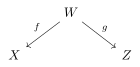
with $g \in E$.
$2$-morphisms between two such spans: diagrams
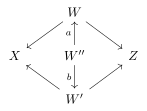
with $a \in P$ and $b \in I$.
Assume $I, P \subseteq E$ are wide and closed under base change, every $e \in E$ factors as $p \circ i$ with $p \in P$ and $i \in I$, and maps in $I \cap P$ are truncated. Then
$$ \mathcal C^{\mathrm{op}} \hookrightarrow \mathsf{Span}_2(\mathcal C, E)_{I, P} $$is the universal $(I, P)$-biadjointable functor — i.e.\ the initial functor under which morphisms in $I$ satisfy left base change and morphisms in $P$ satisfy right base change. ([cll-universal, Thm. 5.17] .)
So a six-functor formalism on $(\mathcal C, E)$ is, by definition, a lax symmetric monoidal functor out of $\mathsf{Span}_{2}(\mathcal C, E)_{I, P}$; constructing one reduces to verifying left base change for $I$, right base change for $P$, and the mixed Beck–Chevalley equivalence on cartesian squares with one $I$-edge and one $P$-edge. Everything else is formal.
Heyer–Mann observed that mixed Beck–Chevalley is often automatic:
The slogan: in any setup where “open immersion” really means open immersion (not some derived enlargement of one), the construction reduces to two independent base-change conditions, no mixing required.
Part II · From localization to $\mathsf{SH}$
We now make the CLL/Mann input concrete in the motivic setting: localization plus base change, two further geometric properties (excision + $\mathbb A^{1}$-invariance), produces $\mathsf{SH}$ — the initial six-functor formalism with these properties.
4. Localization, base change, and cdh descent
The CLL construction asks for left base change on $I$, right base change on $P$, and mixed Beck–Chevalley. To make these concrete in the motivic setting we need one more axiom — localization (recollement) — which together with base change forces cdh descent.
A diagram
$$ \mathcal C_U \xleftarrow{\;j^{\ast}\;} \mathcal C_X \xrightarrow{\;i^{\ast}\;} \mathcal C_Z $$in $\mathsf{Pr}^L_{\mathrm{st}}$ is a recollement if $j^{\ast}$ has a left adjoint $j_{!}$ with $j_{!} j^{\ast} \to \mathrm{id}$ an equivalence, $i^{\ast}$ has a right adjoint $i_{\ast}$ with $\mathrm{id} \to i_{\ast} i^{\ast}$ an equivalence, $j^{\ast} i_{\ast} \simeq 0$, and the square
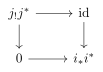
is a pushout in $\mathrm{End}(\mathcal C_X)$.
$\mathsf D\colon (\mathsf{Sch}^{\mathrm{qcqs}})^{\mathrm{op}} \to \mathsf{Pr}^L_{\mathrm{st}}$ satisfies the localization axiom if every closed immersion $i\colon Z \hookrightarrow X$ with open complement $j\colon U \hookrightarrow X$ gives a recollement of $\mathsf D(U), \mathsf D(X), \mathsf D(Z)$.
Localization plus base change feeds directly into descent.
Let $\mathsf D$ satisfy the localization axiom.
- If every étale morphism satisfies left base change, then $\mathsf D$ satisfies Nisnevich descent.
- If every finitely presented proper morphism satisfies right base change, then $\mathsf D$ satisfies abstract blowup descent.
Under both, $\mathsf D$ is a cdh sheaf.
Proof.
We do abstract blowup; Nisnevich is dual. For

write $j\colon U = X \setminus Z \hookrightarrow X$ and $h\colon U \hookrightarrow \tilde X$. We must show
$$ (p^{\ast}, i^{\ast})\colon \mathsf D(X) \to \mathsf D(\tilde X) \times_{\mathsf D(E)} \mathsf D(Z) $$is an equivalence. Right adjoint: $G(A, B) = p_{\ast} A \times_{(iq)_{\ast} C} i_{\ast} B$.
Conservativity. Localization says $(i^{\ast}, j^{\ast})$ is jointly conservative; $j^{\ast} \simeq h^{\ast} p^{\ast}$ since $p$ is iso over $U$, so $(p^{\ast}, i^{\ast})$ is too.
$i^{\ast}$-component. Right base change for $p$ along $i$ gives $i^{\ast} p_{\ast} A \simeq q_{\ast} C$, and full faithfulness of $i_{\ast}$ collapses the pullback to $B$.
$p^{\ast}$-component. Apply $k^{\ast}$ and $h^{\ast}$ separately: $k^{\ast}$ is the previous case, $h^{\ast}$ kills the $Z$-supported terms and is left with $j^{\ast} p_{\ast} A$, which by right base change for $i$ along $p$ and the localization triangle equals $h^{\ast} A$.
$\square$5. SH and Drew–Gallauer initiality
$\mathsf{SH}\colon (\mathsf{Sch}^{\mathrm{qcqs}})^{\mathrm{op}} \to \mathsf{Pr}^L_{\mathrm{st}}$ satisfies the localization axiom ([morel-voevodsky] ). The data of $\mathsf{SH}$ together with smooth $i_{\sharp}$ and proper $p_{\ast}$ extends essentially uniquely to a lax symmetric monoidal
$$ \mathsf{SH}\colon \mathsf{Span}_{2}(\mathsf{Sch}^{\mathrm{qcqs}}, E)_{I, P}^{\otimes} \longrightarrow \mathsf{CAlg}(\mathsf{Pr}^L_{\mathrm{st}}) $$with $E$ = locally finitely presented, $I$ = open immersions, $P$ = proper morphisms, and $f_{!} = p_{\ast} i_{\sharp}$ for $f = p \circ i$. ([ayoub] ; [cisinski-deglise] ; [cll-universal] .)
The proof has a formal half (invoke Theorem 6 ) and a geometric half (smooth/étale base change for $i_{\sharp}$, localization, proper base change for $p_{\ast}$ — Ayoub for projective, Cisinski–Déglise for arbitrary proper via Chow’s lemma). The mixed Beck–Chevalley is not additional input: it follows from proper base change across a square with one étale edge.
Combining Proposition 10 with proper base change: $\mathsf{SH}$ is a cdh sheaf.
In what sense is $\mathsf{SH}$ universal?
Over a noetherian base $k$ of finite Krull dimension, with $\mathcal C$ = separated finite-type $k$-schemes, $I$ open immersions, $P$ proper morphisms: the initial presentable six-functor formalism
$$ \mathsf D\colon \mathsf{Corr}(\mathcal C) \to \mathsf{Pr}^{L}_{\mathrm{st}} $$with open immersions cohomologically étale, proper maps cohomologically proper, every smooth morphism cohomologically smooth, satisfying excision ($j_{!} \mathbf 1 \to \mathbf 1 \to i_{\ast} \mathbf 1$ a fibre sequence for $i \hookrightarrow X$ closed) and $\mathbb A^{1}$-invariance ($\pi^{\ast}\colon \mathsf D(X) \to \mathsf D(\mathbb A^{1}_{X})$ fully faithful) is $\mathsf{SH}$. ([drew-gallauer] ; cf.\ [scholze-six, Lecture XI] .)
The proof is constructive and recovers Morel–Voevodsky: smooth $f_{\sharp}$ forces $\mathsf{PShv}(\mathsf{Sm}_{X}; \mathsf{Sp})$; excision forces Nisnevich localization; $\mathbb A^{1}$-invariance forces $\mathbb A^{1}$-localization; $\otimes$-inverting the Tate object yields $\mathsf{SH}$.
Part III · Cohomological smoothness and the 2-category of kernels
We now zoom into a fixed six-functor formalism $\mathsf D$ and ask which morphisms satisfy Poincaré duality. This is the question that motivates the $2$-category of kernels.
6. Cohomological smoothness
Classical Poincaré duality says: for a proper manifold bundle $f\colon X \to Y$ of relative dimension $d$, $f_{!}$ has a right adjoint $f^{!}$ of the form $f^{!} \simeq f^{\ast}(-) \otimes \omega_{f}$, where $\omega_{f} = f^{!}(\mathbf 1_{Y})$ is the dualizing complex of $f$, locally isomorphic to $\mathbf 1[d]$.
For an abstract $\mathsf D$, this motivates axiomatising the class of morphisms with this behaviour:
A morphism $f\colon X \to Y$ in $E$ is $\mathsf D$-cohomologically smooth (or $\mathsf D$-smooth) if:
- $f^{!}$ exists, and $f^{!}(\mathbf 1_{Y}) \otimes f^{\ast}(-) \to f^{!}(-)$ is an equivalence of functors $\mathsf D(Y) \to \mathsf D(X)$.
- $\omega_{f} \coloneqq f^{!}(\mathbf 1_{Y})$ is $\otimes$-invertible.
- (1) and (2) hold for every base change $f'$ of $f$, and the natural map $g'^{\ast}\omega_{f} \to \omega_{f'}$ is an equivalence.
Checking (1)–(3) looks impossibly hard: each piece involves base changes, and $f^{!}$ is abstractly an adjoint. The point of the next two sections is Scholze’s organising observation: all three conditions together follow for free from a single, minimal piece of $2$-categorical data on $X \times_Y X$ — once we have built the right $2$-category.
7. Integral transforms and the 2-category of kernels
The classical integral transform $T_{K}(F)(x) = \int_{Y} K(x, y)\, F(y)\, dy$ encodes a function $L^{2}(Y) \to L^{2}(X)$ as a function on $X \times Y$. Its categorification — the Fourier–Mukai transform — replaces integration by $\pi_{!}$ and tensor: for $K \in \mathsf D(X \times_{Y} X')$,
$$ \Phi_{K}\colon \mathsf D(X) \to \mathsf D(X'), \qquad A \mapsto (\pi_{X'})_{!}\bigl(\pi_{X}^{\ast} A \otimes K\bigr). $$Two familiar functors are themselves Fourier–Mukai transforms with simple kernels. Take $K = \mathbf 1_{X}$ regarded as an element of $\mathsf D(X \times_{Y} Y) = \mathsf D(X)$ (the “$X \to Y$” slot): then $\Phi_{K} = f_{!}$. Take instead $K = \mathbf 1_{X}$ in $\mathsf D(Y \times_{Y} X) = \mathsf D(X)$ (the “$Y \to X$” slot): then $\Phi_{K} = f^{\ast}$.
So “$f_{!}$ is left adjoint to $f^{\ast}$” translates to “$\mathbf 1_{X}$ (in the $X \to Y$ slot) is left adjoint to $\mathbf 1_{X}$ (in the $Y \to X$ slot) in a suitable $2$-category whose $1$-morphisms are kernels”. Making this precise:
For $\mathsf D\colon \mathsf{Corr}(\mathcal C, E) \to \mathsf{Cat}$ and $Y \in \mathcal C$, the $2$-category of kernels $\mathbb K_{\mathsf D, Y}$ has:
- Objects. Objects of $(\mathcal C_{E})_{/Y}$ — i.e.\ maps $X \to Y$ in $E$.
- Morphism categories. $\mathsf{Hom}_{Y}(X_{1}, X_{2}) \coloneqq \mathsf D(X_{1} \times_{Y} X_{2})$.
- Composition. $M \circ N \coloneqq \pi_{13!}(\pi_{12}^{\ast} M \otimes \pi_{23}^{\ast} N)$.
- Identity. $\mathrm{id}_{X} = (\Delta_{X/Y})_{!}\mathbf 1_{X}$.
([lu-zheng] ; [fargues-scholze, §2.3] ; [scholze-six, Lecture V] ; [heyer-mann] .)
Three structural features fall out of the definition.
Realisation. There is a “realisation” $2$-functor $\Psi_{\mathsf D, Y} \coloneqq \mathsf{Hom}_{Y}(Y, -)\colon \mathbb K_{\mathsf D, Y} \to \mathsf{Cat}_{2}$ sending $X \mapsto \mathsf D(X)$ and a kernel $M$ to its Fourier–Mukai functor. Working in $\mathbb K_{\mathsf D, Y}$ amounts to working with kernels of functors directly, instead of the induced functors.
Factorization ([heyer-mann] ). $\mathsf D$ factors:
$$ \mathsf{Corr}((\mathcal C_{E})_{/Y}) \xrightarrow{\;\Phi_{\mathsf D, Y}\;} \mathbb K_{\mathsf D, Y} \xrightarrow{\;\Psi_{\mathsf D, Y}\;} \mathsf{Cat}, $$with $\Psi \circ \Phi = \mathsf D$. The first $2$-functor is identity on objects and sends a span $X \xleftarrow{g} Z \xrightarrow{f} Y$ to $(f, g)_{!} \mathbf 1_{Z}$.
Functoriality. As $Y$ varies, $\mathbb K_{\mathsf D, (-)}$ is itself a 3-functor formalism, one categorical level higher:
That is: just as $\mathsf D$ is a categorified cohomology theory valued in $\mathsf{Cat}$, $\mathbb K_{\mathsf D}$ is a $2$-categorified one valued in $\mathsf{Cat}_{2}$. This both promotes the classical “base change of suave/prim” lemmas to formal $2$-functoriality, and is the gateway to iteration in §10.
8. Cohomological smoothness as dualizability in $\mathbb K_{\mathsf D}$
Now the punchline. After sliding $\mathcal C$ down to $\mathcal C_{/Y}$, assume $Y$ is final. Consider $\mathbf 1_{X}$ as a $1$-morphism $X \to Y$ in $\mathbb K_{\mathsf D}$; its realisation under $\Psi$ is $f_{!}$.
$f$ is $\mathsf D$-cohomologically smooth iff:
- $\mathbf 1_{X} \in \mathsf{Hom}_{\mathbb K_{\mathsf D}}(X, Y) = \mathsf D(X)$ is a left adjoint in $\mathbb K_{\mathsf D}$ — i.e.\ admits a right adjoint $\omega_{f} \in \mathsf D(X)$;
- $\omega_{f}$ is $\otimes$-invertible in $\mathsf D(X)$.
In this case $\omega_{f} \simeq f^{!}(\mathbf 1_{Y})$. ([scholze-six, Lecture V] .)
Two consequences:
- Dropping invertibility in (2) gives a strictly weaker, far more robust notion — suaveness, the subject of §9.
- Base-change compatibility of $\omega_{f}$ (axiom (3) of Definition 13 ) is automatic, because $\mathbb K_{\mathsf D, Y}$ is functorial in $Y$ (Theorem 15 ) and adjunctions are preserved by $2$-functors.
Even better, the $2$-categorical adjointness of (1) can be verified from a surprisingly small amount of data on $X$, $Y$, $X \times_{Y} X$:
$f\colon X \to Y$ (with $Y$ final) is cohomologically smooth iff there exist:
- a $\otimes$-invertible $L \in \mathsf D(X)$,
- $\alpha\colon \Delta_{!}\mathbf 1_{X} \to \pi_{2}^{\ast} L$ in $\mathsf D(X \times_{Y} X)$,
- $\beta\colon f_{!} L \to \mathbf 1_{Y}$ in $\mathsf D(Y)$,
such that the two composites
$$ \mathbf 1_{X} \cong \pi_{1!}\Delta_{!}\mathbf 1_{X} \xrightarrow{\pi_{1!}\alpha} f^{\ast} f_{!} L \xrightarrow{f^{\ast}\beta} \mathbf 1_{X}, $$$$ L \cong \pi_{2!}(\pi_{1}^{\ast} L \otimes \Delta_{!}\mathbf 1_{X}) \xrightarrow{\alpha} f^{\ast} f_{!} L \otimes L \xrightarrow{f^{\ast}\beta \otimes L} L $$are the identity. Then $\omega_{f} \simeq L$. ([scholze-six, Lecture V] .)
The proof in $(\Leftarrow)$ is the heart of the picture: $(\alpha, \beta)$ translate literally into unit/counit $2$-morphisms making $\mathbf 1_{X}$ (in the $X \to Y$ direction) and $L$ (in the $Y \to X$ direction) an adjoint pair in $\mathbb K_{\mathsf D}$. Applying $\Psi$ gives the adjunction $f_{!} \dashv (f^{\ast}(-) \otimes L)$ in $\mathsf{Cat}$, hence $f^{!} \simeq f^{\ast}(-) \otimes L$ and $L \simeq f^{!}(\mathbf 1_{Y})$.
Part IV · Suave, prim, and transmutation to Gestalten
9. Suave, prim, étale, proper
Dropping invertibility from Theorem 16 produces a strictly larger, far more robust class of morphisms. This was the observation of Heyer–Mann.
Let $f\colon X \to Y$ in $E$. Note $\mathsf{Hom}_{\mathbb K_{\mathsf D, Y}}(X, Y) = \mathsf D(X)$, so the unit $\mathbf 1_{X}$ is a $1$-morphism $X \to Y$.
- $f$ is $\mathsf D$-suave if $\mathbf 1_{X}$ is a left adjoint in $\mathbb K_{\mathsf D, Y}$. The right adjoint $\omega_{f} \in \mathsf D(X)$ is the dualizing complex.
- $f$ is $\mathsf D$-prim if $\mathbf 1_{X}$ is a right adjoint in $\mathbb K_{\mathsf D, Y}$. The left adjoint $\delta_{f} \in \mathsf D(X)$ is the codualizing complex.
The names: suave (Scholze, “close to smooth”); prim (Hansen, “close to but not proper”). $\mathsf D$-cohomological smoothness = $\mathsf D$-suave + $\omega_{f}$ invertible. ([scholze-six, Lecture VI] ; [heyer-mann] .)
Realising through $\Psi$, $f$-suaveness gives the twist formula
$$ f^{!} \simeq \omega_{f} \otimes f^{\ast}, \qquad f^{\ast} \simeq \underline{\mathrm{Hom}}(\omega_{f}, f^{!}), $$so suaveness is the structural half of cohomological smoothness — the identity $f^{!} = \omega_{f} \otimes f^{\ast}$ — without requiring $\omega_{f}$ invertible. Dually for prim and $\delta_{f}$.
Concrete criterion
$f\colon X \to Y$ is $\mathsf D$-suave iff
$$ \pi_{1}^{\ast} \underline{\mathrm{Hom}}(\mathbf 1_{X}, f^{!} \mathbf 1_{Y}) \otimes \pi_{2}^{\ast} \mathbf 1_{X} \;\xrightarrow{\;\sim\;}\; \underline{\mathrm{Hom}}(\pi_{1}^{\ast} \mathbf 1_{X}, \pi_{2}^{!} \mathbf 1_{X}) $$is an isomorphism in $\mathsf D(X \times_{Y} X)$. Then $\omega_{f} = f^{!}\mathbf 1_{Y}$. ([heyer-mann] ; [scholze-six, Lecture VI] .)
Stability and geometric meaning
All from formal $2$-categorical adjointness (using Theorem 15 ):
- Locality on the target: both notions descend along $\mathsf D^{\ast}$-covers.
- Stability: suave morphisms compose, base-change, and are stable under suave pullback.
- Self-duality: $\omega_{f}$ for $f$ suave is itself dualizable, and $\omega_{f}^{\vee} \simeq \omega_{f}$ by uniqueness of adjoints.
([heyer-mann] .) Geometric content:
- Étale sheaves on schemes: $f$-suave = ULA — the original motivation of the kernel category in [fargues-scholze] .
- Topology: topological manifolds are $\mathsf D$-suave with $\omega_{f} \simeq \mathbf 1[\dim f]$.
- Representation theory of locally profinite groups: on classifying stacks, $f$-suave = admissible representations, $f$-prim = compact representations ([heyer-mann] , the main application of HM’s paper).
Étale and proper, via the diagonal
When the dualizing/codualizing complex is trivial — $\omega_{f} \simeq \mathbf 1$ or $\delta_{f} \simeq \mathbf 1$ — we recover the étale/proper hierarchy. The natural definition is recursive on the diagonal.
For $f$ truncated, using the diagonal factorisation, one builds a natural map $f^{!} \to f^{\ast}$ provided $\Delta_{f}^{!} \simeq \Delta_{f}^{\ast}$:
$$ f^{!} \simeq \Delta_{f}^{\ast} \pi_{2}^{\ast} f^{!} \xrightarrow{\sim} \Delta_{f}^{!} \pi_{2}^{\ast} f^{!} \to \Delta_{f}^{!} \pi_{1}^{!} f^{\ast} \simeq f^{\ast}. $$The recursion terminates because the diagonal of an $n$-truncated map is $(n-1)$-truncated.
Let $f\colon X \to Y$ be $n$-truncated in $E$.
- $f$ is cohomologically étale if $f$ is $\mathsf D$-suave and $\Delta_{f}$ is either an isomorphism or cohomologically étale.
- $f$ is cohomologically proper if $f$ is $\mathsf D$-prim and $\Delta_{f}$ is either an isomorphism or cohomologically proper.
The étale-proper dichotomy materialises:
For $f$ truncated:
- If $\Delta_{f}$ is cohomologically étale, the following are equivalent: $f$ is cohomologically étale; $f^{!}\mathbf 1_{Y} \simeq f^{\ast}\mathbf 1_{Y}$; $f^{!} \xrightarrow{\sim} f^{\ast}$.
- If $\Delta_{f}$ is cohomologically proper, the following are equivalent: $f$ is cohomologically proper; $f_{!}\mathbf 1_{X} \simeq f_{\ast}\mathbf 1_{X}$; $f_{!} \xrightarrow{\sim} f_{\ast}$.
Aoki’s one-step reformulation
The inductive definition is clean but unfolds truncations. Aoki observed that the same content packages in one step once one passes through monomorphisms.
Equivalently ([aoki-motives] ): $[X] \to [Y]$ admits a fully faithful $[Y]$-linear left (resp. right) adjoint.
A static (i.e.\ $0$-truncated) morphism $f$ of stacks is:
- unramified if $\Delta_{f}$ is an open immersion;
- étale if $f$ is suave and unramified;
- separated if $\Delta_{f}$ is a closed immersion;
- proper if $f$ is prim and separated.
([aoki-motives] .)
Aoki’s formulation has a structural dividend. With $\mathcal C$ stacks and $E$ = exceptional morphisms (those $n$-truncated $f$ along which $[Y]$ is iteratively dualizable over $[Y]^{\otimes_{[X]} S^{n-1}}$), the $(E, E)$-biadjointability condition of Theorem 6
holds, so CLL produces a six-functor formalism without input compactification. This recovers the classical six operations on locally compact Hausdorff spaces of countable weight built from open subsets of $\mathbb R^{n}$. ([aoki-motives] .)
10. Transmutation to Gestalten
The functoriality theorem (Theorem 15 ) makes $\mathbb K_{\mathsf D, (-)}$ a 3-functor formalism one categorical level higher. The natural next step is to iterate. The output is a tower of $n$-categories controlled by a single algebraic object — a Stefanich ring — and the geometric content of $\mathsf D$ is captured by a functor into $\mathsf{Gest}$.
Functorial form of $\mathbb K_{\mathsf D, Y}$
For iteration we want a description of $\mathbb K_{\mathsf D, Y}$ in which $\mathsf D$-linearity is built in from the start. Set $\mathsf{Corr}_{Y} \coloneqq \mathsf{Corr}((\mathcal C_{E})_{/Y})$. Under Day convolution, $\mathsf D$ (restricted to $\mathsf{Corr}_{Y}$) is a commutative algebra in $\mathsf{Fun}(\mathsf{Corr}_{Y}, 1\mathsf{Pr})$.
$\mathbb K_{\mathsf D, Y}$ is identified with the full sub-$2$-category of
$$ \mathsf{Mod}_{\mathsf D}\!\bigl(\mathsf{Fun}(\mathsf{Corr}_{Y}, 1\mathsf{Pr})\bigr) $$spanned by representable $\mathsf D$-modules $[X] \coloneqq \mathsf D(- \times_{Y} X)$. ([scholze-six, Lecture V, appendix] ; [aoki-motives] .)
In this form, the $\mathsf D$-module structure is intrinsic: a kernel $K \in \mathsf D(X_{1} \times_{Y} X_{2})$ becomes a $\mathsf D$-module morphism $\varphi_{K}\colon [X_{1}] \to [X_{2}]$, and asking for $\varphi_{K}$ to admit a linear adjoint is a direct condition inside $\mathsf{Mod}_{\mathsf D}$. Statements like “$[Y]$ is self-dual over $[X]$” or “the trace of a kernel lives in $\mathsf D(Y)$” become naked symmetric-monoidal statements.
Iteration to Stefanich rings
The functorial form iterates. From $\mathsf D\colon \mathsf{Corr}(\mathcal C) \to 1\mathsf{Pr}$, the functoriality theorem gives a kernel $2$-category $\mathbb K_{\mathsf D, X}$ for each $X$; the same machinery applied to $\mathbb K_{\mathsf D, (-)}$ gives a $3$-category $\mathbb K_{\mathsf D, X}^{(2)}$, and so on. Assembling everything yields a Stefanich ring
$$ A_{\mathsf D, X} \;\coloneqq\; \bigl( \mathsf D(X),\; \mathbb K_{\mathsf D, X},\; \mathbb K_{\mathsf D, X}^{(2)},\; \ldots \bigr) \;\in\; \mathsf{StRing}. $$([scholze-gestalten, §3] , building on [stefanich-thesis] .) Functorially: $\mathcal C^{\mathrm{op}} \to \mathsf{StRing}$.
The transmutation theorem
The Gestalt category is $\mathsf{Gest} \coloneqq \mathsf{StRing}^{\mathrm{op}}$. Composing with $\mathsf{Spec}_{\infty}\colon \mathsf{StRing} \to \mathsf{Gest}^{\mathrm{op}}$ gives the transmutation:
$X \mapsto [X]_{\mathsf D} \coloneqq \mathsf{Spec}_{\infty}(A_{\mathsf D, X})$ extends to a finite-limit-preserving functor $[-]_{\mathsf D}\colon \mathcal C \to \mathsf{Gest}$, and for every $f\colon X \to Y$ in $\mathcal C$:
- $[f]_{\mathsf D}$ is $1$-étale and $1$-proper automatically;
- $f$ is $\mathsf D$-suave (resp.\ $\mathsf D$-prim) iff $[f]_{\mathsf D}$ is $0$-suave (resp.\ $0$-prim);
- $f$ is truncated and $\mathsf D$-cohomologically étale (resp.\ proper)
iff $f$ is truncated and $[f]_{\mathsf D}$ is $0$-étale (resp.
$0$-proper).
Two things at once:
- Level $1$ free. Whatever $f$ is geometrically, $[f]_{\mathsf D}$ is “doubly nice” at the next level — ambidexterity in the Stefanich-ring tower. The 6FF sees only level $0$; $\mathsf{Gest}$ remembers all.
- Level $0$ faithful. Suave, prim, étale, proper for $f$ correspond exactly to their $0$-versions for $[f]_{\mathsf D}$.
Unpacking the dictionary
For $f\colon X \to Y$, write $A = A_{\mathsf D, Y}$, $B = A_{\mathsf D, X}$. The unit $\mathbf 1_{X} \in \mathsf D(X) = \mathrm{Fun}_{Y}(X, \mathbb 1)$ — a morphism $X \to \mathbb 1$ in $\mathbb K_{\mathsf D, Y}$ realising as $f_{!}$ — is the structure map $\mathbb 1 \to (B/A)_{1}$ of the algebra $(B/A)_{1} \in A_{2}$. Its Koszul dual is the counit $(B/A)^{!}_{1} \to \mathbb 1$ of the coalgebra $(B/A)^{!}_{1} = f_{1, \sharp}(\mathbb 1)$. Then ([scholze-gestalten, Defs. 6.9, 6.16] ):
$[f]_{\mathsf D}$ is $0$-prim iff for all $m \geq 1$ the map $\mathbb 1 \to (B/A)_{m}$ admits a right adjoint in $A_{m+1}$. For transmuted maps, $m \geq 2$ follow from ambidexterity, so the content is at $m = 1$: $\mathbb 1 \to (B/A)_{1}$ admits a right adjoint in $A_{2}$.
$[f]_{\mathsf D}$ is $0$-suave iff for all $m \geq 1$ both $\mathbb 1 \to (B/A)_{m}$ admits a left adjoint and $(B/A)^{!}_{m} \to \mathbb 1$ admits a right adjoint — the second a strengthening. Reduces to $m = 1$.
So suave/prim conditions on $f$, abstract adjunction statements in $\mathbb K_{\mathsf D}$, become bare adjoint existence for the unit map $\mathbb 1 \to (B/A)_{1}$ in $A_{2}$.
What this buys us
- Six-functor formalisms forget structure. Higher-categorical data hidden in $\mathsf D$ becomes manifest in $A_{\mathsf D}$; the level-$1$ ambidexterity that was previously a theorem is now a tautology.
- Geometry independent of the formalism. Different 6FFs on $\mathcal C$ can produce the same Gestalt $[X]_{\mathsf D}$, reducing comparison of cohomology theories to comparison of geometric objects.
- The site is encoded. The Morel–Voevodsky example $[\operatorname{Spec}(\mathbb Z)]_{\mathsf{SH}} \in \mathsf{Gest}$ is $2$-affine, generated by $[\mathbb A^{n}_{\mathbb Z}]_{\mathsf{SH}}$, $n \geq 0$. ([scholze-gestalten, Prop. 9.9] .) The “site” of algebraic geometry is reconstructed from $\mathsf D$ alone.
A Gestalt is a six-functor formalism with all its hidden higher-categorical data made manifest. Cohomology, suaveness, properness, smoothness sit at level $0$; everything else encoded above.
References
[Aoki] Ko Aoki. Algebraic 2-motives and ring stacks. Preprint (2025).
[Ayo07] Joseph Ayoub. Les six opérations de Grothendieck et le formalisme des cycles évanescents dans le monde motivique. Astérisque 314, 315 (2007).
[CD19] Denis-Charles Cisinski and Frédéric Déglise. Triangulated Categories of Mixed Motives. Springer Monographs in Mathematics (2019).
[CLL25] Bastiaan Cnossen, Tobias Lenz, Sil Linskens. Universal six-functor formalisms. arXiv:2505.19192 (2025).
[DK25] Adam Dauser and Josefien Kuijper. Uniqueness of six-functor formalisms. arXiv:2412.15780 (2025).
[DG22] Brad Drew and Martin Gallauer. The universal six-functor formalism. Annals of K-theory 7 (2022), 599–649.
[FS24] Laurent Fargues and Peter Scholze. Geometrization of the local Langlands correspondence. arXiv:2102.13459 (2024).
[HM24] Claudius Heyer and Lucas Mann. 6-functor formalisms and smooth representations. Preprint (2024).
[LZ12] Yifeng Liu and Weizhe Zheng. Enhanced six operations and base change theorem for higher Artin stacks. arXiv:1211.5948 (2012).
[LZ22] Qing Lu and Weizhe Zheng. Categorical traces and a relative Lefschetz–Verdier formula. Forum of Mathematics, Sigma 10 (2022).
[Man22] Lucas Mann. A $p$-adic 6-functor formalism in rigid-analytic geometry. arXiv:2206.02022 (2022).
[MV99] Fabien Morel and Vladimir Voevodsky. $\mathbb A^{1}$-homotopy theory of schemes. Publ. Math. IHES 90 (1999), 45–143.
[Sch26] Peter Scholze. Geometry and higher category theory. Lecture notes (2025/26).
[Sch22] Peter Scholze. Six-functor formalisms. Lecture notes, Bonn (WS 2022/23).
[Ste20] Germán Stefanich. Presentable $(\infty,n)$-categories. arXiv:2011.03035 (2020).