In this section we first define the connective K-theory spectrum $\mathrm{k}(\mathcal{C})$ of a category with finite colimits, then extend it to the non-connective K-theory spectrum $\mathrm{K}(\mathcal{C})$.
Connective K-theory
Let $\mathcal{C}$ be a category with pushouts. Applied to the saturated triple $(\mathcal{C}^{\mathrm{op}}, \mathcal{C}^{\mathrm{op}}, \mathcal{C}^{\mathrm{op}})$, the twisted arrow construction produces a complete Segal anima $\mathrm{N}\mathsf{Span}(\mathcal{C}^{\mathrm{op}})$; denote the corresponding category by $\mathsf{coSpan}(\mathcal{C})$. Concretely:
Objects of $\mathsf{coSpan}(\mathcal{C})$ are the objects of $\mathcal{C}$.
A morphism $X \to Y$ in $\mathsf{coSpan}(\mathcal{C})$ is a cospan
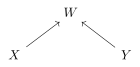
A $2$-morphism between cospans $[X \to W \leftarrow Y]$ and $[X \to W' \leftarrow Y]$ is an equivalence $W \xrightarrow{\sim} W'$ compatible with the two legs:
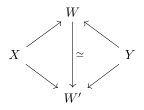
The cospan category inherits a symmetric monoidal structure from the coproduct on $\mathcal{C}^{\sqcup}$ (not the coproduct monoidal structure on $\mathsf{coSpan}(\mathcal{C})$ itself).
Let $\mathcal{C}$ be a category with finite colimits. Its connective algebraic K-theory is
\[ \mathrm{k}(\mathcal{C}) \coloneqq \Omega\left| \mathrm{N}\mathsf{Span}(\mathcal{C}^{\mathrm{op}}) \right|. \]For $n \ge 0$ set $\mathrm{k}_n(\mathcal{C}) \coloneqq \pi_n(\mathrm{k}(\mathcal{C}))$.
Since $\mathsf{coSpan}(\mathcal{C})$ is symmetric monoidal, its geometric realisation $\left| \mathrm{N}\mathsf{Span}(\mathcal{C}^{\mathrm{op}}) \right|$ is naturally a commutative monoid in $\mathsf{An}$. Group completion — equivalently, passage to loops — turns it into a commutative group in $\mathsf{An}$. The equivalence between commutative groups in anima and connective spectra $\mathsf{Sp}_{\ge 0}$ produces the associated spectrum
\[ \mathbb{B}^{\infty}\!\left(\Omega\left| \mathrm{N}\mathsf{Span}(\mathcal{C}^{\mathrm{op}}) \right|\right) \in \mathsf{Sp}_{\ge 0}, \]which we also denote by $\mathrm{k}(\mathcal{C})$ when there is no risk of confusion.
Intuition
At the abstract level, $\mathrm{k}(\mathcal{C})$ already has a commutative group structure. More concretely, its construction encodes the additive relations coming from pushouts, with the initial object corresponding to the zero element $[\varnothing] = 0$.
To see this relation strictly inside $|\mathsf{coSpan}(\mathcal{C})|$, choose $\varnothing$ as the basepoint. For each object $X$ of $\mathcal{C}$, define two morphisms in $\mathsf{coSpan}(\mathcal{C})$: \begin{align*} a_X &\coloneqq (X \to X \leftarrow \varnothing) \qquad \text{(a morphism } X \to \varnothing\text{),} \ b_X &\coloneqq (\varnothing \to X \leftarrow X) \qquad \text{(a morphism } \varnothing \to X\text{).} \end{align*} The composite $a_X \circ b_X$ is the self-map of $\varnothing$ given by the cospan $\varnothing \to X \leftarrow \varnothing$; this is a loop at the basepoint, whose homotopy class we denote $[X]$ (or $p_X$).
More generally:
- For a morphism $g = (X \to A \leftarrow \varnothing)\colon X \to \varnothing$, the composite $g \circ b_X$ has central pushout $A$, so it represents the loop $p_A$.
- For a morphism $f = (\varnothing \to B \leftarrow X)\colon \varnothing \to X$, the composite $a_X \circ f$ has central pushout $B$, hence is $p_B$.
- The composite $g \circ f$ traces out the loop $p_{A \sqcup_X B}$ via the pushout $A \leftarrow X \to B$.
In the abelian group $\pi_1(|\mathsf{coSpan}(\mathcal{C})|)$ one has (in additive notation)
\[ [g \circ f] = [g \circ b_X] - [a_X \circ b_X] + [a_X \circ f], \]so
\[ [A \sqcup_X B] = [A] - [X] + [B] \quad\Longrightarrow\quad [A \sqcup_X B] + [X] = [A] + [B]. \]Geometrically: every pushout diagram in $\mathsf{coSpan}(\mathcal{C})$ supplies a $2$-cell inside the geometric realisation, making the homotopy identity above hold. In particular the cofibre sequence $X \xrightarrow{f} Y \to Y/X$ corresponds to the pushout $\varnothing \sqcup_X Y \simeq Y/X$; taking $A = \varnothing$ and $B = Y$ gives
\[ [Y/X] + [X] = [\varnothing] + [Y] = [Y]. \]Thus, at the level of $\pi_1$, the relation $[Y] = [X] + [Y/X]$ is faithfully witnessed.
This construction, however, is less transparent at higher homotopy levels. We now give a second, more homotopically lucid construction of algebraic K-theory — the Waldhausen $S$-construction.
For this second construction we need $\mathcal{C}$ to be pointed with finite colimits. Before giving the simplicial object itself, here is the motivating picture.
We seek an anima $W$ whose fundamental group is $\mathrm{k}_0(\mathcal{C})$ and whose higher homotopy groups give the higher K-groups directly. So $W$ should carry the following data:
a basepoint $0$;
for each $X \in \mathcal{C}$ a loop in $W$, representing $[X] \in \pi_1(W) \simeq \mathrm{k}_0(\mathcal{C})$;
for each cofibre sequence $X \to Y \to Y/X$, the relation $[Y] = [X] + [Y/X]$ in $\pi_1(W)$. Equivalently, every map $f\colon X \to Y$ should satisfy $[Y] = [Y/X] + [X]$ where $Y/X \coloneqq \mathrm{cofib}(f)$;
higher coherence data: for a sequence $X \to Y \to Z$ we want $[Z] = [X] + [Y/X] + [Z/Y]$. Two natural routes derive this:
- via $X \to Z \to Z/X$ and $Y/X \to Z/X \to Z/Y$, giving $[Z] = [X] + [Z/X]$ and $[Z/X] = [Y/X] + [Z/Y]$; or
- via $Y \to Z \to Z/Y$ and $X \to Y \to Y/X$, giving $[Z] = [Y] + [Z/Y]$ and $[Y] = [X] + [Y/X]$.
Each route is the concatenation of two $2$-cells; the four $2$-cells bound a $2$-sphere inside $|W|$, and the composable pair $(f,g)$ supplies a $3$-cell filling it. All of this is packaged in the $\mathsf{S}_3$ diagram
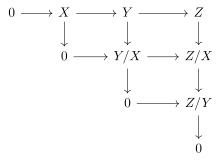
and this pattern extends: length-$n$ sequences give objects of $\mathsf{S}_n\mathcal{C}$, consisting of all subquotients $X_j / X_i$ and their pushout relations; the boundary of each such object is a $(n-1)$-sphere built from lower-order $\mathsf{S}$-data, and the new $\mathsf{S}_n$-data provides the $n$-cell that fills it.
Let $\mathcal{C}$ be a pointed category with finite colimits. Its Waldhausen $\mathsf{S}$-construction is the simplicial object $\mathsf{S}_{\bullet}\mathcal{C}$ whose level $n$, $\mathsf{S}_n\mathcal{C} \subseteq \mathsf{Fun}(\mathsf{Ar}[n], \mathcal{C})$, is the full subcategory spanned by $x\colon \mathsf{Ar}[n] \to \mathcal{C}$ with
$x_{i,i} = 0$ for $0 \le i \le n$;
every square
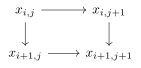
with $0 \le i < j < n$ is a pushout.
The simplicial-category structure comes from the functoriality in $[n]$ of $\mathsf{Fun}(\mathsf{Ar}[n], \mathcal{C})$. In other words, $\mathsf{S}_n\mathcal{C}$ is the category of diagrams of the shape
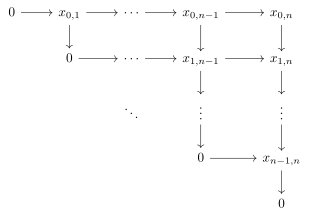
with every square a pushout.
We next show that $\mathcal{C}$ and its pointed completion have the same algebraic K-theory.
Let $\mathcal{C}$ be a category with finite colimits. Consider the pointed version $\mathsf{Ind}(\mathcal{C})_*$ of $\mathsf{Ind}(\mathcal{C})$ and the canonical composite
\[ \mathcal{C} \xrightarrow{\;y\;} \mathsf{Ind}(\mathcal{C}) \xrightarrow{\;(-)_+\;} \mathsf{Ind}(\mathcal{C})_*. \]Let $\mathcal{C}_+$ denote the smallest full subcategory generated under finite colimits by the essential image of this composite. One checks that the functor $\mathcal{C} \to \mathcal{C}_+$ is the pointed completion of $\mathcal{C}$: it turns $\mathcal{C}$ into a pointed category with finite colimits.
Equipping $\mathsf{Cat}^{\mathrm{rex}}$ with the Lurie tensor product, $\mathcal{C}_+$ is naturally identified with $\mathcal{C} \otimes \mathsf{An}_*^{\mathrm{fin}}$. Since the Lurie tensor product preserves colimits in each variable, the assignment $\mathcal{C} \mapsto \mathcal{C}_+$ preserves filtered colimits.
Another useful point: let $\mathsf{Cat}^{\mathrm{rex}}_* \subset \mathsf{Cat}^{\mathrm{rex}}$ be the subcategory of pointed categories with finite colimits and finite-colimit-preserving pointed functors. Then $\mathsf{Cat}^{\mathrm{rex}}_*$ is closed under colimits in $\mathsf{Cat}^{\mathrm{rex}}$.
Proof.
First suppose $\mathcal{C}$ has a terminal object $*$. Then $\mathcal{C}_+ = \mathcal{C}_{*/}$, so the task reduces to showing that the functor
\[ \mathsf{coSpan}(\mathcal{C}) \to \mathsf{coSpan}(\mathcal{C}_+) \]induces an equivalence on geometric realisations.
There is a forgetful functor $\mathcal{C}_{*/} \to \mathcal{C}$ preserving pushouts (but not the initial object). Consider the composites
\[ \mathcal{C}_+ \to \mathcal{C} \to \mathcal{C}_+, \qquad X \mapsto X_+ = X \sqcup *, \](with basepoint the newly adjoined $*$), and the reverse composite
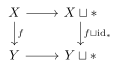
\[ \mathcal{C} \to \mathcal{C}_+ \to \mathcal{C}, \qquad X \mapsto X_+. \]Since the $\mathsf{coSpan}$ construction depends only on pushouts, it is functorial in pushout-preserving functors. In both composites the canonical map $X \to X \sqcup *$ is a natural transformation from the identity to the composite, and for each morphism $f\colon X \to Y$ the square
is a pushout. By [sheaves-on-manifolds, Prop. 3.1.9] , a natural transformation whose squares are all pushouts induces a homotopy between the $\mathsf{coSpan}$ realisations. Thus each composite is homotopic to the identity on $\mathrm{k}$, and the forgetful and $(-)_+$ functors induce mutually inverse equivalences $\mathrm{k}(\mathcal{C}) \simeq \mathrm{k}(\mathcal{C}_+)$ whenever $\mathcal{C}$ has a terminal object.
In general, view $\mathsf{Ar}(\mathcal{C}) \to \mathcal{C}$ as the left Bousfield localisation of $\mathcal{C}$ at $t$-pushout maps, so that $\mathcal{C}$ is a colimit of its over-categories,
\[ \mathcal{C} \simeq \operatorname*{colim}_{X \in \mathcal{C}} \mathcal{C}_{/X}. \]Each $\mathcal{C}_{/X}$ has the terminal object $\mathrm{id}_X$, so the first part gives $\mathrm{k}(\mathcal{C}_{/X}) \xrightarrow{\sim} \mathrm{k}((\mathcal{C}_{/X})_+)$. Since $\mathcal{C}$ has finite colimits it is filtered as an index, and $\mathcal{C}_+ \simeq \operatorname*{colim}_X (\mathcal{C}_{/X})_+$. Filtered colimits are preserved by both $\mathrm{k}$ and $(-)_+$ ( ), so the equivalence lifts to
\[ \mathrm{k}(\mathcal{C}) \simeq \operatorname*{colim}_X \mathrm{k}(\mathcal{C}_{/X}) \xrightarrow{\;\sim\;} \operatorname*{colim}_X \mathrm{k}((\mathcal{C}_{/X})_+) \simeq \mathrm{k}(\mathcal{C}_+). \] $\square$Basic properties
Definition 2 is well-behaved on morphisms. Writing $\mathsf{Cat}^{\mathrm{rex}}$ for categories with finite colimits and right-exact functors between them, Definition 2 upgrades to a functor
\[ \mathrm{k}\colon \mathsf{Cat}^{\mathrm{rex}} \to \mathsf{Sp}_{\ge 0}. \]Recall that both $\mathsf{Cat}^{\mathrm{rex}}$ and $\mathsf{Sp}_{\ge 0}$ are semi-additive, i.e. finite products coincide with finite coproducts.
The geometric-realisation functor is essentially a sifted colimit, so it commutes with finite products in $\mathsf{An}$; the loop functor $\Omega$, as a right adjoint, preserves limits. Combining these, $\mathrm{k}$ preserves finite products, and in a semi-additive category that amounts to preserving finite coproducts. More informally, for functors $F, G\colon \mathcal{C} \to \mathcal{D}$,
\[ \mathrm{k}(F \sqcup G) \simeq \mathrm{k}(F) + \mathrm{k}(G). \]In fact $\mathrm{k}$ also preserves filtered colimits:
Proof.
First, filtered colimits in $\mathsf{Cat}^{\mathrm{rex}}$ agree with those in $\mathsf{Cat}$. The claim then reduces to showing that, for a filtered colimit $\mathcal{C} \simeq \operatorname*{colim}_i \mathcal{C}_i$ in $\mathsf{Cat}$ (so $\mathcal{C}^{\mathrm{op}} \simeq \operatorname*{colim}_i \mathcal{C}_i^{\mathrm{op}}$), one has
\[ \operatorname*{colim}_{i} \mathrm{N}\mathsf{Span}(\mathcal{C}_i^{\mathrm{op}}) \simeq \mathrm{N}\mathsf{Span}(\mathcal{C}^{\mathrm{op}}) \]in $\mathsf{CSeg}(\mathsf{An})$. Complete Segal objects are simplicial objects, and simplicial colimits are levelwise. At level $n$, $\mathrm{N}\mathsf{Span}(\mathcal{C})_n = \mathrm{Hom}_{\mathsf{AdTrip}}(\mathsf{TwAr}([n]), \mathcal{C})$, and $\mathrm{Hom}_{\mathsf{AdTrip}}(\mathsf{TwAr}([n]), -)$ preserves filtered colimits, so the claim follows.
$\square$Stabilisation
We now extend connective K-theory to stable categories. Since $\mathcal{C}$ has only finite colimits, we cannot stabilise by taking limits directly; instead we dualise and build the Spanier–Whitehead category.
Let $\mathcal{C}$ be a category with finite colimits. Its Spanier–Whitehead category is
\[ \mathsf{SW}(\mathcal{C}) \coloneqq \operatorname{colim}\!\left( \mathcal{C}_+ \xrightarrow{\Sigma_+} \mathcal{C}_+ \xrightarrow{\Sigma_+} \cdots \right), \]with colimit computed in $\mathsf{Cat}^{\mathrm{rex}}$. By Gabriel–Ulmer duality $\mathsf{Cat}^{\mathrm{rex},\mathrm{idem}} \simeq \mathsf{Pr}_{\aleph_0}^L$ and the fact that Ind does not distinguish a small category from its idempotent completion ($\mathsf{Ind}(\mathcal{A}) \simeq \mathsf{Ind}(\mathcal{A}^{\mathrm{idem}})$), we get $\mathsf{Ind}(\mathsf{SW}(\mathcal{C})) \in \mathsf{Pr}_{\aleph_0}^L$. Colimits in $\mathsf{Pr}_{\aleph_0}^L$ are limits in $\mathsf{Pr}_{\aleph_0}^R$, and the forgetful functor $\mathsf{Pr}_{\aleph_0}^R \to \mathsf{Cat}$ preserves limits, which gives
\[ \mathsf{Ind}(\mathsf{SW}(\mathcal{C})) \simeq \mathsf{Sp}(\mathsf{Ind}(\mathcal{C})) \simeq \mathsf{Sp} \otimes \mathsf{Ind}(\mathcal{C}). \]The canonical composite is $\mathcal{C} \to \mathcal{C}_+ \to \mathsf{SW}(\mathcal{C})$.
The canonical functor $\mathcal{C} \to \mathsf{SW}(\mathcal{C})$ induces an equivalence
\[ \mathrm{k}(\mathcal{C}) \xrightarrow{\;\sim\;} \mathrm{k}(\mathsf{SW}(\mathcal{C})). \]Proof.
So connective K-theory restricts to a functor
\[ \mathrm{k}\colon \mathsf{Cat}^{\mathrm{ex}} \to \mathsf{Sp}_{\ge 0}. \]Dense embeddings and cofinality
Let $\mathcal{C} \to \mathcal{D}$ be a dense embedding. The cofibre of $\mathrm{k}(\mathcal{C}) \to \mathrm{k}(\mathcal{D})$ is $0$-truncated: the map $\mathrm{k}_i(\mathcal{C}) \to \mathrm{k}_i(\mathcal{D})$ is an isomorphism for $i > 0$ and injective for $i = 0$.
A class $[D] \in \mathrm{k}_0(\mathcal{D})$ lies in the essential image of $\mathrm{k}_0(\mathcal{C})$ iff there exists $n \ge 0$ with $\Sigma^n(D_+)$ in the essential image of $\mathcal{C}_+ \to \mathcal{D}_+$.
It is natural to ask whether K-theory detects essential surjectivity: given $D \in \mathcal{D}$, is $D$ in $\mathcal{C} \subseteq \mathcal{D}$?
Clearly a necessary condition is that $[D] \in \mathrm{k}_0(\mathcal{D})$ lies in the image. When $\mathcal{C}$ and $\mathcal{D}$ are both stable, this is also sufficient. In the unstable case, cofinality only guarantees that some suspension of $D$ lies in the image; there are classical counterexamples in topology of finitely dominated but non-finite anima. After two suspensions, however, any finitely dominated anima becomes simply connected (and remains finitely dominated); Wall’s insight is that simply connected finitely dominated anima are automatically finite.
Let $\mathcal{C} \hookrightarrow \mathcal{D}$ be a dense embedding in $\mathsf{Cat}^{\mathrm{rex}}$. An object $d \in \mathcal{D}$ lies in the essential image of $\mathcal{C}$ iff the class $[\mathrm{id}_d] \in \mathrm{k}_0(\mathcal{D}_{/d})$ is in the essential image of
\[ \mathrm{k}_0(\mathcal{C}_{/d}) \to \mathrm{k}_0(\mathcal{D}_{/d}). \]Apply this to the embedding $\mathsf{An}^{\mathrm{fin}} \hookrightarrow \mathsf{An}^{\aleph_0}$ of finite and finitely dominated anima. For $X \in \mathsf{An}^{\aleph_0}_{\ge 1}$, $X$ is a finite anima iff $[\mathrm{id}_X] \in \mathrm{k}_0(\mathsf{An}_{/X}^{\aleph_0}) = \mathrm{k}_0((\mathsf{Sp}^X)^{\aleph_0})$ lies in the essential image of $\mathrm{k}_0((\mathsf{Sp}^X)^{\mathrm{fin}}) \to \mathrm{k}_0((\mathsf{Sp}^X)^{\aleph_0})$. For connected $X$,
\[ \mathrm{k}_0((\mathsf{Sp}^X)^{\aleph_0}) = \mathrm{k}_0(\mathbb{S}[\Omega X]) = \mathrm{k}_0(\mathbb{Z}[\pi_1 X]), \]and $\mathrm{k}_0((\mathsf{Sp}^X)^{\mathrm{fin}}) = \mathbb{Z}$. The finiteness question reduces to whether $[\mathrm{id}_X]$ vanishes in the reduced K-group
\[ \tilde{\mathrm{k}}_0(\mathbb{Z}[\pi_1 X]) = \mathrm{k}_0(\mathbb{Z}[\pi_1 X])/\mathbb{Z}. \]Non-connective K-theory
We now extend $\mathrm{k}\colon \mathsf{Cat}^{\mathrm{rex}} \to \mathsf{Sp}_{\ge 0}$ to a functor
\[ \mathrm{K}\colon \mathsf{Cat}^{\mathrm{rex}} \to \mathsf{Sp} \]landing in all spectra — the non-connective K-theory.
Verdier sequences
The stable case
Let
\[ \mathcal{C} \xrightarrow{f} \mathcal{D} \xrightarrow{p} \mathcal{E} \]be a sequence in $\mathsf{Cat}^{\mathrm{ex}}$ with $p \circ f \simeq 0$. It is a Verdier sequence if it is simultaneously a fibre and cofibre sequence in $\mathsf{Cat}^{\mathrm{ex}}$. In this case $f$ is a Verdier embedding and $p$ is a Verdier projection.
The condition $p \circ f \simeq 0$ is taken inside $\mathsf{Fun}^{\mathrm{ex}}(\mathcal{C}, \mathcal{E})$. Equivalently, $p \circ f$ factors as $\mathcal{C} \to \{0\} \subset \mathcal{E}$, i.e. there is a commuting square

Recall how fibres and cofibres are computed in $\mathsf{Cat}^{\mathrm{ex}}$. The fibre of an exact $F\colon \mathcal{C} \to \mathcal{D}$ is the categorical fibre; the cofibre is subtler.
Let $F\colon \mathcal{C} \to \mathcal{D}$ be exact.
- $\mathcal{D}/\mathcal{C}$ is stable.
- For any stable $\mathcal{E}$, the restriction $\mathsf{Fun}^{\mathrm{ex}}(\mathcal{D}/\mathcal{C}, \mathcal{E}) \to \mathsf{Fun}^{\mathrm{ex}}(\mathcal{D}, \mathcal{E})$ is fully faithful with essential image the functors whose precomposition with $F$ vanishes. In particular, $\mathcal{C} \to \mathcal{D} \to \mathcal{D}/\mathcal{C}$ is a cofibre sequence in $\mathsf{Cat}^{\mathrm{ex}}$.
The non-stable case
$\mathsf{Cat}^{\mathrm{rex}}$ is pointed, with zero object the terminal category
$*$, so we can consider cofibre sequences there too. For
$F\colon \mathcal{C} \to \mathcal{D}$ the cofibre is the pushout
For concrete computation we lift everything to presentable categories using Gabriel–Ulmer duality. In its strict form,
\[ \mathsf{Ind}\colon \mathsf{Cat}^{\mathrm{rex},\mathrm{idem}} \xrightarrow{\;\simeq\;} \mathsf{Pr}_{\aleph_0}^L \colon (-)^{\omega}, \]where $\mathsf{Cat}^{\mathrm{rex},\mathrm{idem}}$ is idempotent-complete categories with finite colimits. Idempotent completeness cannot be dropped at $\kappa = \aleph_0$: there exist non-idempotent-complete categories with finite colimits, and for such a $\mathcal{C}$ the category $\mathsf{Ind}(\mathcal{C})^{\omega}$ is idempotent-complete (it is the idempotent completion $\mathcal{C}^{\mathrm{idem}}$), not $\mathcal{C}$ itself.
For uncountable $\kappa$ the picture simplifies. A category with $\kappa$-small colimits automatically has all countable colimits, in particular sequential colimits. By [lurie-htt, Prop. 5.5.7.8] or [kerodon, Cor. 8.5.4.19] , a category admitting sequential colimits (or limits) is automatically idempotent-complete, since split idempotents are realised as sequential colimits. Hence for $\kappa > \aleph_0$,
\[ \mathsf{Cat}^{\mathrm{rex}(\kappa)} \simeq \mathsf{Pr}_{\kappa}^L, \]with no extra idempotent-completeness hypothesis. We will use this repeatedly when working with $\mathsf{Ind}(\mathcal{C})^{\aleph_1}$.
Returning to cofibres. Gabriel–Ulmer extends $F$ to a colimit-preserving functor between presentable categories,
\[ \mathsf{Ind}(F)\colon \mathsf{Ind}(\mathcal{C}) \to \mathsf{Ind}(\mathcal{D}). \]Colimits in $\mathsf{Cat}^{\mathrm{rex}}$ are unwieldy to compute directly; using $\mathsf{Pr}_{\aleph_0}^L \simeq (\mathsf{Pr}_{\aleph_0}^R)^{\mathrm{op}}$, a colimit in $\mathsf{Cat}^{\mathrm{rex}}$ is a limit in $\mathsf{Pr}_{\aleph_0}^R$, and the forgetful $\mathsf{Pr}_{\aleph_0}^R \to \mathsf{Cat}$ preserves limits, letting us compute in $\mathsf{Cat}$.
Concretely, consider $\mathsf{Ind}(F)^R\colon \mathsf{Ind}(\mathcal{D}) \to \mathsf{Ind}(\mathcal{C})$, and let $K \coloneqq \mathrm{fib}(\mathsf{Ind}(F)^R)$ — the full subcategory of $\mathsf{Ind}(\mathcal{D})$ on those $d$ with $\mathsf{Ind}(F)^R(d) \simeq *$. From the right-adjoint side this is exactly the cofibre of the large picture: $K \simeq \mathsf{Ind}(\mathcal{D}/\mathcal{C})$.
To get back to the left-adjoint side, take the left adjoint of the inclusion $K \hookrightarrow \mathsf{Ind}(\mathcal{D})$ to get a localisation $\mathsf{Ind}(\mathcal{D}) \to K$; restricting along $\mathcal{D} \subset \mathsf{Ind}(\mathcal{D})$ gives $p\colon \mathcal{D} \to K$.
This is where the idempotent-completeness issue resurfaces. Because the genuine Gabriel–Ulmer duality is $\mathsf{Cat}^{\mathrm{rex},\mathrm{idem}} \simeq \mathsf{Pr}_{\aleph_0}^L$, passing from $K \in \mathsf{Pr}_{\aleph_0}^L$ to small categories by taking compact objects gives $K^{\omega} = (\mathcal{D}/\mathcal{C})^{\mathrm{idem}}$ — the idempotent completion of the cofibre. The cofibre itself is the full subcategory of $K$ generated under finite colimits by the essential image of $p$.
Under the further assumptions that
- $F$ is fully faithful (hence so is $\mathsf{Ind}(F)$), and
- $\mathsf{Ind}(F)^R$ preserves pushouts,
one obtains the pushout square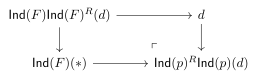
This is the unstable analogue of the Verdier quotient’s mapping-space formula; in the stable case both assumptions are automatic. The description is compatible with idempotent completion, since $\mathsf{Ind}(\mathcal{C}^{\mathrm{idem}}) \simeq \mathsf{Ind}(\mathcal{C})$.
What we actually care about are the cofibre sequences in $\mathsf{Cat}^{\mathrm{rex}}$ that induce long exact sequences in connective K-theory. This property is not automatic under idempotent completion (recall cofinality: dense embeddings are only injective, not surjective, on $\mathrm{k}_0$). The following definition assembles all the needed technical assumptions.
A sequence
\[ \mathcal{C} \xrightarrow{i} \mathcal{D} \xrightarrow{p} \mathcal{E} \]in $\mathsf{Cat}^{\mathrm{rex}}$ is a Verdier sequence if:
- it is a cofibre sequence;
- $i$ is fully faithful;
- $\mathsf{Ind}(i)^R$ preserves pushouts;
- the image of $i_+\colon \mathcal{C}_+ \to \mathcal{D}_+$ is closed under retracts.
Let $S = (\mathcal{C} \xrightarrow{i} \mathcal{D} \xrightarrow{p} \mathcal{E})$ be a sequence in $\mathsf{Cat}^{\mathrm{rex}}$. Consider the conditions:
- $S$ is a cofibre sequence, both $\mathcal{C}$ and $\mathcal{D}$ have terminal objects, $i$ is fully faithful with retract-closed image, and $i$ preserves the terminal object (then $\mathcal{E}$ also has a terminal object, and $p$ preserves it).
- $S$ is a Verdier sequence (Definition 18 ).
- $(2')$ $S$ is a cofibre sequence, $i$ is fully faithful, $i_+$’s image is retract-closed, and $\mathsf{Ind}(i)$ is a strong left adjoint (its right adjoint has a right adjoint).
- $S_+ = (\mathcal{C}_+ \xrightarrow{i_+} \mathcal{D}_+ \xrightarrow{p_+} \mathcal{E}_+)$ is a cofibre sequence with $i_+$ fully faithful and retract-closed image.
- $\mathsf{SW}(S)$ is a Verdier sequence in $\mathsf{Cat}^{\mathrm{ex}}$.
- $\mathrm{k}(S) = (\mathrm{k}(\mathcal{C}) \to \mathrm{k}(\mathcal{D}) \to \mathrm{k}(\mathcal{E}))$ is a fibre sequence in $\mathsf{Sp}_{\ge 0}$.
Then $(2') \Rightarrow (2) \Rightarrow (3) \Rightarrow (4) \Rightarrow (5)$ and $(1) \Rightarrow (3)$. Moreover:
- When $\mathcal{C}, \mathcal{D}$ (hence $\mathcal{E}$) are pointed, $(1) \Leftrightarrow (3)$ and $(2) \Leftrightarrow (2')$. When they are stable, all implications reverse except $(5) \Rightarrow (6)$.
- The functors $(-)^{\mathrm{idem}}$, $(-)_+$ and $\mathsf{SW}(-)$ preserve sequences of types $(1)$–$(4)$; the last two also preserve type $(6)$.
- The classes of sequences satisfying $(3)$, $(4)$, $(6)$ are each closed under filtered colimits in $\mathsf{Cat}^{\mathrm{rex}}$.
Proof.
See [sheaves-on-manifolds, Prop. 3.2.3] .
We sketch $(2) \Rightarrow (3)$, the most instructive unstable implication. We must show $i_+$ is fully faithful. Recall $\mathsf{Ind}((-)_+) \simeq \mathsf{An}_* \otimes \mathsf{Ind}(-)$, so $\mathsf{Ind}(\mathcal{C}_+) \simeq \mathsf{Ind}(\mathcal{C})_*$ and $\mathsf{Ind}(i_+) \simeq \mathsf{Ind}(i)_*$. In general, if $\ell\colon \mathcal{A} \hookrightarrow \mathcal{B}$ is fully faithful in $\mathsf{Pr}^L$ with $\ell^R$ preserving pushouts, then $\ell_*\colon \mathcal{A}_* \to \mathcal{B}_*$ is fully faithful. Indeed, $(\ell_*)^R$ is the restriction of $\ell^R$ to slice categories; fully faithfulness of $\ell$ and pushout-preservation of $\ell^R$ together force the counit of the adjunction $\ell_*$ to be an equivalence.
$\square$Non-connective K-theory
Take an idempotent-complete $\mathcal{C} \in \mathsf{Cat}^{\mathrm{rex},\mathrm{idem}}$. Consider the Yoneda embedding $y\colon \mathcal{C} \hookrightarrow \mathsf{Ind}(\mathcal{C})$ and its $\aleph_1$-truncation $j\colon \mathcal{C} \hookrightarrow \mathsf{Ind}(\mathcal{C})^{\aleph_1}$. We get a natural cofibre sequence
\[ \mathcal{C} \xrightarrow{\;j\;} \mathsf{Ind}(\mathcal{C})^{\aleph_1} \longrightarrow \mathsf{Ind}(\mathcal{C})^{\aleph_1} / \mathcal{C}. \]Idempotent completeness makes $j$ fully faithful with retract-closed image, and $\mathsf{Ind}(j) = \hat{y}\colon \mathsf{Ind}(\mathcal{C}) \to \mathsf{Ind}(\mathsf{Ind}(\mathcal{C})^{\aleph_1})$ is a strong left adjoint (see the chapter on compactly assembled categories); condition $(2')$ of Proposition 19 is satisfied and the sequence induces a fibre sequence on $\mathrm{k}$:
\[ \mathrm{k}(\mathcal{C}) \to \mathrm{k}(\mathsf{Ind}(\mathcal{C})^{\aleph_1}) \to \mathrm{k}(\mathsf{Ind}(\mathcal{C})^{\aleph_1} / \mathcal{C}). \]Next, $\mathsf{Ind}(\mathcal{C})^{\aleph_1}$ has countable colimits — in fact all $\aleph_1$-small colimits, and is idempotent-complete by . The Eilenberg swindle gives $\mathrm{k}(\mathsf{Ind}(\mathcal{C})^{\aleph_1}) \simeq 0$, and the fibre sequence becomes
\[ \mathrm{k}(\mathcal{C}) \simeq \Omega \mathrm{k}(\mathsf{Ind}(\mathcal{C})^{\aleph_1} / \mathcal{C}). \]In particular $\mathrm{k}_0(\mathsf{Ind}(\mathcal{C})^{\aleph_1} / \mathcal{C}) = 0$.
The quotient $\mathsf{Ind}(\mathcal{C})^{\aleph_1} / \mathcal{C}$ is not automatically idempotent-complete, so we cannot iterate directly. Idempotent completion plus cofinality (Proposition 12 ) gives
\[ \mathrm{k}(\mathcal{C}) \simeq \tau_{\ge 0} \Omega \mathrm{k}\!\left((\mathsf{Ind}(\mathcal{C})^{\aleph_1} / \mathcal{C})^{\mathrm{idem}}\right). \]The key point: $\mathrm{k}_0((\mathsf{Ind}(\mathcal{C})^{\aleph_1} / \mathcal{C})^{\mathrm{idem}})$ need not vanish, signalling the existence of negative K-groups and the path to extending K-theory to all spectra.
For idempotent-complete $\mathcal{C}$ with finite colimits, the Calkin category is
\[ \mathsf{Calk}(\mathcal{C}) \coloneqq (\mathsf{Ind}(\mathcal{C})^{\aleph_1} / \mathcal{C})^{\mathrm{idem}}. \]For general $\mathcal{C} \in \mathsf{Cat}^{\mathrm{rex}}$ and $n \ge 0$, recursively define
\[ \mathsf{Calk}^0(\mathcal{C}) = \mathcal{C}^{\mathrm{idem}}, \qquad \mathsf{Calk}^{n+1}(\mathcal{C}) = \mathsf{Calk}(\mathsf{Calk}^n(\mathcal{C})). \]This defines an endofunctor $\mathsf{Calk}\colon \mathsf{Cat}^{\mathrm{rex},\mathrm{idem}} \to \mathsf{Cat}^{\mathrm{rex},\mathrm{idem}}$.
For all $n \ge 0$,
\[ \tau_{\ge 0} \Omega \mathrm{k}(\mathsf{Calk}^{n+1}(\mathcal{C})) \simeq \mathrm{k}(\mathsf{Calk}^n(\mathcal{C})), \]which leads naturally to the definition:
Let $\mathcal{C} \in \mathsf{Cat}^{\mathrm{rex}}$. The non-connective algebraic K-theory of $\mathcal{C}$ is the spectrum $\mathrm{K}(\mathcal{C})$ characterised by
\[ \tau_{\ge -n} \mathrm{K}(\mathcal{C}) \simeq \Omega^n \mathrm{k}(\mathsf{Calk}^n(\mathcal{C})) \]together with $\mathrm{K}(\mathcal{C}) \simeq \operatorname*{colim}_n \tau_{\ge -n} \mathrm{K}(\mathcal{C})$. For $n \in \mathbb{Z}$ set $\mathrm{K}_n(\mathcal{C}) \coloneqq \pi_n(\mathrm{K}(\mathcal{C}))$.
By cofinality, the natural map $\mathrm{k}_n(\mathcal{C}) \to \mathrm{K}_n(\mathcal{C})$ is an isomorphism for $n > 0$ and injective for $n = 0$; when $\mathcal{C}$ is idempotent-complete, it is an isomorphism at $n = 0$ too.
For negative degrees, by definition $\mathrm{K}_{-1}(\mathcal{C}) = \mathrm{k}_0(\mathsf{Calk}(\mathcal{C}))$, which measures the retract-obstruction to idempotent-completeness of the quotient $\mathsf{Ind}(\mathcal{C})^{\aleph_1} / \mathcal{C}$. In many practical cases this obstruction vanishes: for a regular ring $R$, $\mathcal{C} = \mathsf{Perf}(R)$ yields an automatically idempotent-complete quotient, so $\mathrm{K}_{-1}(R) = 0$; in fact all negative K-groups of a regular ring vanish, and $\mathrm{K}(R) \simeq \mathrm{k}(R)$.
The key tool for lifting connective results to the non-connective world is:
$\mathsf{Calk}\colon \mathsf{Cat}^{\mathrm{rex},\mathrm{idem}} \to \mathsf{Cat}^{\mathrm{rex},\mathrm{idem}}$ satisfies:
- Given a filtered diagram $\mathcal{C}_{\bullet}\colon I \to \mathsf{Cat}^{\mathrm{rex},\mathrm{idem}}$, the sequence \[ \operatorname*{colim}_i \mathcal{C}_i \to \operatorname*{colim}_i \mathsf{Ind}(\mathcal{C}_i)^{\aleph_1} \to \operatorname*{colim}_i \mathsf{Calk}(\mathcal{C}_i) \] at the filtered colimit satisfies condition $(2')$ of Proposition 19 .
- $\mathsf{Calk}$ preserves type-$(6)$ sequences: if a cofibre sequence $\mathcal{C} \to \mathcal{D} \to \mathcal{E}$ induces a long exact sequence on $\mathrm{k}$, then so does $\mathsf{Calk}(\mathcal{C}) \to \mathsf{Calk}(\mathcal{D}) \to \mathsf{Calk}(\mathcal{E})$.
- At the level of endofunctors on $\mathsf{Cat}^{\mathrm{rex},\mathrm{idem}}$, there are natural $\mathrm{k}$-equivalences \[ \mathsf{Calk}(-)_+ \simeq_{\mathrm{k}} \mathsf{Calk}((-)_+), \qquad \mathsf{SW}(\mathsf{Calk}(-)) \simeq_{\mathrm{k}} \mathsf{Calk}(\mathsf{SW}(-)). \]
- $\mathsf{Calk}$ preserves filtered colimits up to $\mathrm{k}$-equivalence: \[ \mathrm{k}\!\left(\operatorname*{colim}_i \mathsf{Calk}(\mathcal{C}_i)\right) \xrightarrow{\;\sim\;} \mathrm{k}\!\left(\mathsf{Calk}\!\left(\operatorname*{colim}_i \mathcal{C}_i\right)\right). \]
Proof.
(1) Via $\mathsf{Cat}^{\mathrm{rex},\mathrm{idem}} \simeq \mathsf{Pr}_{\aleph_0}^L$ and the inclusion $\mathsf{Pr}_{\aleph_0}^L \subset \mathsf{Pr}_{\mathrm{ca}}^L$, we prove a more general statement for filtered diagrams in $\mathsf{Pr}_{\mathrm{ca}}^L$.
The key fact about compactly assembled categories: for $\mathcal{C} \in \mathsf{Pr}_{\mathrm{ca}}^L$ the colimit functor $k\colon \mathsf{Ind}(\mathcal{C}) \to \mathcal{C}$ has both a right adjoint $y$ (Yoneda) and a left adjoint $\hat{y}$,
\[ \hat{y} \dashv k \dashv y. \]The embedding $\hat{y}\colon \mathcal{C} \hookrightarrow \mathsf{Ind}(\mathcal{C})$ is fully faithful and colimit-preserving, though it need not preserve limits — this is the extra structure provided by compact assembly.
Crucially, compactly assembled functors preserve this adjoint structure. For a transition functor $F_{ij}\colon \mathcal{C}_i \to \mathcal{C}_j$ in our filtered diagram, compact assembly gives a commuting diagram
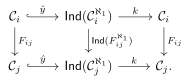
Consider the induced functor
\[ \phi\colon \operatorname*{colim}_i \mathcal{C}_i \to \operatorname*{colim}_i \mathsf{Ind}(\mathcal{C}_i^{\aleph_1}) \simeq \mathsf{Ind}\!\left(\operatorname*{colim}_i \mathcal{C}_i^{\aleph_1}\right). \]We show $\phi$ is a strong left adjoint. Passing to right adjoints (using that $\hat{y}$’s right adjoint is $k$, and $k$’s right adjoint is $y$), limits can be computed in $\mathsf{Cat}$; the limit identifies $y$’s limit as the right adjoint of the right adjoint of $\phi$, establishing strongness.
Fully faithfulness and retract-closedness pass through filtered colimits by below.
(2) Assume $\mathcal{C} \to \mathcal{D} \to \mathcal{E}$ induces a $\mathrm{k}$-long-exact sequence. Consider the $3 \times 3$ diagram
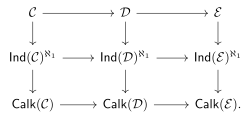
All columns induce $\mathrm{k}$-long-exact sequences (by the earlier construction); the top row does by assumption; the middle row is zero by the Eilenberg swindle, hence trivially long-exact. Commutativity of cofibres in $\mathsf{Sp}$ gives long-exactness of the bottom row.
(3) For the stabilised version $\mathsf{SW}(\mathsf{Calk}(-)) \simeq_{\mathrm{k}} \mathsf{Calk}(\mathsf{SW}(-))$, consider for $\mathcal{C} \in \mathsf{Cat}^{\mathrm{rex},\mathrm{idem}}$ the diagram
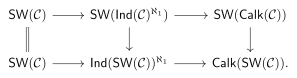
Both rows satisfy $(2')$, hence are $\mathrm{k}$-long-exact; the middle column is zero by the Eilenberg swindle. The five lemma forces the right column to be a $\mathrm{k}$-equivalence. The pointed case follows similarly, or from the stable case via $\mathsf{SW}((-)_+) \simeq \mathsf{SW}(-)$ and Proposition 6 .
(4) For a filtered diagram $\mathcal{C}_{\bullet}$ with colimit $\mathcal{C}$, consider
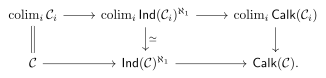
The middle vertical is an equivalence because $\mathsf{Ind}(-)^{\aleph_1}$ preserves filtered colimits. Both rows are $(2')$-sequences (by part 1 for the top), so they are $\mathrm{k}$-long-exact. The middle term is zero (Eilenberg), and the five lemma gives the claim.
$\square$Proof.
Full faithfulness: mapping spaces in a filtered colimit of categories are filtered colimits of the levelwise mapping spaces.
Retract-closedness: suppose $d \in \mathcal{D}_{\infty} = \operatorname*{colim}_i \mathcal{D}_i$ is a retract of some $\alpha_{\infty}(c)$. The minimal diagram witnessing a retract relation is finite, hence compact in $\mathsf{Cat}$, so the witness already lives at some finite stage $\mathcal{D}_i$: there is a $d_i \in \mathcal{D}_i$ retract of $\alpha_i(c_i)$. By the levelwise hypothesis $d_i = \alpha_i(c_i')$, so $d = \alpha_{\infty}(\lambda_i(c_i'))$.
$\square$The main corollary lifts connective properties of $\mathrm{k}$ to non-connective $\mathrm{K}$.
The non-connective K-theory functor $\mathrm{K}\colon \mathsf{Cat}^{\mathrm{rex}} \to \mathsf{Sp}$ has:
- Idempotent-completion invariance. The natural map $\mathrm{k}(\mathcal{C}) \to \mathrm{K}(\mathcal{C})$ is an isomorphism on $\pi_n$ for $n \ge 1$ and injective on $\pi_0$. When $\mathcal{C}$ is idempotent-complete, $\mathrm{k}(\mathcal{C}) \to \mathrm{K}(\mathcal{C})$ is the connective cover.
- $\mathrm{K}$ preserves filtered colimits and finite products.
- Eilenberg swindle. If $F\colon \mathcal{C} \to \mathcal{C}$ is finite-colimit-preserving with $F \sqcup \mathrm{id} \simeq F$, then $\mathrm{K}(\mathcal{C}) \simeq 0$.
- If $S = (\mathcal{C} \to \mathcal{D} \to \mathcal{E})$ in $\mathsf{Cat}^{\mathrm{rex},\mathrm{idem}}$ induces a $\mathrm{k}$-long-exact sequence, then it also induces a $\mathrm{K}$-long-exact sequence. In particular, all sequence types of Proposition 19 are sent to long-exact sequences by $\mathrm{K}$.
- $\mathrm{K}$ sends the canonical maps $\mathcal{C} \to \mathcal{C}_+$ and $\mathcal{C} \to \mathsf{SW}(\mathcal{C})$ to equivalences.
Given connective $\mathrm{k}$, properties 1 and 4 already determine $\mathrm{K}$ uniquely.
Proof.
(1) Definition plus cofinality.
(2) Semi-additivity of $\mathsf{Cat}^{\mathrm{rex}}$ gives product-preservation for $\mathsf{Calk}$, hence for $\mathrm{K} = \operatorname*{colim} \Omega^n \mathrm{k} \mathsf{Calk}^n$. Filtered colimits: reduce to idempotent-complete $\mathcal{C}$ via (1), then combine Proposition 7 and Proposition 23 (4).
(3) Product-preservation yields a map $\mathrm{K}(F)\colon \mathrm{K}(\mathcal{C}) \to \mathrm{K}(\mathcal{C})$ with $\mathrm{K}(F) + \mathrm{id} = \mathrm{id}$ in $\pi_0 \mathrm{Hom}_{\mathsf{Sp}}(\mathrm{K}(\mathcal{C}), \mathrm{K}(\mathcal{C}))$. This is a group, so $\mathrm{id} = 0$ and $\mathrm{K}(\mathcal{C}) \simeq 0$.
(4) By Proposition 23 (2).
(5) Combine Proposition 23 (3) with the connective equivalences Proposition 6 and Proposition 9 .
$\square$References
- A. Krause, T. Nikolaus, P. Pützstück. Sheaves on Manifolds. 2024. PDF.
- J. Lurie. Higher Topos Theory. Ann. Math. Stud. 170, Princeton Univ. Press, 2009.
- J. Lurie. Kerodon. Online, 2018–. kerodon.net.