The goal of this note is to study the dualizable stable categories — the compactly assembled categories. The reasons to care about them are several:
In practice, many categories we meet are not compactly generated ($\aleph_0$-presentable), but compactly assembled (compactly generated categories are a fortiori compactly assembled). A typical example is the category of sheaves $\mathsf{Shv}(X)$ on a locally compact Hausdorff space $X$.
Given a topos $\mathcal{X}$ and a category $\mathcal{C}$, set $\mathsf{Shv}_{\mathcal{C}}(\mathcal{X}) \coloneqq \mathsf{Fun}^{\lim}(\mathcal{X}^{\mathrm{op}}, \mathcal{C})$ (sensible because every colimit in a topos is van Kampen, i.e. of descent type). One would like a notion of $\mathcal{C}$-valued structure sheaf on $\mathcal{X}$. One route is the classifying topos: a topos $\mathcal{E}$ equipped with a universal object $\mathcal{F} \in \mathsf{Shv}_{\mathcal{C}}(\mathcal{E})$ such that for every topos $\mathcal{X}$ the assignment $f^* \mapsto f^*\mathcal{F}$ gives an equivalence
\[ \mathsf{Fun}^*(\mathcal{E}, \mathcal{X}) \xrightarrow{\;\sim\;} \mathsf{Shv}_{\mathcal{C}}(\mathcal{X}); \]then $f^*\mathcal{F} \in \mathsf{Shv}_{\mathcal{C}}(\mathcal{X})$ is the universal $\mathcal{C}$-valued sheaf $\mathcal{O}_{\mathcal{X}}$. Such a classifying topos need not exist — but when $\mathcal{C}$ is compactly assembled, it always does, and is given by $\mathsf{Fun}^{\omega}(\mathcal{C}, \mathsf{An})$.
Consider $\mathsf{Pr}_{\mathbb{S}}^L = \mathsf{Pr}_{\mathrm{st}}^L$, the category of $\mathbb{S}$-linear presentable categories. The compactly assembled stable categories are exactly the dualizable objects inside it; this gives them a status analogous to finite-dimensional vector spaces. From the K-theoretic standpoint this is our main reason to study them.
Dualizability in $R$-linear categories
For a commutative ring spectrum $R$, $\mathsf{Mod}_R$ is automatically presentable and a commutative algebra in $(\mathsf{Pr}^L, \otimes)$ under the Lurie tensor product, so we can form the category of modules $\mathsf{Mod}_{\mathsf{Mod}_R}(\mathsf{Pr}^L)$.
Since $\mathsf{Sp} \simeq \mathsf{Mod}_{\mathbb{S}}$, we have $\mathsf{Pr}_{\mathbb{S}}^L \simeq \mathsf{Pr}_{\mathrm{st}}^L$: on every presentable stable $\mathcal{C}$ there is a canonical action $\mathsf{Sp} \otimes \mathcal{C} \to \mathcal{C}$ preserving colimits in each variable.
Dualizable objects
Let $\mathcal{C}$ be a symmetric monoidal category and $X, Y \in \mathcal{C}$. A map $\mathrm{ev}\colon Y \otimes X \to \mathbb{1}$ exhibits $Y$ as a dual of $X$ if there is $\mathrm{coev}\colon \mathbb{1} \to X \otimes Y$ satisfying the triangle identities:
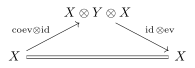
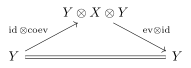
We then call $\mathrm{ev}$ the evaluation and $\mathrm{coev}$ the coevaluation, and call $(Y, \mathrm{ev})$ dualizing data for $X$; $X$ is a dualizable object.
Proof.
Let $X \in \mathcal{C}$ be dualizable with dual $X^{\vee}$, and let $i\colon A \rightleftarrows X \colon r$ with $r \circ i = \operatorname{id}_A$. Set $e \coloneqq i \circ r\colon X \to X$.
Dualizing produces an idempotent $e^{\vee}\colon X^{\vee} \to X^{\vee}$,
\[ e^{\vee} \coloneqq X^{\vee} \xrightarrow{\operatorname{id} \otimes \mathrm{coev}} X^{\vee} \otimes X \otimes X^{\vee} \xrightarrow{\operatorname{id} \otimes e \otimes \operatorname{id}} X^{\vee} \otimes X \otimes X^{\vee} \xrightarrow{\mathrm{ev} \otimes \operatorname{id}} X^{\vee}. \]By idempotent completeness it splits: there are $A^{\vee} \in \mathcal{C}$ and $i'\colon A^{\vee} \rightleftarrows X^{\vee} \colon r'$ with $r' \circ i' = \operatorname{id}_{A^{\vee}}$ and $i' \circ r' = e^{\vee}$.
Define \begin{align*} \mathrm{ev}_A &\colon A^{\vee} \otimes A \xrightarrow{i’ \otimes i} X^{\vee} \otimes X \xrightarrow{\mathrm{ev}_X} \mathbb{1}, \ \mathrm{coev}_A &\colon \mathbb{1} \xrightarrow{\mathrm{coev}_X} X \otimes X^{\vee} \xrightarrow{r \otimes r’} A \otimes A^{\vee}. \end{align*}
We verify the first triangle identity; the second is analogous. The composite $(\operatorname{id}_A \otimes \mathrm{ev}_A) \circ (\mathrm{coev}_A \otimes \operatorname{id}_A)$ unfolds to
\[ A \xrightarrow{i} X \xrightarrow{\mathrm{coev}_X \otimes \operatorname{id}} X \otimes X^{\vee} \otimes X \xrightarrow{\operatorname{id} \otimes e^{\vee} \otimes \operatorname{id}} X \otimes X^{\vee} \otimes X \xrightarrow{\operatorname{id} \otimes \mathrm{ev}_X} X \xrightarrow{r} A. \]Using the adjunction identity $(\operatorname{id} \otimes e^{\vee}) \circ \mathrm{coev}_X = (e \otimes \operatorname{id}) \circ \mathrm{coev}_X$, this rewrites as $r \circ e \circ \big[(\operatorname{id} \otimes \mathrm{ev}_X) \circ (\mathrm{coev}_X \otimes \operatorname{id})\big] \circ i$. The bracketed term is $\operatorname{id}_X$ by $X$’s triangle identity, and $r \circ e \circ i = r \circ i \circ r \circ i = \operatorname{id}_A$.
$\square$Compactly generated categories are dualizable
Let $\mathcal{C}$ be a compactly generated stable category. As a compactly
generated category we have $\mathcal{C} \simeq \mathsf{Ind}(\mathcal{C}^{\aleph_0})$,
and as a stable category we have the mapping-spectrum functor
$\mathrm{hom}_{\mathcal{C}}\colon \mathcal{C}^{\mathrm{op}} \times \mathcal{C} \to \mathsf{Sp}$,
determined by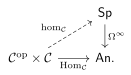
Currying gives $\rho_{\mathcal{C}}\colon \mathcal{C}^{\mathrm{op}} \to \mathsf{Fun}(\mathcal{C}, \mathsf{Sp})$, $\rho_{\mathcal{C}}(D) = \mathrm{hom}_{\mathcal{C}}(D, -)$. Since $\mathrm{hom}_{\mathcal{C}}$ is the internal-Hom functor, it preserves limits in the first variable, so $\rho_{\mathcal{C}}$ preserves limits.
Restricting to $(\mathcal{C}^{\aleph_0})^{\mathrm{op}}$ gives an exact functor $\rho_{\mathcal{C}}^{\aleph_0}\colon (\mathcal{C}^{\aleph_0})^{\mathrm{op}} \to \mathsf{Fun}(\mathcal{C}, \mathsf{Sp})$ (left exactness plus the stable target gives exactness). For a compact $D \in \mathcal{C}^{\aleph_0}$ the functor $\mathrm{hom}_{\mathcal{C}}(D, -)$ preserves filtered colimits (by compactness) and is exact, hence preserves all colimits. So $\rho_{\mathcal{C}}^{\aleph_0}$ lands in $\mathsf{Fun}^L(\mathcal{C}, \mathsf{Sp})$. By the Ind-extension universal property,
\[ \mathsf{Fun}^L\!\left(\mathsf{Ind}\!\left((\mathcal{C}^{\aleph_0})^{\mathrm{op}}\right),\, \mathsf{Fun}^L(\mathcal{C}, \mathsf{Sp})\right) \simeq \mathsf{Fun}^{\mathrm{rex}}\!\left((\mathcal{C}^{\aleph_0})^{\mathrm{op}},\, \mathsf{Fun}^L(\mathcal{C}, \mathsf{Sp})\right), \]so $\rho_{\mathcal{C}}^{\aleph_0}$ uniquely extends to a colimit-preserving $\mathrm{P}\colon \mathsf{Ind}((\mathcal{C}^{\aleph_0})^{\mathrm{op}}) \to \mathsf{Fun}^L(\mathcal{C}, \mathsf{Sp})$. Since $\mathsf{Fun}^L(\mathcal{C}, \mathsf{Sp})$ is the internal-Hom in $\mathsf{Pr}^L$, $\mathrm{P}$ corresponds to a morphism in $\mathsf{Pr}^L$,
\[ \mathsf{Fun}^L\!\left(\mathsf{Ind}((\mathcal{C}^{\aleph_0})^{\mathrm{op}}),\, \mathsf{Fun}^L(\mathcal{C}, \mathsf{Sp})\right) \simeq \mathsf{Fun}^L\!\left(\mathsf{Ind}((\mathcal{C}^{\aleph_0})^{\mathrm{op}}) \otimes \mathcal{C},\, \mathsf{Sp}\right), \]and we obtain the evaluation
\[ \mathrm{ev}\colon \mathsf{Ind}((\mathcal{C}^{\aleph_0})^{\mathrm{op}}) \otimes \mathcal{C} \to \mathsf{Sp}. \]Similarly $\mathrm{hom}_{\mathcal{C}^{\aleph_0}}\colon (\mathcal{C}^{\aleph_0})^{\mathrm{op}} \times \mathcal{C}^{\aleph_0} \to \mathsf{Sp}$ is exact in both variables and gives an object of $\mathsf{Ind}((\mathcal{C}^{\aleph_0})^{\mathrm{op}}) \otimes \mathsf{Ind}(\mathcal{C}^{\aleph_0})$, hence the coevaluation
\[ \mathrm{coev}\colon \mathsf{Sp} \to \mathcal{C} \otimes \mathsf{Ind}((\mathcal{C}^{\aleph_0})^{\mathrm{op}}). \]The triangle identities check out, so $\mathcal{C}$ is dualizable in $\mathsf{Pr}^L_{\mathrm{st}}$ with $\mathcal{C}^{\vee} \simeq \mathsf{Ind}((\mathcal{C}^{\aleph_0})^{\mathrm{op}})$.
Compactly assembled categories
The natural question is: what does a general dualizable object in $\mathsf{Pr}^L_{\mathrm{st}}$ look like? This is the compactly assembled setting.
By what we just established, compactly generated stable categories are dualizable. $\mathsf{Pr}_{\mathrm{st}}^L$ is idempotent-complete, so Lemma 3 tells us retracts of compactly generated categories are still dualizable.
Conversely, every dualizable object is a retract of a compactly generated one. Let $\mathcal{C} \in \mathsf{Pr}^L_{\mathrm{st}}$ be dualizable with dual $\mathcal{C}^{\vee}$. Pick a regular cardinal $\kappa$ such that $\mathcal{C}$ is $\kappa$-presentable; the canonical functor
\[ \varphi\colon \mathcal{D} \coloneqq \mathsf{Ind}(\mathcal{C}^{\kappa}) \to \mathcal{C} \]is a left Bousfield localization ([sheaves-on-manifolds, Cor. 2.1.27] ). Localizations in $\mathsf{Pr}^L$ are preserved by tensor product ([sheaves-on-manifolds, Ex. 2.8.4] ), so $\varphi \otimes \mathrm{id}_{\mathcal{C}^{\vee}}\colon \mathcal{D} \otimes \mathcal{C}^{\vee} \to \mathcal{C} \otimes \mathcal{C}^{\vee}$ is also a localization, in particular essentially surjective. Dualizability identifies these tensor products with $\mathsf{Fun}^L(\mathcal{C}, \mathcal{D})$ and $\mathsf{Fun}^L(\mathcal{C}, \mathcal{C})$, so $\mathrm{id}_{\mathcal{C}} \in \mathsf{Fun}^L(\mathcal{C}, \mathcal{C})$ has a preimage $\psi\colon \mathcal{C} \to \mathcal{D}$ with $\varphi \circ \psi \simeq \mathrm{id}_{\mathcal{C}}$. So $\mathcal{C}$ is a retract of the compactly generated $\mathcal{D}$ in $\mathsf{Pr}^L$.
Dualizable objects in $\mathsf{Pr}_{\mathrm{st}}^L$ are therefore exactly the retracts of compactly generated stable categories. This is an external characterisation; we now give an intrinsic one.
Let $\mathcal{C}$ be presentable.
A morphism $f\colon X \to Y$ in $\mathcal{C}$ is a compact morphism if, for every filtered colimit $Z \simeq \operatorname*{colim}_i Z_i$, the square
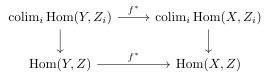
is a pullback. Equivalently, the fibre $\operatorname{fib}(\operatorname{Hom}(Y,Z) \xrightarrow{f^*} \operatorname{Hom}(X,Z))$ preserves filtered colimits in $Z$.
An object $X$ is compactly exhaustible if
\[ X \simeq \operatorname*{colim}\left(X_0 \to X_1 \to X_2 \to \cdots\right) \]with every $X_i \to X_{i+1}$ a compact morphism.
$\mathcal{C}$ is compactly assembled if it is generated under colimits by compactly exhaustible objects.
We now identify compactly assembled categories intrinsically.
Let $\mathcal{C}$ be $\kappa$-presentable. Then $\mathcal{C}$ is compactly assembled iff the colimit functor
\[ k\colon \mathsf{Ind}(\mathcal{C}^{\kappa}) \to \mathcal{C} \]has a left adjoint. The property “$k$ has a left adjoint” is closed under retracts in $\mathsf{Pr}^L$.
Proof.
($\Rightarrow$) Suppose $\mathcal{C}$ is compactly assembled. Then $\mathcal{C}$ is $\aleph_1$-presentable (every compactly exhaustible object is $\aleph_1$-compact, and conversely every $\aleph_1$-compact object is compactly exhaustible). Construct the left adjoint $\hat{y}\colon \mathcal{C} \to \mathsf{Ind}(\mathcal{C}^{\aleph_1})$ explicitly: for $X \in \mathcal{C}$, write $X \simeq \operatorname*{colim}_n X_n$ with $X_n \to X_{n+1}$ compact, and set
\[ \hat{y}(X) \coloneqq \operatorname*{colim}_n y(X_n), \]the colimit computed in $\mathsf{Ind}(\mathcal{C}^{\aleph_1})$. This $\hat{y}$ is fully faithful. To verify the adjunction, use that for $Z \simeq \operatorname*{colim}_i Z_i$ filtered,
\[ \operatorname{Hom}_{\mathcal{C}}(X, Z) \simeq \lim_n \operatorname{Hom}(X_n, Z) \simeq \lim_n \operatorname*{colim}_i \operatorname{Hom}(X_n, Z_i) \simeq \operatorname{Hom}_{\mathsf{Ind}}(\operatorname*{colim}_n y(X_n), \operatorname*{colim}_i y(Z_i)), \]where the second equivalence uses that $(\operatorname{Hom}(X_n, Z))_n$ and $(\operatorname*{colim}_i \operatorname{Hom}(X_n, Z_i))_n$ are isomorphic in $\mathsf{Pro}(\mathsf{An})$ — a consequence of the compact-morphism condition. The fully faithful embedding $\mathsf{Ind}(\mathcal{C}^{\aleph_1}) \hookrightarrow \mathsf{Ind}(\mathcal{C}^{\kappa})$ transfers the adjoint to the general $\kappa$ case.
($\Leftarrow$) If $\hat{y}$ exists, write $\hat{y}(X) \simeq \operatorname*{colim}_i y(X_i)$ in $\mathsf{Ind}(\mathcal{C}^{\kappa})$ with $X_i \in \mathcal{C}^{\kappa}$. Full faithfulness of $\hat{y}$ and pullbacks against filtered colimits of $Z$ give the compact-morphism pullback square at each $y(X_i) \to \hat{y}(X)$, showing $X$ is compactly exhaustible.
Retract closure: view $\mathsf{Pr}^L$ as a $2$-category with internal $\mathsf{Fun}^L$. By [ramzi-dualizable, Lem. 1.47] , a $1$-morphism $f$ in a $2$-category $\mathbb{B}$ has a left adjoint provided that $\mathsf{Hom}_{\mathbb{B}}(X, Z)$ is idempotent-complete for every $Z$ and $f$ is a retract (in $\mathsf{Fun}([1], \mathbb{B})$) of some $g$ with a left adjoint. For presentable $\mathcal{C}, \mathcal{D}$ the category $\mathsf{Fun}^L(\mathcal{C}, \mathcal{D})$ is always idempotent-complete, and for compactly generated $\mathcal{D}$ the canonical $k$ is an equivalence, with a trivial left adjoint; retracts inherit the left adjoint.
$\square$Proof.
($\Rightarrow$) If $\mathcal{C}$ is compactly assembled, Lemma 5 gives a left adjoint $\hat{y}$ to $k\colon \mathcal{D} \coloneqq \mathsf{Ind}(\mathcal{C}^{\kappa}) \to \mathcal{C}$. As a localization, $k$ has fully faithful right adjoint $y$, so the counit $\varepsilon\colon ky \xrightarrow{\sim} \operatorname{id}_{\mathcal{C}}$ is an equivalence. Using the two adjunctions,
\[ \operatorname{Hom}_{\mathcal{C}}(k(\hat{y}(c)), c') \simeq \operatorname{Hom}_{\mathcal{D}}(\hat{y}(c), y(c')) \simeq \operatorname{Hom}_{\mathcal{C}}(c, ky(c')) \simeq \operatorname{Hom}_{\mathcal{C}}(c, c'), \]naturally in $c'$, so $k \circ \hat{y} \simeq \operatorname{id}_{\mathcal{C}}$ by Yoneda. Since $\hat{y}$ is a left adjoint it is a $\mathsf{Pr}^L$-map, exhibiting $\mathcal{C}$ as a retract of the compactly generated $\mathcal{D}$.
($\Leftarrow$) A retract of a compactly generated category has $k\colon \mathsf{Ind}((\cdot)^{\omega}) \to (\cdot)$ an equivalence in the compactly generated case, so the retract inherits a left adjoint to its own $k$, and by Lemma 5 it is compactly assembled.
$\square$Combining with the earlier characterisation: in $\mathsf{Pr}^L_{\mathrm{st}}$, dualizable objects are exactly retracts of compactly generated stable categories, so the intrinsic notion (compactly assembled) and the external notion (dualizable) coincide in the stable world.
A finer statement inside general $\mathsf{Pr}^L$:
For presentable $\mathcal{C}$, the following are equivalent:
- $\mathcal{C}$ is compactly assembled.
- $\mathcal{C}$ is $\aleph_1$-presentable and the colimit functor $k\colon \mathsf{Ind}(\mathcal{C}^{\aleph_1}) \to \mathcal{C}$ has a left adjoint $\hat{y}$.
- There is a regular cardinal $\kappa$ for which $\mathcal{C}$ is $\kappa$-presentable and $\mathsf{Ind}(\mathcal{C}^{\kappa}) \to \mathcal{C}$ has a left adjoint.
- $\mathcal{C}$ is a retract in $\mathsf{Pr}^L$ of a compactly generated category.
- Filtered colimits in $\mathcal{C}$ distribute over all small limits: for every small $K$ and filtered $I$, \[ \operatorname*{colim}_{I^K} \operatorname*{lim}_K F \xrightarrow{\;\sim\;} \operatorname*{lim}_K \operatorname*{colim}_I F. \]
Proof.
The canonical example:
Let $X$ be Hausdorff. The following are equivalent:
- $\mathsf{Shv}(X)$ is compactly assembled.
- $\mathsf{Open}(X)$ is compactly assembled.
- $X$ is locally compact.
Properties
We record some properties; proofs are omitted.
With $\hat{y} \dashv k \dashv y$ at hand we may construct a natural
transformation $\hat{y} \Rightarrow y$. Contemplate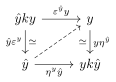
For a morphism $f\colon X \to Y$ in a compactly assembled $\mathcal{C}$, the following are equivalent:
- $f$ is a compact morphism.
- $y(f)\colon y(X) \to y(Y)$ factors through $\hat{y}(Y)$.
- $\hat{y}(f)\colon \hat{y}(X) \to \hat{y}(Y)$ factors through $y(X)$.
- $\hat{y}(f)$ is a compact morphism in $\mathsf{Ind}(\mathcal{C}^{\aleph_1})$.
So a compact morphism $f\colon X \to Y$ is recorded by a lift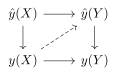
Let $\mathcal{C}$ be compactly assembled. A compactly assembled morphism $X \to Y$ is a compact morphism together with a choice of lift $y(X) \to \hat{y}(Y)$. Set
\[ \operatorname{Hom}_{\mathcal{C}}^{\mathrm{ca}}(X,Y) \coloneqq \operatorname{Hom}_{\mathsf{Ind}(\mathcal{C})}(y(X), \hat{y}(Y)). \]The map $\operatorname{Hom}_{\mathcal{C}}^{\mathrm{ca}}(X,Y) \to \operatorname{Hom}_{\mathcal{C}}(X,Y)$ (via $\hat{y}(Y) \to y(Y)$) is not a subspace inclusion: a compactly assembled morphism carries strictly more information (the choice of lift), expressed as higher-homotopy data.
Ind-extension and assembly
For compactly assembled $\mathcal{C}$ and a category $\mathcal{D}$ with
filtered colimits, any functor $F\colon \mathcal{C} \to \mathcal{D}$ has an
Ind-extension: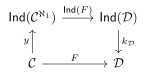
There is also $\hat{y}\colon \mathcal{C} \to \mathsf{Ind}(\mathcal{C}^{\aleph_1})$, prompting the question: how do $y^*$ and $\hat{y}^*$ relate?
Let $\mathcal{C}$ be compactly assembled and $\mathcal{D}$ a category with filtered colimits. A functor $F\colon \mathcal{C} \to \mathcal{D}$ preserves filtered colimits iff its Ind-extension sends $\hat{y} \Rightarrow y$ to an equivalence. Explicitly, there is an equivalence
\[ y^* \simeq \hat{y}^*\colon \mathsf{Fun}_{\hat{y} \Rightarrow y}^{\mathrm{filt}}(\mathsf{Ind}(\mathcal{C}^{\aleph_1}), \mathcal{D}) \xrightarrow{\;\sim\;} \mathsf{Fun}^{\mathrm{filt}}(\mathcal{C}, \mathcal{D}), \]where the left side consists of filtered-colimit-preserving functors sending $\hat{y} \Rightarrow y$ to an equivalence.
$\mathsf{Fun}^{\mathrm{filt}}(\mathcal{C}, \mathcal{D})$ is a left Bousfield localization of $\mathsf{Fun}(\mathcal{C}, \mathcal{D})$ with localization
\[ \mathrm{asm}_{\mathrm{filt}}\colon \mathsf{Fun}(\mathcal{C}, \mathcal{D}) \to \mathsf{Fun}^{\mathrm{filt}}(\mathcal{C}, \mathcal{D}), \qquad F \mapsto k_{\mathcal{D}} \circ \mathsf{Ind}(F) \circ \hat{y}. \]The counit
\[ k_{\mathcal{D}} \circ \mathsf{Ind}(F) \circ \hat{y} \Rightarrow F \]is the assembly map: the terminal object of $\mathsf{Fun}^{\mathrm{filt}}(\mathcal{C}, \mathcal{D})_{/F}$.
Intuitively, the assembled functor $\mathrm{asm}_{\mathrm{filt}}(F)$ is $F$ restricted to compactly exhaustible objects, reassembled by filtered colimits.
The category $\mathsf{Pr}^L_{\mathrm{ca}}$
The relevant functors between compactly assembled categories are those that preserve the defining structure — compact morphisms.
Let $\mathcal{C}$ and $\mathcal{D}$ be compactly assembled. A left adjoint $F\colon \mathcal{C} \to \mathcal{D}$ is a compactly assembled functor if it preserves compact morphisms. Let
\[ \mathsf{Pr}^L_{\mathrm{ca}} \subset \mathsf{Pr}^L \]be the non-full subcategory of compactly assembled categories and compactly assembled functors.
A left adjoint $F\colon \mathcal{C} \to \mathcal{D}$ between compactly assembled categories preserves compact morphisms iff it commutes with $\hat{y}$:
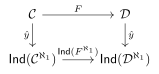
Let $F\colon \mathcal{C} \to \mathcal{D}$ be a morphism in $\mathsf{Pr}^L$ with $\mathcal{C}$ compactly assembled. Then $F$ preserves compact morphisms iff $F^R$ preserves filtered colimits.
Via Gabriel–Ulmer $\mathsf{Pr}_{\aleph_1}^L \simeq \mathsf{Cat}^{\mathrm{rex}(\aleph_1)}$ we can recognise $\mathsf{Pr}^L_{\mathrm{ca}}$ intrinsically. Since $\mathsf{Pr}^L_{\mathrm{ca}} \subset \mathsf{Pr}_{\aleph_1}^L$, only an extra condition on $\mathsf{Cat}^{\mathrm{rex}(\aleph_1)}$ is needed.
Define $\mathsf{Cat}^{\mathrm{ca}}$:
- Objects are small categories $\mathcal{C}$ with countable colimits in which every object is compactly exhaustible (an $\mathbb{N}$-colimit along compact morphisms).
- Morphisms are functors preserving $\aleph_1$-small colimits and compact morphisms.
Proof.
($\Rightarrow$) For compactly assembled $\mathcal{C}$, $\mathcal{C}^{\aleph_1}$ has countable colimits, and every object is compactly exhaustible, so $\mathcal{C}^{\aleph_1} \in \mathsf{Cat}^{\mathrm{ca}}$.
($\Leftarrow$) For $\mathcal{C} \in \mathsf{Cat}^{\mathrm{ca}}$, set $\mathcal{D} = \mathsf{Ind}_{\aleph_1}(\mathcal{C})$. By Lemma 5 , it suffices to construct a left adjoint to $k\colon \mathsf{Ind}(\mathcal{C}) \to \mathcal{D}$. For $X = \operatorname*{colim}_n X_n \in \mathcal{C}$ compactly exhaustible and any $Y \in \mathsf{Ind}(\mathcal{C})$,
\[ \operatorname{Hom}_{\mathsf{Ind}(\mathcal{C})}(\operatorname*{colim}_n y(X_n), Y) \simeq \operatorname{Hom}_{\mathcal{D}}(\operatorname*{colim}_n X_n, kY) = \operatorname{Hom}_{\mathcal{D}}(X, kY), \]exhibiting $\hat{y}(X) = \operatorname*{colim}_n y(X_n)$ as the left adjoint.
$\square$- $\mathsf{Pr}^L_{\mathrm{ca}}$ has all colimits, and the inclusion $\mathsf{Pr}^L_{\mathrm{ca}} \to \mathsf{Pr}^L$ preserves colimits.
- For any regular cardinal $\kappa$, the functor $(-)^{\kappa}\colon \mathsf{Pr}^L_{\mathrm{ca}} \to \mathsf{Cat}^{\mathrm{rex,idem}}$ preserves $\kappa$-filtered colimits.
- $\mathsf{Pr}^L_{\mathrm{ca}}$ is $\aleph_1$-presentable.
- $\mathsf{Pr}^L_{\mathrm{ca}} \to \mathsf{Pr}^L$ preserves finite limits; $\mathsf{Pr}^L_{\mathrm{ca}}$ has finite products, so is semi-additive.
Symmetric monoidal structure
Finally, we sketch the symmetric monoidal structure on $\mathsf{Pr}^L_{\mathrm{ca}}$. In $\mathsf{Pr}^L$ the Lurie tensor product is classified by bifunctors $F\colon \mathcal{C} \times \mathcal{D} \to \mathcal{E}$ preserving colimits in each variable. To descend to $\mathsf{Pr}^L_{\mathrm{ca}}$ we add a compact-morphism condition: for compact $f \in \mathcal{C}$ and $g \in \mathcal{D}$, $F(f, g)$ must be a compact morphism in $\mathcal{E}$.
The universal property is then: for such $F$, there is a unique (up to
homotopy) factorisation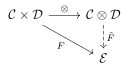
To make this concrete we use the Gabriel–Ulmer construction of $\mathsf{Pr}_{\kappa}^L$’s monoidal structure from [lurie-ha, §4.8.1] . Take $\kappa = \aleph_1$. The idea: equip $\mathsf{Cat}^{\mathrm{rex}(\aleph_1)}$ (small categories with countable colimits) with the monoidal structure induced from $\mathsf{Cat}^{\times}$, then transport to $\mathsf{Pr}_{\aleph_1}^L$ via duality. At this level,
\[ \mathsf{Ind}_{\aleph_1}(\mathcal{C}_0) \otimes \mathsf{Ind}_{\aleph_1}(\mathcal{D}_0) \simeq \mathsf{Ind}_{\aleph_1}(\mathcal{C}_0 \otimes \mathcal{D}_0). \]Restricting to $\mathsf{Pr}^L_{\mathrm{ca}}$: every object of $\mathcal{C}_0 \otimes \mathcal{D}_0$ is a countable colimit, and cofinality lets us reduce such a colimit to an $\mathbb{N}$-colimit of compactly exhaustible generators. This shows $\mathcal{C} \otimes \mathcal{D}$ remains in $\mathsf{Pr}^L_{\mathrm{ca}}$. The fact that the induced $\mathcal{C} \otimes \mathcal{D} \to \mathcal{E}$ is a valid morphism of $\mathsf{Pr}^L_{\mathrm{ca}}$ likewise reduces to a small-category statement via Gabriel–Ulmer.
For any compactly assembled $\mathcal{C}$ and any locally compact Hausdorff $X$ there is a lax symmetric monoidal equivalence
\[ \mathsf{Shv}(X, \mathcal{C}) \simeq \mathsf{Shv}(X) \otimes \mathcal{C}. \]Since both factors are compactly assembled, so is their tensor product; $\mathsf{Sp}$ is compactly generated (hence compactly assembled), so $\mathsf{Shv}(X, \mathsf{Sp})$ is compactly assembled.
Note also that $\mathsf{Sp}$ is a commutative algebra in $\mathsf{Pr}_{\mathrm{ca}}^L$, so we may form $\mathsf{Mod}_{\mathsf{Sp}}(\mathsf{Pr}_{\mathrm{ca}}^L)$ — the category of compactly assembled stable categories, inheriting the symmetric monoidal structure. Denote it $\mathsf{Pr}^L_{\mathrm{dual}}$.
Let $\mathcal{C}$ be a compactly assembled stable category.
- $\mathcal{C}$ is smooth if $\mathsf{Sp} \to \mathcal{C} \otimes \mathcal{C}^{\vee}$ is a strong left adjoint (its right adjoint has a right adjoint).
- $\mathcal{C}$ is proper if $\mathcal{C} \otimes \mathcal{C}^{\vee} \to \mathsf{Sp}$ is a strong left adjoint.
References
- A. Krause, T. Nikolaus, P. Pützstück. Sheaves on Manifolds. 2024. PDF.
- M. Ramzi. Dualizable presentable $\infty$-categories. 2024. arXiv:2410.21537.
- A. I. Efimov. K-theory and localizing invariants of large categories. 2025. arXiv:2405.12169.
- J. Lurie. Higher Algebra. PDF.