Recall that for a category with finite colimits and idempotent-completeness, $\mathcal{C} \in \mathsf{Cat}^{\mathrm{rex,idem}}$, we defined the Calkin category $\mathsf{Calk}(\mathcal{C}) = (\mathsf{Ind}(\mathcal{C})^{\aleph_1}/\mathcal{C})^{\mathrm{idem}}$ and used the relation $\mathrm{k}(\mathsf{Calk}^n(\mathcal{C})) \simeq \tau_{\ge 0}\Omega\mathrm{k}(\mathsf{Calk}^{n+1}(\mathcal{C}))$ to construct non-connective algebraic K-theory $\mathrm{K}$.
The aim of this note is to use the inclusion $\mathsf{Cat}^{\mathrm{rex}} \subset \mathsf{Cat}^{\mathrm{ca}} \simeq \mathsf{Pr}^L_{\mathrm{ca}}$ to extend algebraic K-theory to compactly assembled categories. The result is continuous (Efimov) K-theory.
The continuous Calkin category
First we extend the Calkin construction from small categories to compactly
assembled categories, i.e. we want to produce a dashed arrow making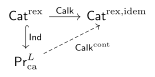
For compactly assembled $\mathcal{C}$, consider the Verdier cofibre sequence in $\mathsf{Pr}^L_{\mathrm{ca}}$,
\[ \mathcal{C} \xhookrightarrow{\;\hat{y}\;} \mathsf{Ind}(\mathcal{C}^{\aleph_1}) \longrightarrow \mathsf{Ind}(\mathcal{C}^{\aleph_1}) / \mathcal{C}. \]Since $\mathsf{Pr}^L_{\mathrm{ca}} \to \mathsf{Pr}^L$ preserves colimits and
colimits in $\mathsf{Pr}^L$ correspond to limits in $\mathsf{Pr}^R$ under
right-adjoint duality, this cofibre can be computed as the fibre of the right
adjoint $k\colon \mathsf{Ind}(\mathcal{C}^{\aleph_1}) \to \mathcal{C}$ over the
terminal object: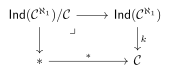
Proof.
The right adjoint is the inclusion $k^{-1}(*) \hookrightarrow \mathsf{Ind}(\mathcal{C}^{\aleph_1})$, which is fully faithful, so we have a Bousfield localization.
For compact generation, it suffices to show the inclusion preserves filtered colimits. Let $(X_i)_{i \in I}$ be a filtered diagram in $k^{-1}(*)$. Since $k$ is a left adjoint, $k(\operatorname*{colim}_i X_i) \simeq \operatorname*{colim}_i k(X_i) \simeq \operatorname*{colim}_i * \simeq *$, so $\operatorname*{colim}_i X_i \in k^{-1}(*)$. The inclusion hence preserves filtered colimits, so the localization preserves compact objects, and their image generates the quotient. Since $\mathsf{Ind}(\mathcal{C}^{\aleph_1})$ is compactly generated, so is the quotient.
$\square$By Gabriel–Ulmer duality, the compact objects $(\mathsf{Ind}(\mathcal{C}^{\aleph_1}) / \mathcal{C})^{\aleph_0}$ of a compactly generated category form an idempotent-complete category with finite colimits.
Let $\mathcal{C}$ be compactly assembled. The continuous Calkin category of $\mathcal{C}$ is
\[ \mathsf{Calk}^{\mathrm{cont}}(\mathcal{C}) \coloneqq \left( \mathsf{Ind}(\mathcal{C}^{\aleph_1}) / \mathcal{C} \right)^{\aleph_0}. \]For compactly assembled $\mathcal{C}$, there is a right-exact $p\colon \mathcal{C}^{\aleph_1} \to \mathsf{Calk}^{\mathrm{cont}}(\mathcal{C})$ such that
\[ \mathsf{Ind}(p)\colon \mathsf{Ind}(\mathcal{C}^{\aleph_1}) \to \mathsf{Ind}(\mathsf{Calk}^{\mathrm{cont}}(\mathcal{C})) \]is a Bousfield localization. Moreover, there is a natural cofibre sequence
\[ \mathcal{C} \xrightarrow{\;\hat{y}\;} \mathsf{Ind}(\mathcal{C}^{\aleph_1}) \xrightarrow{\;\mathsf{Ind}(p)\;} \mathsf{Ind}(\mathsf{Calk}^{\mathrm{cont}}(\mathcal{C})), \]and $\mathsf{Ind}(p)^R$ preserves pushouts.
Proof.
$\mathsf{Ind}(p)$ is the Bousfield localization of Proposition 1 , and it preserves compact objects, so by Gabriel–Ulmer we recover a right-exact $p$ on the small-category side.
For the pushout claim: $\mathsf{Ind}(p)^R$ is the inclusion $k^{-1}(*) \hookrightarrow \mathsf{Ind}(\mathcal{C}^{\aleph_1})$, which sits inside the pullback
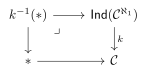
Given a pushout diagram $A, B, C \in k^{-1}(*)$, the pushout $A \cup_C B$ taken in $\mathsf{Ind}(\mathcal{C}^{\aleph_1})$ satisfies $k(A \cup_C B) \simeq k(A) \cup_{k(C)} k(B) \simeq * \cup_* * \simeq *$, since $k$ preserves colimits. So $A \cup_C B \in k^{-1}(*)$, and the inclusion preserves pushouts.
$\square$For an idempotent-complete $\mathcal{C}$ with finite colimits,
\[ \mathsf{Calk}^{\mathrm{cont}}(\mathsf{Ind}(\mathcal{C})) \simeq \mathsf{Calk}(\mathcal{C}). \]Proof.
Plugging the compactly generated $\mathsf{Ind}(\mathcal{C})$ into the previous cofibre sequence,
\[ \mathsf{Ind}(\mathcal{C}) \xhookrightarrow{\;\hat{y}\;} \mathsf{Ind}(\mathsf{Ind}(\mathcal{C})^{\aleph_1}) \xrightarrow{\;\mathsf{Ind}(p)\;} \mathsf{Ind}(\mathsf{Calk}^{\mathrm{cont}}(\mathsf{Ind}(\mathcal{C}))). \]Compactly-generated makes $\hat{y} = \mathsf{Ind}(y)$ (idempotent completeness gives $\mathcal{C} \simeq \mathsf{Ind}(\mathcal{C})^{\aleph_0} \subset \mathsf{Ind}(\mathcal{C})^{\aleph_1}$). So the full sequence is obtained by applying $\mathsf{Ind}$ to $\mathcal{C} \xrightarrow{y} \mathsf{Ind}(\mathcal{C})^{\aleph_1} \xrightarrow{p} \mathsf{Calk}^{\mathrm{cont}}(\mathsf{Ind}(\mathcal{C}))$. Gabriel–Ulmer equivalence $\mathsf{Cat}^{\mathrm{rex,idem}} \simeq \mathsf{Pr}^L_{\aleph_0}$ lets us recover
\[ \mathsf{Calk}^{\mathrm{cont}}(\mathsf{Ind}(\mathcal{C})) \simeq \left( \mathsf{Ind}(\mathcal{C})^{\aleph_1} / \mathcal{C} \right)^{\aleph_0} \simeq \left( \mathsf{Ind}(\mathcal{C})^{\aleph_1} / \mathcal{C} \right)^{\mathrm{idem}} = \mathsf{Calk}(\mathcal{C}), \]the second equivalence because compact objects of a compactly generated category are automatically idempotent-complete.
$\square$Verdier cofibre sequences in $\mathsf{Pr}^L_{\mathrm{ca}}$
For a more thorough study of $\mathsf{Calk}^{\mathrm{cont}}$ we need an appropriate notion of Verdier sequence in the large setting.
A cofibre sequence
\[ \mathcal{C} \xrightarrow{\;i\;} \mathcal{D} \xrightarrow{\;p\;} \mathcal{E} \]in $\mathsf{Pr}^L_{\mathrm{ca}}$ is a Verdier cofibre sequence if
- $i$ is fully faithful;
- $i^R$ preserves pushouts.
The natural sequence $\mathcal{C} \xrightarrow{\hat{y}} \mathsf{Ind}(\mathcal{C}^{\aleph_1}) \to \mathsf{Ind}(\mathsf{Calk}^{\mathrm{cont}}(\mathcal{C}))$ from Proposition 3 is a Verdier cofibre sequence.
Continuous (Efimov) K-theory
We now have all the pieces to define continuous K-theory.
Let $\mathcal{C}$ be a compactly assembled category. Its continuous K-theory is
\[ \mathrm{K}^{\mathrm{cont}}(\mathcal{C}) \coloneqq \Omega \mathrm{K}(\mathsf{Calk}^{\mathrm{cont}}(\mathcal{C})). \]Iteration reduces $\mathrm{K}^{\mathrm{cont}}$ to connective $\mathrm{k}$ just as before. For compactly assembled $\mathcal{C}$ and $n \ge 1$, define
\[ \mathsf{Calk}^{\mathrm{cont}, n}(\mathcal{C}) \coloneqq \mathsf{Calk}^{n-1}(\mathsf{Calk}^{\mathrm{cont}}(\mathcal{C})). \]Then $\mathrm{K}^{\mathrm{cont}}(\mathcal{C})_n = \mathrm{k}(\mathsf{Calk}^{\mathrm{cont},n}(\mathcal{C}))$ for $n \ge 1$. The $n = 0$ layer has no such formula: the first Calkin step already passes from the large world to the small.
Basic properties
The functor $\mathrm{K}^{\mathrm{cont}}\colon \mathsf{Pr}^L_{\mathrm{ca}} \to \mathsf{Sp}$ has the following properties.
- Agreement with classical $\mathrm{K}$. There is a natural map $\mathrm{K}(\mathcal{C}^{\omega}) \to \mathrm{K}^{\mathrm{cont}}(\mathcal{C})$ that is an equivalence when $\mathcal{C}$ is compactly generated.
- $\mathrm{K}^{\mathrm{cont}}$ preserves filtered colimits and finite products.
- Eilenberg swindle. If there is a compactly assembled functor $F\colon \mathcal{C} \to \mathcal{C}$ with $F \sqcup \operatorname{id} \simeq F$, then $\mathrm{K}^{\mathrm{cont}}(\mathcal{C}) \simeq 0$.
- If $S = (\mathcal{C} \to \mathcal{D} \to \mathcal{E})$ is a sequence in $\mathsf{Pr}^L_{\mathrm{ca}}$ whose stabilization $\mathsf{Sp} \otimes S$ is a Verdier sequence (in particular, if $S$ is a Verdier cofibre sequence), then $\mathrm{K}^{\mathrm{cont}}(S)$ is a cofibre sequence.
- $\mathrm{K}^{\mathrm{cont}}$ inverts the canonical maps $\mathcal{C} \to \mathsf{An}_* \otimes \mathcal{C}$ and $\mathcal{C} \to \mathsf{Sp} \otimes \mathcal{C}$.
Given $\mathrm{K}$, properties (1) and (2) already determine $\mathrm{K}^{\mathrm{cont}}$ uniquely.
The proof flows from a structural theorem on how the Calkin construction interacts with various cofibre sequences in $\mathsf{Pr}^L_{\mathrm{ca}}$ — the large-scale analogue of from the previous section.
Let $S = (\mathcal{C} \xrightarrow{i} \mathcal{D} \xrightarrow{p} \mathcal{E})$ be a sequence in $\mathsf{Pr}^L_{\mathrm{ca}}$. Consider the conditions:
- $S$ is a cofibre sequence, $i$ is fully faithful, and $i$ preserves the terminal object.
- $S$ is a Verdier cofibre sequence (Definition 5 ). $(2')$ $S$ is a cofibre sequence and $i$ is a fully faithful strong left adjoint.
- $\mathsf{An}_* \otimes S = (\mathcal{C}_* \to \mathcal{D}_* \to \mathcal{E}_*)$ is a cofibre sequence with $\mathsf{An}_* \otimes i$ fully faithful.
- $\mathsf{Sp} \otimes S$ is a Verdier sequence in the stable setting, i.e. a cofibre sequence with $\mathsf{Sp} \otimes i$ fully faithful.
- $\mathrm{K}^{\mathrm{cont}}(S)$ is a cofibre sequence.
Then $(2') \Rightarrow (2)$, $(1) \Rightarrow (3) \Rightarrow (4) \Rightarrow (5)$ and $(2) \Rightarrow (3)$.
Moreover:
- When $\mathcal{C}, \mathcal{D}, \mathcal{E}$ are pointed, $(1) \Leftrightarrow (3)$ and $(2) \Leftrightarrow (2')$; when they are stable, all implications except $(4) \Rightarrow (5)$ become equivalences. Accordingly, $\mathsf{An}_* \otimes -$ and $\mathsf{Sp} \otimes -$ preserve sequences of all listed types.
- The natural cofibre sequence $\mathcal{C} \xhookrightarrow{\hat{y}} \mathsf{Ind}(\mathcal{C}^{\aleph_1}) \to \mathsf{Ind}(\mathsf{Calk}^{\mathrm{cont}}(\mathcal{C}))$ is of type $(2')$.
- Types $(3)$, $(4)$ and $(5)$ are closed under filtered colimits; filtered colimits of the natural type-$(2')$ sequences above are again type-$(2')$.
- $\mathsf{Ind}\colon \mathsf{Cat}^{\mathrm{rex,idem}} \to \mathsf{Pr}^L_{\mathrm{ca}}$ preserves sequences of all types (idempotent-completeness is needed only for type $(5)$), and $\mathsf{Calk}^{\mathrm{cont}}\colon \mathsf{Pr}^L_{\mathrm{ca}} \to \mathsf{Cat}^{\mathrm{rex,idem}}$ preserves Verdier cofibre sequences. As a consequence $\mathsf{Calk}$ also preserves Verdier cofibre sequences.
Proof.
See [sheaves-on-manifolds, Prop. 3.4.3] . The key non-trivial implication is $(4) \Rightarrow (5)$: for a type-$(4)$ sequence $\mathcal{C} \to \mathcal{D} \to \mathcal{E}$, natural equivalences
\[ \Sigma \mathrm{K}^{\mathrm{cont}} \simeq \mathrm{K}(\mathsf{Calk}^{\mathrm{cont}}(-)) \simeq \mathrm{K}(\mathsf{SW}(\mathsf{Calk}^{\mathrm{cont}}(-))) \simeq \mathrm{K}(\mathsf{Calk}^{\mathrm{cont}}(\mathsf{Sp} \otimes -)) \]reduce the question to: tensoring with $\mathsf{Sp}$ turns the sequence into a Verdier cofibre sequence, $\mathsf{Calk}^{\mathrm{cont}}$ preserves these, and $\mathrm{K}$ sends Verdier cofibre sequences in $\mathsf{Cat}^{\mathrm{rex,idem}}$ to cofibre sequences.
$\square$Proof of Theorem on K^cont.
Given Proposition 8 , we can extract each property of Theorem 7 :
(1) When $\mathcal{C}$ is compactly generated, $\mathcal{C} \simeq \mathsf{Ind}(\mathcal{C}^{\omega})$ and Proposition 4 gives $\mathsf{Calk}^{\mathrm{cont}}(\mathcal{C}) \simeq \mathsf{Calk}(\mathcal{C}^{\omega})$, so
\[ \mathrm{K}^{\mathrm{cont}}(\mathcal{C}) = \Omega \mathrm{K}(\mathsf{Calk}^{\mathrm{cont}}(\mathcal{C})) = \Omega \mathrm{K}(\mathsf{Calk}(\mathcal{C}^{\omega})) \simeq \mathrm{K}(\mathcal{C}^{\omega}). \](2) Filtered colimits and finite products: $\mathsf{Calk}^{\mathrm{cont}}$ preserves them ($\mathsf{Pr}^L_{\mathrm{ca}}$ is semi-additive and $\mathsf{Calk}^{\mathrm{cont}}$ is computed via $(-)^{\aleph_0}$ which preserves both operations on compactly generated quotients), and $\mathrm{K}$ does too.
(3) Product-preservation gives a map $\mathrm{K}^{\mathrm{cont}}(F)$ with $\mathrm{K}^{\mathrm{cont}}(F) + \operatorname{id} = \operatorname{id}$ in $\pi_0 \mathrm{End}(\mathrm{K}^{\mathrm{cont}}(\mathcal{C}))$; this group is abelian, so $\operatorname{id} = 0$.
(4) By Proposition 8 , $(4) \Rightarrow (5)$.
(5) By part of Proposition 8 , since $\mathcal{C} \to \mathsf{An}_* \otimes \mathcal{C}$ and $\mathcal{C} \to \mathsf{Sp} \otimes \mathcal{C}$ are inverted under $\mathrm{K}^{\mathrm{cont}}$.
Uniqueness. Given $\mathrm{K}$ and properties (1) and (2), $\mathrm{K}^{\mathrm{cont}}$ is determined. Indeed, every compactly assembled $\mathcal{C}$ is a filtered colimit of compactly generated categories (via $\mathsf{Ind}(-)^{\aleph_1}$-style approximations and cofinality), and (1) pins $\mathrm{K}^{\mathrm{cont}}$ on the compactly generated ones while (2) propagates the definition along the filtered colimit.
$\square$Finite products vs. products
A common thread in the proofs is that finite-product preservation combined with a stable/additive target forces additional properties automatically. Concretely:
The universal property of $\mathrm{K}^{\mathrm{cont}}$
The construction $F \mapsto F^{\mathrm{cont}} \coloneqq \Omega F \circ \mathsf{Calk}^{\mathrm{cont}}$ makes sense for any localizing invariant $F\colon \mathsf{Cat}^{\mathrm{rex,idem}} \to \mathcal{D}$, not just $\mathrm{K}$. Write $\mathrm{Loc}(\mathcal{D})$ for the category of such $F$, and $\mathrm{Loc}^{\mathrm{cont}}(\mathcal{D})$ for the category of continuous localizing invariants $\mathsf{Pr}^L_{\mathrm{ca}} \to \mathcal{D}$ (those preserving Verdier cofibre sequences and filtered colimits).
Restriction along $\mathsf{Ind}\colon \mathsf{Cat}^{\mathrm{rex,idem}} \to \mathsf{Pr}^L_{\mathrm{ca}}$ gives an equivalence
\[ \mathrm{Loc}^{\mathrm{cont}}(\mathcal{D}) \xrightarrow{\;\sim\;} \mathrm{Loc}(\mathcal{D}), \]restricting to an equivalence between the finitary subcategories $\mathrm{Loc}^{\mathrm{cont}}_{\omega}(\mathcal{D}) \xrightarrow{\sim} \mathrm{Loc}_{\omega}(\mathcal{D})$. Write $F^{\mathrm{cont}}$ for the inverse image of $F \in \mathrm{Loc}(\mathcal{D})$.
Proof.
For $F \in \mathrm{Loc}(\mathcal{D})$, the natural cofibre sequence $\mathcal{C} \hookrightarrow \mathsf{Ind}(\mathcal{C}^{\aleph_1}) \to \mathsf{Ind}(\mathsf{Calk}^{\mathrm{cont}}(\mathcal{C}))$ and the Eilenberg swindle force
\[ F^{\mathrm{cont}}(\mathcal{C}) \coloneqq \Omega F(\mathsf{Calk}^{\mathrm{cont}}(\mathcal{C})). \]This gives $F^{\mathrm{cont}}(\mathsf{Ind}(-)) = F$ by Proposition 4 , and $F^{\mathrm{cont}}$ is determined by this. That $\mathsf{Calk}^{\mathrm{cont}}$ preserves Verdier cofibre sequences (part of Proposition 8 ) together with $F$’s localizing property gives localizingness of $F^{\mathrm{cont}}$. The finitary case is analogous, using that $\mathsf{Calk}^{\mathrm{cont}}$ preserves filtered colimits up to $\mathrm{k}$-equivalence.
$\square$In particular this produces $\mathrm{K}^{\mathrm{cont}}$ as the unique continuous extension of $\mathrm{K}$ — the universal status claimed on the index page of this series.
References
- A. Krause, T. Nikolaus, P. Pützstück. Sheaves on Manifolds. 2024. PDF.
- A. I. Efimov. K-theory and localizing invariants of large categories. 2025. arXiv:2405.12169.
- M. Ramzi. Dualizable presentable $\infty$-categories. 2024. arXiv:2410.21537.