Definition
Let $\kappa$ be a regular cardinal (for example $\kappa = \omega$ or $\kappa = \aleph_1$).
A category $\mathcal{I}$ is called $\kappa$-filtered if for any $\kappa$-small category $\mathcal{K}$ and any functor $F\colon \mathcal{K} \to \mathcal{I}$, there exists an extension $F^{\rhd} \colon \mathcal{K}^{\rhd} \to \mathcal{I}$. When $\kappa = \omega$, we simply call a $\kappa$-filtered category a filtered category.
Let $\mathcal{C}$ be a category admitting small colimits. An object $X \in \mathcal{C}$ is called $\kappa$-compact if for any $\kappa$-filtered diagram $(Y_i)_{i \in \mathcal{I}}$, there is an isomorphism of mapping spaces
\[ \operatorname{Hom}_{\mathcal{C}}(X,\operatorname{colim}_i Y_i) \simeq \operatorname{colim}_i \operatorname{Hom}_{\mathcal{C}}(X,Y_i). \]Denote by $\mathcal{C}^{\kappa} \subset \mathcal{C}$ the full subcategory spanned by all $\kappa$-compact objects. When $\kappa = \omega$, we simply call $\kappa$-compact objects compact objects.
Proof.
The proof can be found in [HTT, Proposition 5.3.3.3] , and a model-independent version of the proof can be found in [Hau25, Corollary 9.9.3] . In fact, this statement also holds for general anima.
In fact, the underlying intuition is relatively simple; we take the case of $\kappa$-small products as an example. Consider
\[ \operatorname{colim}_{i \in I} \prod_{j \in J} X_{ij} \to \prod_{j \in J} \operatorname{colim}_{i \in I} X_i. \]Here $I$ is a $\kappa$-filtered category and $J$ is a $\kappa$-small category. We note that
A point in the anima on the left-hand side actually consists of the following data: there exists an $i \in I$, and for each $j \in J$ a chosen point in $X_{ij}$.
For each $j \in J$, choose some $i(j) \in I$, and then choose a point in $X_{i(j),j}$.
Since $I$ is a $\kappa$-filtered category, for the functor $J \to I$, we can extend it to $J^{\rhd} \to I$. This means that in $I$ we can always choose an upper bound of the $i(j)$. Thus, a point in the anima on the right-hand side is equivalent to choosing some $\operatorname{sup}_{j \in J} i(j) \in I$, and then making the choices for each $j \in J$, which yields the isomorphism.
$\square$From the proposition above, we can easily obtain the following corollary.
Proof.
Let $(X_i)_{i \in I}$ be some $\kappa$-compact objects in $\mathcal{C}$, where $I$ is a $\kappa$-small category. We verify that $\operatorname{colim}_{i \in I} X_i$ is $\kappa$-compact. For this, it suffices to note that
\[ \operatorname{Hom}_{\mathcal{C}}(\operatorname{colim}_i X_i,-) \simeq \operatorname{lim}_i \operatorname{Hom}_{\mathcal{C}}(X_i,-). \]For the case of retracts, let $X$ be a retract of a $\kappa$-compact object $X'$. Then $\operatorname{Hom}_{\mathcal{C}}(X,-)$ is a retract of $\operatorname{Hom}_{\mathcal{C}}(X',-)$. Since a retract of an isomorphism is still an isomorphism, the result follows.
$\square$Now consider the presheaf category
\[ \mathsf{PShv}(\mathcal{C}) = \mathsf{Fun}(\mathcal{C}^{\operatorname{op}}, \mathsf{An}), \]and denote the Yoneda embedding by
\[ y \colon \mathcal{C} \longrightarrow \mathsf{PShv}(\mathcal{C}). \]Proof.
Suppose $F$ is $\kappa$-compact, and decompose $F$ as a colimit
\[ F \simeq \operatorname{colim}_i y(X_i). \]Since any colimit can be written as a combination of a $\kappa$-filtered colimit and a $\kappa$-small colimit, we may write the indexing category $I$ as a filtered colimit
\[ I \simeq \operatorname{colim}_{k \in K} \varphi, \]where $\varphi \colon K \to \mathsf{Cat}$ is a diagram of $\kappa$-small categories. Then
\[ \operatorname{Hom}_{\mathsf{PShv}(\mathcal{C})}(F,F) \simeq \operatorname{colim}_k \operatorname{Hom}_{\mathsf{PShv}(\mathcal{C})} \bigl(F,\operatorname{colim}_{\varphi(k)} y(X_i)\bigr). \]It is not hard to see that there exists some $k \in K$ such that $F$ is a retract of $\operatorname{colim}_{i \in \varphi(k)} y(X_i)$.
Conversely, since each $y(X)$ is $\kappa$-compact, this is exactly Corollary 3 .
Ind Completion
Dually, consider the covariant Yoneda embedding
\[ y' \colon \mathcal{C} \longrightarrow \mathsf{Fun}(\mathcal{C},\mathsf{An})^{\operatorname{op}}, \qquad X \longmapsto \operatorname{Hom}_{\mathcal C}(X,-). \]Define $\mathsf{Pro}_{\kappa}(\mathcal{C})$ to be the full subcategory of $\mathsf{Fun}(\mathcal{C},\mathsf{An})^{\operatorname{op}}$ that contains $y'(\mathcal{C})$ and is closed under $\kappa$-cofiltered limits. It is easy to see that
\[ \mathsf{Pro}_{\kappa}(\mathcal{C}) \simeq \mathsf{Ind}_{\kappa}(\mathcal{C}^{\operatorname{op}})^{\operatorname{op}}. \]By definition, any object in $\mathsf{Ind}_{\kappa}(\mathcal{C})$ can be written as a $\kappa$-filtered colimit of the form
\[ \operatorname{colim}_{i} y(X_i), \]where the indexing category is $\kappa$-filtered.
However, in general there is no natural isomorphism
\[ \operatorname{colim}_{i} y(X_i) \;\simeq\; y\!\left(\operatorname{colim}_{i} X_i\right). \]Therefore, even if the corresponding filtered colimit exists in $\mathcal{C}$, it need not agree with the formally given filtered colimit in $\mathsf{Ind}_{\kappa}(\mathcal{C})$.
One can also compute the Hom anima in $\mathsf{Ind}_{\kappa}(\mathcal{C})$ in this way:
\[\begin{align*} \operatorname{Hom}_{\mathsf{Ind}_{\kappa}(\mathcal{C})}(X,Y) & \simeq \operatorname{Hom}_{\mathsf{Ind}_{\kappa}(\mathcal{C})} \bigl(\operatorname{colim}_i y(X_i),\operatorname{colim}_j y(Y_j)\bigr) \\ & \simeq \operatorname{lim}_i \operatorname{Hom}_{\mathsf{Ind}_{\kappa}(\mathcal{C})} \bigl(y(X_i),\operatorname{colim}_j y(Y_j)\bigr)\\ & \simeq \operatorname{lim}_i \operatorname{colim}_{j} y(Y_j)(X_i) = \operatorname{lim}_i \operatorname{colim}_{j} \operatorname{Hom}_{\mathcal{C}}(X_i,Y_j). \end{align*}\]Let $\mathcal I$ be a cofiltered category whose objects are $\mathbb N$, and such that for $m \le n$ there is a unique morphism $n \to m$. Define a functor
\[ X \colon \mathcal I \to \mathsf{Ab}, \qquad n \longmapsto \mathbb Z, \]whose structure map $n \to m$ is given by multiplication by $2^{\,n-m}$. Then
\[ \lim_{\mathcal I} X = 0 . \]View $X$ as an object of $\mathsf{Pro}(\mathsf{Ab})$. Tensor it levelwise with $\mathbb Z[1/2]$, obtaining a cofiltered diagram $X \otimes \mathbb Z[1/2]$. Since multiplication by $2$ is an isomorphism on $\mathbb Z[1/2]$, this diagram is equivalent to a constant diagram, hence
\[ \lim_{\mathcal I} (X \otimes \mathbb Z[1/2]) \cong \mathbb Z[1/2]. \]This shows that an object of $\mathsf{Pro}(\mathsf{Ab})$ is not determined by its limit in $\mathsf{Ab}$.
We can summarize the universal property of $\mathsf{Ind}_{\kappa}(\mathcal{C})$ as follows.
Let $\mathcal{D}$ be a category admitting $\kappa$-filtered colimits. Then the Yoneda embedding induces an equivalence of categories
\[ \mathsf{Fun}^{\kappa\text{-fil}}(\mathsf{Ind}_{\kappa}(\mathcal{C}),\mathcal{D}) \simeq \mathsf{Fun}(\mathcal{C},\mathcal{D}). \]Therefore, given a category $\mathcal{D}$ admitting $\kappa$-filtered colimits and a functor $F \colon \mathcal{C} \to \mathcal{D}$, one obtains an induced functor $\mathsf{Ind}_{\kappa}(F) \colon \mathsf{Ind}_{\kappa}(\mathcal{C}) \to \mathcal{D}$ such that the following diagram commutes:
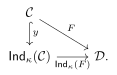
We also call $\mathsf{Ind}_{\kappa} F$ the $\mathsf{Ind}_{\kappa}$-extension of $F$. Its concrete construction is nothing but Kan extension.
Moreover, if $F$ is fully faithful and its image lands in the full subcategory of $\kappa$-compact objects $\mathcal{D}^{\kappa}$, then its $\mathsf{Ind}_{\kappa}$-extension is also fully faithful. Furthermore, if $F(\mathcal{C})$ generates $\mathcal{D}$ under $\kappa$-filtered colimits, then $\mathsf{Ind}_{\kappa}(F)$ is an equivalence of categories.
When $\mathcal{C}$ admits $\kappa$-small colimits, we can identify $\mathsf{Ind}_{\kappa}(\mathcal{C})$ as $\mathsf{Fun}^{\kappa\text{-rex}}(\mathcal{C}^{\operatorname{op}},\mathsf{An})$, that is, the category of all functors $\mathcal{C}^{\operatorname{op}} \to \mathsf{An}$ preserving $\kappa$-small limits.
Let $\mathcal{C}$ be a small category admitting $\kappa$-small colimits. Then there is an equivalence of categories
\[ \mathsf{Ind}_{\kappa}(\mathcal{C}) \simeq \mathsf{Fun}^{\kappa\text{-rex}}(\mathcal{C}^{\operatorname{op}},\mathsf{An}). \]Since limits in $\mathsf{Fun}(\mathcal{C}^{\operatorname{op}},\mathsf{An})$ are computed pointwise, and using the commutation of limits, it follows that $\mathsf{Ind}_{\kappa}(\mathcal{C})$ admits all limits.
Proof.
For $F \in \mathsf{Ind}_{\kappa}(\mathcal{C})$, we may write $F$ as a $\kappa$-filtered colimit
\[ \operatorname{colim}_i y(X_i) = \operatorname{colim}_i \operatorname{Hom}_{\mathcal{C}}(-,X_i). \]For $\kappa$-small limits in $\mathcal{C}^{\operatorname{op}}$, these are automatically $\kappa$-small colimits in $\mathcal{C}$. Using
\[ \operatorname{colim}_i \operatorname{Hom}_{\mathcal{C}}(\operatorname{colim}_j Y_j,X_i) \simeq \operatorname{colim}_i \operatorname{lim}_j \operatorname{Hom}_{\mathcal{C}}(Y_j,X_i) \]together with Proposition Proposition 2 , the claim follows.
Now let $F \colon \mathcal{C}^{\operatorname{op}} \to \mathsf{An}$ be a functor preserving $\kappa$-small limits. The Grothendieck construction $\mathsf{El}(F)$ is given by the pullback
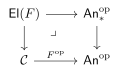
Since $F$ preserves $\kappa$-small limits, $\mathsf{El}(F)$ is a $\kappa$-filtered category. Hence $F$, as the colimit of the composite
\[ \mathsf{El}(F) \to \mathcal{C} \to \mathsf{PShv}(\mathcal{C}), \]is a $\kappa$-filtered colimit.
Let $\mathcal{C}$ be a category admitting $\kappa$-small colimits. Then
\[ y \colon \mathcal{C} \to \mathsf{PShv}(\mathcal{C}) \]preserves $\kappa$-small colimits.
Proof.
It suffices to show that for any diagram $(X_i)_i$ indexed by a $\kappa$-small category $I$, there is an equivalence in $\mathsf{Ind}_{\kappa}(\mathcal{C})$
\[ \operatorname{colim}_i y(X_i) \simeq y(\operatorname{colim}_i X_i). \]By the Yoneda lemma, this is equivalent to saying that for any $F \in \mathsf{Ind}_{\kappa}(\mathcal{C})$,
\[ \operatorname{lim}_i F(X_i) \simeq F(\operatorname{colim}_i X_i), \]which reduces to Proposition Proposition 8 .
$\square$Since any colimit can be written as a $\kappa$-filtered colimit together with a $\kappa$-small colimit, for a small category $\mathcal{C}$ admitting $\kappa$-small colimits, $\mathsf{Ind}_{\kappa}$ also yields the following universal property.
Let $\mathcal{C}$ be a small category admitting $\kappa$-small colimits. Then for any category $\mathcal{D}$ admitting small colimits, there is an equivalence of categories
\[ \mathsf{Fun}^{\operatorname{colim}}(\mathsf{Ind}_{\kappa}(\mathcal{C}),\mathcal{D}) \simeq \mathsf{Fun}^{\kappa\text{-colim}}(\mathcal{C},\mathcal{D}). \]In everyday practice, the vast majority of “large categories” we encounter can naturally be written as the Ind-completion of some small category. In other words, they are often generated by a family of “finite / compact objects” under filtered colimits.
For example:
The category of sets can be presented as
\[ \mathsf{Set} \;\simeq\; \mathsf{Ind}(\mathsf{FinSet}), \]that is, any set is a filtered colimit of finite sets.
The anima category can be presented as
\[ \mathsf{An} \;\simeq\; \mathsf{Ind}(\mathsf{An}^{\mathrm{fin}}), \]where $\mathsf{An}^{\mathrm{fin}}$ denotes the full subcategory of finite anima.
For a fixed (derived) ring $R$, the category of modules can be presented as
\[ \mathsf{Mod}_R \;\simeq\; \mathsf{Ind}(\mathsf{Perf}_R), \]that is, any $R$-module is a filtered colimit of perfect modules.
These examples show that Ind-completion is not an abstract artificial construction, but a unified language for describing “large objects generated from small data via filtered colimits”. This also leads to the notion of accessible categories.
Accessible Categories
We want to investigate the following question: which categories can be regarded as the $\mathsf{Ind}_{\kappa}$-completion of their $\kappa$-compact objects?
Let $\mathcal{C}$ be a category, and let $\kappa$ be a regular cardinal. We say that $\mathcal{C}$ is a $\kappa$-accessible category if:
- $\mathcal{C}$ admits $\kappa$-filtered colimits.
- The full subcategory $\mathcal{C}^{\kappa}$ is small.
- There is an equivalence $\mathcal{C} \simeq \mathsf{Ind}_{\kappa}(\mathcal{C}^{\kappa})$.
We say that $\mathcal{C}$ is an accessible category if there exists some $\kappa$ such that $\mathcal{C}$ is $\kappa$-accessible.
From the description of Hom anima in $\mathsf{Ind}_{\kappa}(\mathcal{C})$ above, it follows that accessible categories are locally small categories.
In fact, accessible categories can be characterized as idempotent complete categories.
Proof.
General Adjoint Functor Theorem
In [NRS18] , they prove the following theorem.
Let $F \colon \mathcal{C} \to \mathcal{D}$ be a functor between locally small categories.
Assume that $\mathcal{C}$ and $\mathcal{D}$ have all colimits and that $\mathcal{C}$ is generated under colimits by an essentially small subcategory $\mathcal{C}_0 \subset \mathcal{C}$. Then $F$ admits a right adjoint $G \colon \mathcal{D} \to \mathcal{C}$ if and only if $F$ preserves colimits.
Assume that $\mathcal{C}$ and $\mathcal{D}$ have all limits, that $\mathcal{C}$ is accessible, and that for every object $y \in \mathcal{D}$ there exists a regular cardinal $\kappa_y$ such that $y$ is $\kappa_y$-compact. If there exists a regular cardinal $\kappa$ such that $F$ preserves limits as well as $\kappa$-filtered colimits, then $F$ admits a left adjoint $G \colon \mathcal{D} \to \mathcal{C}$. The converse is true as well provided that $\mathcal{D}$ is accessible too.
Thus, one can find that in an accessible category, completeness is equivalent to cocompleteness.
Let $\mathcal C$ be a locally small category.
If $\mathcal C$ admits all small colimits and is generated under colimits by an essentially small sub-category, then $\mathcal C$ admits all small limits.
If $\mathcal C$ is accessible and admits all small limits, then $\mathcal C$ admits all small colimits.
Proof.
Let $\mathcal I$ be an essentially small category. Then $\operatorname{Fun}(\mathcal I,\mathcal C)$ is locally small, and the constant diagram functor
\[ \operatorname{const} \colon \mathcal C \longrightarrow \operatorname{Fun}(\mathcal I,\mathcal C) \]preserves all limits and colimits.
(a) If $\mathcal C$ admits all small colimits and is generated under colimits by an essentially small subcategory, then by the adjoint functor theorem, $\operatorname{const}$ admits a right adjoint
\[ \lim_{\mathcal I} \colon \operatorname{Fun}(\mathcal I,\mathcal C) \to \mathcal C. \]Since $\mathcal I$ was arbitrary, $\mathcal C$ admits all small limits.
(b) Assume that $\mathcal C$ is accessible and admits all small limits. We show that $\operatorname{const}$ admits a left adjoint
\[ \operatorname{colim}_{\mathcal I} \colon \operatorname{Fun}(\mathcal I,\mathcal C) \to \mathcal C. \]By accessibility, every object of $\mathcal C$ is $\kappa$-compact for some regular cardinal $\kappa$. For any functor $\alpha \colon \mathcal I \to \mathcal C$, choose a sufficiently large regular cardinal $\tau$ such that $\mathcal I$ is $\tau$-small and each value $\alpha(i)$ is $\tau$-compact.
Using that $\tau$-small limits commute with $\tau$-filtered colimits, and that colimits in functor categories are computed pointwise, it follows that $\alpha$ is $\tau$-compact. Hence $\operatorname{Fun}(\mathcal I,\mathcal C)$ is generated under filtered colimits by compact objects, and the adjoint functor theorem implies that $\operatorname{const}$ admits a left adjoint. Therefore $\mathcal C$ admits all small colimits.
$\square$Presentable Categories
Now, we discuss presentable categories.
Let $\mathcal{C}$ be a category and let $\kappa$ be a regular cardinal. We say that $\mathcal{C}$ is $\kappa$-presentable (or $\kappa$-compactly generated) if:
- $\mathcal{C}$ is $\kappa$-accessible.
- $\mathcal{C}$ admits small limits.
We say that $\mathcal{C}$ is presentable if there exists some $\kappa$ such that $\mathcal{C}$ is $\kappa$-presentable. In particular, when $\kappa = \omega$, we say that $\mathcal{C}$ is compactly generated.
Let $\mathcal{C}$ be an idempotent complete category. For a regular cardinal $\kappa$, the following are equivalent:
- $\mathcal{C}$ admits $\kappa$-small colimits.
- $i \colon \mathcal{C} \hookrightarrow \mathsf{PShv}(\mathcal{C})^{\kappa}$ admits a left adjoint $L$.
Proof.
- Suppose that $\mathcal{C}$ admits $\kappa$-small colimits. We need to show that the copresheaf $\operatorname{Hom}_{\mathsf{PShv}(\mathcal{C})}(\mathcal{F},y)$ on $\mathcal{C}$ is corepresentable for every $\mathcal{F} \in \mathsf{PShv}(\mathcal{C})^{\kappa}$. By Proposition 4 , there exists a functor $p \colon K \to \mathcal{C}$ such that $\mathcal{F}$ is a retract of $\psi = \operatorname{colim} y \circ p$. Observe that by the Yoneda lemma, we have an isomorphism \[ \operatorname{Hom}_{\mathsf{PShv}(\mathcal{C})}(\psi,y(-)) \simeq \operatorname{lim}_{K^{\operatorname{op}}}\operatorname{Hom}_{\mathcal{C}}(p,-) \simeq \operatorname{Hom}_{\mathcal{C}}(\operatorname{colim} p,-). \] Since $\mathcal{C}$ is idempotent complete, it then follows that the original copresheaf is corepresented by a retract of $\operatorname{colim} p$.
- Now, suppose 2. is satisfied, so $i \colon \mathcal{C} \to \mathsf{PShv}(\mathcal{C})^{\kappa}$ admits a left adjoint $L$. For a diagram $p \colon K \to \mathcal{C}$, we know that $i \circ p$ admits a colimit in $\mathsf{PShv}(\mathcal{C})^{\kappa}$, since $L$ is a Bousfield localization, $p$ has a colimit in $\mathcal{C}$.
Suppose that we have an adjunction $f \dashv g$. Then we can get an adjunction $g^{\operatorname{op}} \dashv f^{\operatorname{op}}$ (Since $(-)^{\operatorname{op}}$ is a 2-functor and 2-functors preserve adjunctions), and so an adjunction $f^{\operatorname{op},*} \dashv g^{\operatorname{op},*}$. Since adjunction is unique, we have $f^{\operatorname{op},*} \simeq g^{\operatorname{op}}_!$. So that we also have
\[ f_!^{\operatorname{op}} \dashv g_!^{\operatorname{op}}. \]Here, both functors restrict to $\mathsf{Ind}_{\kappa}(-)$, then we obtain an adjunction
\[ \mathsf{Ind}_{\kappa} f \dashv \mathsf{Ind}_{\kappa} g. \]Since $\mathsf{PShv}(\mathcal{C}) \simeq \mathsf{Ind}_{\kappa}(\mathsf{PShv}(\mathcal{C})^{\kappa})$, we have an adjunction
\[ \mathsf{Ind}_{\kappa} L \dashv \mathsf{Ind}_{\kappa} i \]between $\mathsf{PShv}(\mathcal{C})$ and $\mathsf{Ind}_{\kappa}(\mathcal{C})$. One can also see that $\mathsf{Ind}_{\kappa} i$ is a fully faithful functor, thus $\mathsf{Ind}_{\kappa} L$ is still a Bousfield localization. By Proposition 8 , one can find that in this case, $\mathsf{Ind}_{\kappa}(\mathcal{C})$ is a presentable category.
We may summarize the preceding discussion in the following equivalent characterizations of presentable categories.
Let $\mathcal{C}$ be a category, the following conditions are equivalent:
- $\mathcal{C}$ is $\kappa$-presentable.
- $\mathcal{C}$ is a Bousfield localization of $\mathsf{PShv}(\mathcal{D})$ for some small category $\mathcal{D}$ with $\kappa$-small colimits.
- There exists a small category $\mathcal{D}$ with $\kappa$-small colimits such that $\mathcal{C} \simeq \mathsf{Ind}_{\kappa}(\mathcal{D})$.
- $\mathcal{C}^{\kappa}$ is small, and the $\mathsf{Ind}_{\kappa}$-extension \[ \mathsf{Ind}_{\kappa}(\mathcal{C}^{\kappa}) \to \mathcal{C} \] is an equivalence.
The preceding proposition suggests that a presentable category $\mathcal{C}$ should be regarded as generated, under all small colimits, by its $\kappa$-compact objects We now make this perspective precise.
Let $\mathcal{C}$ be a category admitting all small colimits, and assume that the full subcategory $\mathcal{C}^{\kappa}$ of $\kappa$-compact objects is small. The following conditions are equivalent:
- $\mathcal{C}$ is $\kappa$-presentable.
- Every object of $\mathcal{C}$ can be expressed as a small colimit of $\kappa$-compact objects.
Proof.
(1) $\Rightarrow$ (2). Assume that $\mathcal{C}$ is $\kappa$-presentable. By definition, the canonical functor
\[ \mathsf{Ind}_{\kappa}(\mathcal{C}^{\kappa}) \longrightarrow \mathcal{C} \]is an equivalence. In particular, it is essentially surjective.
Let $X \in \mathcal{C}$. Since $\mathcal{C}$ admits all small colimits, $X$ can be written as a small colimit
\[ X \simeq \operatorname{colim}_{K} Z_k \]of objects $Z_k \in \mathcal{C}^{\kappa}$. Any small colimit can be expressed as a $\kappa$-filtered colimit of $\kappa$-small colimits, hence we may write
\[ X \simeq \operatorname{colim}_{K' \subset K} \operatorname{colim}_{K'} Z_k, \]where $K'$ ranges over the $\kappa$-small subcategories of $K$. By Corollary 3 , each colimit $\operatorname{colim}_{K'} Z_k$ is again $\kappa$-compact. Therefore $X$ is a $\kappa$-filtered colimit of $\kappa$-compact objects, and hence lies in the essential image of $\mathsf{Ind}_{\kappa}(\mathcal{C}^{\kappa})$.
(2) $\Rightarrow$ (1). Assume that every object of $\mathcal{C}$ can be expressed as a small colimit of $\kappa$-compact objects. Then, in particular, every object of $\mathcal{C}$ is a $\kappa$-filtered colimit of objects of $\mathcal{C}^{\kappa}$. It follows that the canonical functor
\[ \mathsf{Ind}_{\kappa}(\mathcal{C}^{\kappa}) \longrightarrow \mathcal{C} \]is essentially surjective. Since it is fully faithful, it is an equivalence, and therefore $\mathcal{C}$ is $\kappa$-presentable.
$\square$In presentable category, Theorem 14 admits a substantially simpler formulation.
Let $\mathcal C$ and $\mathcal D$ be presentable categories, and let $F \colon \mathcal C \to \mathcal D$ be a functor.
The functor $F$ admits a right adjoint if and only if it preserves all small colimits.
The functor $F$ admits a left adjoint if and only if it preserves all small limits, and there exists a regular cardinal $\kappa$ such that $F$ preserves $\kappa$-filtered colimits.
The Category of Presentable Categories
Now, we define the category of presentable categories.
Let $\mathsf{Pr}^L$ be the category whose objects are presentable categories and whose morphisms are colimit-preserving functors.
For a regular cardinal $\kappa$, let $\mathsf{Pr}^{L}_{\kappa} \subset \mathsf{Pr}^L$ denote the non-full subcategory whose objects are $\kappa$-presentable categories and whose morphisms are those colimit-preserving functors that additionally preserve $\kappa$-compact objects.
Every presentable category is necessarily a big category. Consequently, the category $\mathsf{Pr}^L$ of all presentable categories is a very big category.
Nevertheless, a presentable category $\mathcal C$ admits a presentation by a pair $(\kappa, \mathcal C^{\kappa})$, consisting of a regular cardinal $\kappa$ and a small category $\mathcal C^{\kappa}$ of $\kappa$-compact objects. From this point of view, $\mathsf{Pr}^L$ may be regarded as a big category, in the sense that its objects can be encoded by small data.
Despite this, $\mathsf{Pr}^L$ is not locally small. Indeed, for any $\mathcal C \in \mathsf{Pr}^L$, one has
\[ \operatorname{Hom}_{\mathsf{Pr}^L}(\mathsf{An}, \mathcal C) \simeq \mathcal C, \]since $\mathsf{An}$ is the free presentable category generated by a single object, and $\mathcal C$ itself is large.
By contrast, the category $\mathsf{Pr}^{L}_{\kappa}$ is locally small. Indeed, by definition of morphisms in $\mathsf{Pr}^{L}_{\kappa}$, any functor $\mathsf{An} \to \mathcal C$ must preserve $\kappa$-compact objects, and hence factors through the small category $\mathcal C^{\kappa}$. As a result,
\[ \operatorname{Hom}_{\mathsf{Pr}^{L}_{\kappa}}(\mathsf{An}, \mathcal C) \simeq \mathcal C^{\kappa}. \]Thus, we consider the category $\mathsf{Rex}_{\kappa}$ defined as follows:
- the objects of $\mathsf{Rex}_{\kappa}$ are small categories $\mathcal D$ admitting all $\kappa$-small colimits and closed under retracts;
- the morphisms of $\mathsf{Rex}_{\kappa}$ are functors preserving $\kappa$-small colimits.
There is an equivalence
\[ \mathsf{Pr}_{\kappa}^L \simeq \mathsf{Rex}_{\kappa}, \]sending a $\kappa$-presentable category $\mathcal C$ to its full subcategory $\mathcal C^{\kappa}$ of $\kappa$-compact objects, and sending $\mathcal D \in \mathsf{Rex}_{\kappa}$ to $\mathsf{Ind}_{\kappa}(\mathcal D)$. This equivalence is known as Gabriel–Ulmer duality [HTT, Proposition 5.5.7.8 and Proposition 5.5.7.10] .
We see that $\mathsf{Pr}^L$ is too large to be an object of itself—it is not even locally small. However, after fixing a regular cardinal $\kappa$, the situation improves substantially.
Let $\kappa$ be a regular cardinal. Then the category $\mathsf{Pr}^{L}_{\kappa}$ is itself $\kappa$-presentable; in particular,
\[ \mathsf{Pr}^{L}_{\kappa} \in \mathsf{Pr}^{L}_{\kappa}. \]Proof.
By Gabriel–Ulmer duality, we may identify $\mathsf{Pr}_{\kappa}^L$ with $\mathsf{Rex}_{\kappa}$. It therefore suffices to show that $\mathsf{Rex}_{\kappa}$ is $\kappa$-presentable.
First, by the remark above, $\mathsf{Rex}_{\kappa}$ is locally small. Consider the forgetful functor
\[ G \colon \mathsf{Rex}_{\kappa} \longrightarrow \mathsf{Cat}. \]This functor admits a left adjoint
\[ F \colon \mathsf{Cat} \longrightarrow \mathsf{Rex}_{\kappa}, \qquad F(S) = \mathsf{PShv}(S)^{\kappa}. \]We claim that the adjunction $F \dashv G$ is monadic, so that $\mathsf{Rex}_{\kappa}$ is equivalent to the category of algebras over the monad $GF$ on $\mathsf{Cat}$. By the Barr–Beck–Lurie theorem, it suffices to verify the following conditions: \begin{itemize}
- the functor $G$ is conservative;
- $G$ preserves geometric realizations of $G$-split simplicial objects.
The first condition is immediate. For the second, let $\mathcal C_\bullet$ be a simplicial object of $\mathsf{Rex}_{\kappa}$ whose geometric realization $\mathcal C_{-1}$ exists in $\mathsf{Cat}$, and assume that the augmentation $\mathcal C_\bullet \to \mathcal C_{-1}$ is split in $\mathsf{Cat}$. Then for any $\kappa$-small category $I$, the induced morphism
\[ \mathsf{Fun}(I, \mathcal C_\bullet) \longrightarrow \mathsf{Fun}(I, \mathcal C_{-1}) \]is again a geometric realization in $\mathsf{Cat}$. Applying this observation to $I$ and to its right cone $I^{\rhd}$, one readily verifies that $G$ preserves the required geometric realizations.
Thus, $\mathsf{Rex}_{\kappa}$ is monadic over $\mathsf{Cat}$ and in particular admits all small colimits. Since $\mathsf{Cat}$ is compactly generated by the finite ordinal categories $[n]$ (and hence $\kappa$-compactly generated), it remains to observe that the functor $F$ preserves $\kappa$-compact objects. Equivalently, the right adjoint $G$ preserves $\kappa$-filtered colimits, which follows from [HTT, Proposition 5.5.7.11] .
$\square$It naturally leads to a question:
Given that $\mathsf{Pr}_{\kappa}^L$ is $\kappa$-presentable, it has a large subcategory $(\mathsf{Pr}_{\kappa}^L)^{\kappa}$ of $\kappa$-compact objects. Is it, in fact, a $\kappa$-compact object of itself, i.e.
\[ \mathsf{Pr}_{\kappa}^L \in (\mathsf{Pr}_{\kappa}^L)^{\kappa}? \]
This is not full truth.
Colimits and Limits in $\mathsf{Pr}^L$
By Theorem 20 , one obtains the following result. We say a functor $F$ is accessible if there is some $\kappa$ such that $F$ commutes with $\kappa$-filtered colimits.
Let $\mathsf{Pr}^R$ be the category whose objects are presentable categories and morphisms are accessible functors that commute with all limits. Then there is an equivalence
\[ (\mathsf{Pr}^L)^{\operatorname{op}} \simeq \mathsf{Pr}^R \]giving by passing to adjoint functors.
Similarly, let $\mathsf{Pr}^R_{\kappa}$ be the category whose objects are $\kappa$-presentable categories and morphisms are functors commute with $\kappa$-filtered colimits and all small limits. Then the above equivalence restricts to an equivalence
\[ (\mathsf{Pr}^L_{\kappa})^{\operatorname{op}} \simeq \mathsf{Pr}_{\kappa}^R. \]Next, we will discuss various operations within $\mathsf{Pr}^L$.
- $\mathsf{Pr}^L$ admits all small limits, and the forgetful functor \[ \mathsf{Pr}^L \to \widehat{\mathsf{Cat}} \] preserves small limits.
- Similarly, for regular cardinal $\kappa$, $\mathsf{Pr}_{\kappa}^L$ admits all small limits, and the composite $\mathsf{Pr}_{\kappa}^L \simeq \mathsf{Rex}_{\kappa} \to \mathsf{Cat}$ preserves small limits.
- If $\kappa$ is uncountable, the inclusion $\mathsf{Pr}_{\kappa}^L \hookrightarrow \mathsf{Pr}^L$ preserves $\kappa$-small limits.
- $\mathsf{Pr}^R$ admits all small limits, and the forgetful functor \[ \mathsf{Pr}^R \to \widehat{\mathsf{Cat}} \] preserves small limits.
- Similarly, for regular cardinal $\kappa$, $\mathsf{Pr}_{\kappa}^R$ admits all small limits.
- The inclusion $\mathsf{Pr}_{\kappa}^R \hookrightarrow \mathsf{Pr}^R$ preserves all small limits.
Let us compute some examples.
- Let $I$ be a set, and let $\mathcal{C}_i \in \mathsf{Pr}^L$ be presentable categories, then the product of $\mathcal{C}_i$ in $\mathsf{Pr}^L$ agrees with the naive product $\prod_{i \in I}\mathcal{C}_i$.
- Let $I$ be a set, and let $\mathcal{C}_i \in \mathsf{Pr}^L$ be presentable categories, then the coproduct of $\mathcal{C}_i$ in $\mathsf{Pr}^L$ agrees with the naive product $\prod_{i \in I}\mathcal{C}_i$ (by passing to adjoint functor), which means \[ \coprod_{i}^{\mathsf{Pr}^L} \mathcal{C}_i \to \prod_{i}^{\mathsf{Pr}^L} \mathcal{C}_i = \prod_i \mathcal{C}_i \] is an equivalence. In other words, $\mathsf{Pr}^L$ is $\kappa$-semiadditive for all cardinal $\kappa$.
- Let $S$ be a small category. Then we can form the free presentable category $\langle S \rangle_{\text{pres}} \coloneqq \mathsf{PShv}(S)$. This can also be seen as an instance of colimits (or free constructions) in $\mathsf{Pr}^L$ agreeing with limits (or cofree construction). Indeed, giving any presentable category $\mathcal{C}$ with a functor $i \colon S \to \mathcal{C}$, we get a functor $\mathcal{C} \to \mathsf{PShv}(S)$ via $X \mapsto \left(T \mapsto \operatorname{Hom}_{\mathcal{C}}(i(T),X)\right)$. This functor commutes with all limits and is accessible, thus a left adjoint $\mathsf{PShv}(S) \to \mathcal{C}$, extending the giving functor $i$.
Lurie Tensor Product
In this section, we will introduce the symmetric monoidal structure on $\mathsf{Pr}^L$, in fact, we will find that we have the following table of vague analogies
| Linear algebra | Presentable category theory |
|---|---|
| ring | $\mathsf{An}$ |
| module | presentable category |
| linear map | colimit-preserving functor |
| bilinear map | functor preserving colimits in each variable |
| tensor product $\otimes$ | Lurie tensor product $\otimes$ in $\mathsf{Pr}^L$ |
Let $\mathcal{C}$ and $\mathcal{D}$ be presentable categories. There is a universal presentable category $\mathcal{C} \otimes \mathcal{D}$ equipped with functor
\[ \mathcal{C} \times \mathcal{D} \to \mathcal{C} \otimes \mathcal{D} \]that commutes with small colimits in each variable. If $\mathcal{C}$ and $\mathcal{D}$ are $\kappa$-presentable, then $\mathcal{C} \otimes \mathcal{D}$ are $\kappa$-presentable, and $\mathcal{C} \times \mathcal{D} \to \mathcal{C} \otimes \mathcal{D}$ preserves $\kappa$-compact objects. This endows $\mathsf{Pr}^L$ and $\mathsf{Pr}_{\kappa}^L$ with compactible symmetric monoidal structres, with unit object $\mathsf{An}$. This symmetric monoidal structure is called Lurie tensor product.
sketch of construction.
It suffices to prove existence. By Theorem 18 , one can choose small categories $S$ and $T$ such that
\[ \mathcal{C} = \langle S \rangle_{\text{pres}}[R^{-1}] \quad \text{and} \quad \mathcal{D} = \langle T \rangle_{\text{pres}}[Q^{-1}]. \]Then it is easy to see that
\[ \mathcal{C} \otimes \mathcal{D} \coloneqq \langle S \times T \rangle_{\text{pres}}[(R \times Q)^{-1}] \] $\square$By construction of $\mathcal{C} \otimes \mathcal{D}$, one can easily find that for small category $\mathcal{C}$, we have
\[ \mathsf{PShv}(\mathcal{C}) \otimes \mathcal{D} \simeq \mathsf{Fun}(\mathcal{C}^{\operatorname{op}},\mathcal{D}) \]Now, one can introduce the notion of a symmetric monoidal presentable category.
- A presentable symmetric monoidal category is a commutative algebra object in $\mathsf{Pr}^L$ with respect to the Lurie tensor product.
- A $\kappa$-presentable symmetric monoidal category is a commutative algebra object in $\mathsf{Pr}^L_{\kappa}$ with respect to the Lurie tensor product.
In other words, if $\mathcal{C}$ is a $\kappa$-presentable symmetric monoidal category, then its tensor product commutes with colimits in each variable, preserves $\kappa$-compact objects, and its unit object is $\kappa$-compact.