Stefanich Rings
In the last note, we define
\[ n\mathsf{Pr} \coloneqq \mathsf{Mod}_{(n-1)\mathsf{Pr}}(1\mathsf{Pr}), \qquad 1\mathsf{Pr} \coloneqq \mathsf{Pr}_{\aleph_1}^{L}. \]Now, we let $0\mathsf{Pr} \coloneqq \mathsf{An}$.
Since we have
\[ \mathsf{CAlg}(\mathcal{C}) \hookrightarrow \mathsf{CAlg}(\mathsf{Mod}_{\mathcal{C}}(\mathsf{Pr}_{\aleph_1}^L)), \quad A \mapsto \mathsf{Mod}_A(\mathcal{C}), \]and $1\mathsf{Pr} \in \mathsf{Pr}_{\aleph_1}^L$, we obtain a sequence
\[ \mathsf{CAlg}(0\mathsf{Pr}) \hookrightarrow \mathsf{CAlg}(1\mathsf{Pr}) \hookrightarrow \cdots \hookrightarrow \mathsf{CAlg}(n\mathsf{Pr}) \hookrightarrow \cdots . \]In Presentable Categories, we know that $1\mathsf{Pr}$ admits all small colimits, which can be computed in $\widehat{\mathsf{Cat}}$ by passing to adjoint functors. Thus, we obtain the following definition.
The $\aleph_1$-presentable category $\mathsf{StRing}$ of Stefanich rings is
\[ \begin{aligned} \mathsf{StRing} &= \operatorname{colim}_{1\mathsf{Pr}} \bigl( \mathsf{CAlg}(\mathsf{An}) \hookrightarrow \mathsf{CAlg}(1\mathsf{Pr}) \hookrightarrow \cdots \bigr) \\ &= \operatorname{lim}_{\widehat{\mathsf{Cat}}} \bigl( \mathsf{CAlg}(\mathsf{An}) \xleftarrow{\mathsf{End}_{(-)}(1)} \mathsf{CAlg}(1\mathsf{Pr}) \xleftarrow{\mathsf{End}_{(-)}(1)} \cdots \bigr). \end{aligned} \]We often write $A = (A_0, A_1, \dots) \in \mathsf{StRing}$, where $A_n \in \mathsf{CAlg}(n\mathsf{Pr})$ and $A_{n} \simeq \mathsf{End}_{A_{n+1}}(1)$.
Stefanich rings are also known as $\aleph_1$-compactly generated categorical spectra, originally introduced by [ACS, Remark 3.3.6] .
In [Aok25] , the author uses $\mathsf{PrSp}^{\aleph_1}$ to denote the category of Stefanich rings, and also considers the construction
\[ \mathsf{PrSp} \coloneqq \operatorname{colim}_{\kappa} \mathsf{PrSp}^{\kappa}. \]Unfortunately, this notion is no longer stable: as shown in [Aok25, Theorem C] , there exists an object which is not given by a sequence $(A_n)_n \in \prod_{n} \mathsf{CAlg}(n\mathsf{Pr}^L)$, where $n\mathsf{Pr}^L \coloneqq \operatorname{colim}_{\kappa} n\mathsf{Pr}^{L}_{\kappa}$.
The unit object in $\mathsf{StRing}$ is given by $(*,\mathsf{Ani},1\mathsf{Pr},\cdots)$. Consequently, any Stefanich ring $A$ is equipped with compatible symmetric monoidal maps $(n-1)\mathsf{Pr} \to A_n$. This map admits a lax symmetric monoidal right adjoint, which induces a forgetful functor
$$ \mathsf{CAlg}(A_n) \to \mathsf{CAlg}((n-1)\mathsf{Pr}), $$allowing us to regard an $A_n$-algebra as a $(n-1)\mathsf{Pr}$-algebra. For $n \geq 1$, these structures naturally arise from the identification
$$ A_n \in \mathsf{CAlg}(n\mathsf{Pr}) \simeq \mathsf{CAlg}\bigl(\mathsf{Mod}_{(n-1)\mathsf{Pr}}(1\mathsf{Pr})\bigr). $$A morphism $f \colon A \to B$ of Stefanich rings consists of compatible maps $f_{n-1}^* \colon A_n \to B_n$ in $\mathsf{CAlg}(n\mathsf{Pr})$ for all $n \geq 1$. Since $f_{n-1}^*$ is a morphism in $1\mathsf{Pr}$, it admits a lax symmetric monoidal right adjoint $f_{n-1,*} \colon B_n \to A_n$, which induces a functor
$$ f_{n-1,*} \colon \mathsf{CAlg}(B_n) \to \mathsf{CAlg}(A_n). $$In particular, the unit $\mathbb{1}_{B_n} \in \mathsf{CAlg}(B_n)$ determines a commutative algebra
$$ (B/A)_{n-1} \coloneqq f_{n-1,*}(\mathbb{1}_{B_n}) \in \mathsf{CAlg}(A_n). $$Under the forgetful functor $\mathsf{CAlg}(A_n) \to \mathsf{CAlg}((n-1)\mathsf{Pr})$, this object maps to $B_{n-1} \in \mathsf{CAlg}((n-1)\mathsf{Pr})$. Thus, any $A$-Stefanich algebra $B$ determines a sequence $\bigl((B/A)_0, (B/A)_1, \ldots\bigr)$.
To make this precise, we introduce the following adjunctions. For each $n \geq 0$, there is an adjunction
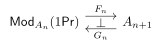
where $G_n(X) \coloneqq \underline{\mathsf{Hom}}_{A_{n+1}}(\mathbb{1}_{A_{n+1}}, X)$. By definition of a Stefanich ring, there is a canonical equivalence
$$ A_n \xrightarrow{\sim} G_n(\mathbb{1}_{A_{n+1}}) = \mathsf{End}_{A_{n+1}}(\mathbb{1}_{A_{n+1}}). $$Let $A$ be a Stefanich ring. There are equivalences of categories
$$ \begin{align*} \mathsf{StRing}_{A/} &\simeq \operatorname{lim}_{\widehat{\mathsf{Cat}}} \Bigl( \mathsf{CAlg}(A_1) \xleftarrow{\;\mathsf{End}_{G_1(-)}(\mathbb{1})\;} \mathsf{CAlg}(A_2) \xleftarrow{\;\mathsf{End}_{G_2(-)}(\mathbb{1})\;} \cdots \Bigr)\\ &\simeq \operatorname{colim}_{1\mathsf{Pr}} \Bigl( \mathsf{CAlg}(A_1) \xrightarrow{\;F_1(\mathsf{Mod}_{(-)}(A_1))\;} \mathsf{CAlg}(A_2) \xrightarrow{\;F_2(\mathsf{Mod}_{(-)}(A_2))\;} \cdots \Bigr). \end{align*} $$Furthermore, for each $n \geq 0$, the structure map from the $(n{+}1)$-th term of the colimit defines a fully faithful embedding
$$ \operatorname{Spec}_n \colon \mathsf{CAlg}(A_{n+1}) \hookrightarrow \mathsf{StRing}_{A/}, $$whose right adjoint
$$ \Gamma_n \colon \mathsf{StRing}_{A/} \to \mathsf{CAlg}(A_{n+1}), \qquad B \longmapsto (B/A)_n $$recovers the $(n{+}1)$-th component of the limit.
Proof.
Step 1: Limit description.
Since $\mathsf{StRing}$ is defined as a limit in $\widehat{\mathsf{Cat}}$, the slice $\mathsf{StRing}_{A/}$ is the limit of the corresponding slices at each level. Lurie’s identification $\mathsf{CAlg}(n\mathsf{Pr})_{A_n/} \simeq \mathsf{CAlg}(\mathsf{Mod}_{A_n}(1\mathsf{Pr}))$ gives
$$ \mathsf{StRing}_{A/} \simeq \operatorname{lim}_{\widehat{\mathsf{Cat}}} \Bigl( \cdots \to \mathsf{CAlg}(\mathsf{Mod}_{A_{n+1}}(1\mathsf{Pr})) \xrightarrow{T_n} \mathsf{CAlg}(\mathsf{Mod}_{A_n}(1\mathsf{Pr})) \to \cdots \Bigr). $$One checks that each $T_n$ factors through $\mathsf{CAlg}(A_{n+1})$ via
$$ \mathsf{CAlg}(\mathsf{Mod}_{A_{n+1}}(1\mathsf{Pr})) \xrightarrow{\mathsf{End}_{(-)}(\mathbb{1}_{A_{n+1}})} \mathsf{CAlg}(A_{n+1}) \xrightarrow{G_n^*} \mathsf{CAlg}(\mathsf{Mod}_{A_n}(1\mathsf{Pr})), $$so inserting the intermediate terms $\mathsf{CAlg}(A_{n+1})$ does not change the limit.
Step 2: Colimit description.
The transition functors $\mathsf{End}_{G_n(-)}(\mathbb{1}) \colon \mathsf{CAlg}(A_{n+1}) \to \mathsf{CAlg}(A_n)$ preserve limits and $\aleph_1$-filtered colimits, hence lie in $\mathsf{Pr}^R_{\aleph_1}$. Under the equivalence $(\mathsf{Pr}^L_{\aleph_1})^{\mathrm{op}} \simeq \mathsf{Pr}^R_{\aleph_1}$, the limit of these right adjoints corresponds to the colimit of their left adjoints $R \mapsto F_n(\mathsf{Mod}_R(A_n))$ in $1\mathsf{Pr}$.
Step 3: Full faithfulness of $\operatorname{Spec}_n$.
It suffices to show that each transition functor $R \mapsto F_n(\mathsf{Mod}_R(A_n))$ is fully faithful, i.e.\ that the unit $R \to \mathsf{End}_{G_n(F_n(\mathsf{Mod}_R(A_n)))}(\mathbb{1}_{A_n})$ is an equivalence. Since $\mathsf{Mod}_R(A_n)$ is generated by $A_n$ with $\mathsf{End}_{\mathsf{Mod}_R(A_n)}(A_n) \simeq R$, and since $F_n$ is symmetric monoidal and maps $A_n$ to $\mathbb{1}_{A_{n+1}}$, we get
$$ \mathsf{End}_{G_n(F_n(\mathsf{Mod}_R(A_n)))}(\mathbb{1}_{A_n}) \simeq \mathsf{End}_{F_n(\mathsf{Mod}_R(A_n))}(\mathbb{1}_{A_{n+1}}) \simeq R. $$Since $\mathsf{StRing}_{A/}$ is the colimit of these fully faithful embeddings, each structure map $\operatorname{Spec}_n$ is fully faithful.
$\square$The notation is motivated by the geometric picture. On the level of Gestalten $\mathsf{Gest} = \mathsf{StRing}^{\mathrm{op}}$, the induced functor $\mathsf{CAlg}(A_{n+1})^{\mathrm{op}} \to \mathsf{Gest}_{/X}$ is a relative $\operatorname{Spec}$ at the $n$-th categorical level, and $\Gamma_n$ extracts the ``$n$-th level global sections’’. We write $\operatorname{Spec}_n$ on the ring side (strictly speaking $\operatorname{Spec}_n^{\mathrm{op}}$) for brevity.
The transition functors appearing in the colimit and limit descriptions of Proposition 2 are then expressed as composites:
$$ R \mapsto F_n(\mathsf{Mod}_R(A_n)) \quad\text{is}\quad \Gamma_n \circ \operatorname{Spec}_{n-1}, \qquad B \mapsto \mathsf{End}_{G_n(B)}(\mathbb{1}_{A_n}) \quad\text{is}\quad \Gamma_{n-1} \circ \operatorname{Spec}_n. $$Here $\Gamma_n \circ \operatorname{Spec}_{n-1}$ takes the $(n{-}1)$-affine approximation and extracts its $n$-th level data, while $\Gamma_{n-1} \circ \operatorname{Spec}_n$ forgets down one categorical level.
Proof.
Since $F_n$ preserves colimits and $G_n$ preserves $\aleph_1$-filtered colimits, it suffices to treat dualizable objects. For dualizable $X, Y$, we compute
$$ \operatorname{Hom}_{A_{n+1}}(F_n X, F_n Y) \simeq \operatorname{Hom}_{A_{n+1}}(F_n(X \otimes Y^\vee), \mathbb{1}_{A_{n+1}}) \simeq \operatorname{Hom}_{\mathsf{Mod}_{A_n}(1\mathsf{Pr})} (X \otimes Y^\vee, G_n(\mathbb{1}_{A_{n+1}})). $$By the defining equivalence $G_n(\mathbb{1}_{A_{n+1}}) \simeq \mathbb{1}_{A_n}$, this becomes
$$ \operatorname{Hom}_{\mathsf{Mod}_{A_n}(1\mathsf{Pr})} (X \otimes Y^\vee, \mathbb{1}_{A_n}) \simeq \operatorname{Hom}_{\mathsf{Mod}_{A_n}(1\mathsf{Pr})}(X, Y), $$which proves full faithfulness.
$\square$Shifting
For any Stefanich ring $A = (A_0, A_1, A_2, \ldots)$, the shifted sequence $(A_1, A_2, A_3, \ldots)$ is again a Stefanich ring: the defining equivalences $A_n \simeq \mathsf{End}_{A_{n+1}}(\mathbb{1})$ simply shift their indices. This gives a shifting functor on $\mathsf{StRing}$, which turns out to be an equivalence.
The shifting functor $(A_0, A_1, A_2, \ldots) \mapsto (A_1, A_2, A_3, \ldots)$ induces an equivalence
$$ \mathsf{StRing} \xrightarrow{\;\sim\;} \mathsf{StRing}_{(1\mathsf{Pr},\, 2\mathsf{Pr},\, \ldots)/}. $$More generally, shifting $n$ times yields an equivalence $\mathsf{StRing} \simeq \mathsf{StRing}_{(n\mathsf{Pr},\, (n+1)\mathsf{Pr},\, \ldots)/}$.
Proof.
This follows from the identification
$$ \mathsf{CAlg}((n+1)\mathsf{Pr}) = \mathsf{CAlg}\bigl(\mathsf{Mod}_{n\mathsf{Pr}}(1\mathsf{Pr})\bigr) = \mathsf{CAlg}(1\mathsf{Pr})_{n\mathsf{Pr}/}. $$Since also $\mathsf{CAlg}(n\mathsf{Pr}) = \mathsf{CAlg}(1\mathsf{Pr})_{(n-1)\mathsf{Pr}/}$, the slice over $n\mathsf{Pr}$ gives
$$ \mathsf{CAlg}(n\mathsf{Pr})_{n\mathsf{Pr}/} = \bigl(\mathsf{CAlg}(1\mathsf{Pr})_{(n-1)\mathsf{Pr}/}\bigr)_{n\mathsf{Pr}/} = \mathsf{CAlg}(1\mathsf{Pr})_{n\mathsf{Pr}/} = \mathsf{CAlg}((n+1)\mathsf{Pr}), $$which is exactly the transition in the colimit defining $\mathsf{StRing}$, but based at $n\mathsf{Pr}$ instead of $0\mathsf{Pr}$.
$\square$The shifting operation has no known geometric or intuitive meaning. Its very existence is tied to our choice of foundations: it is not a priori clear that a functor $2\mathsf{Pr} \to 1\mathsf{Pr}$ should exist, and the construction is not compatible with changing the cutoff cardinal $\kappa$ (which we fixed to be $\aleph_1$). Had we worked stably, i.e.\ over the base $S = (D(\mathbb{S}), 1\mathsf{Pr}_{\mathrm{st}}, \ldots)$, the shifting operation would not be available.
Nonetheless, shifting is extremely useful as a technical device: it allows us to assume without loss of generality that $n = 0$ in most proofs about properties of morphisms, thereby simplifying notation considerably.
Tensor products of Stefanich rings
Limits and spectrification
Limits of Stefanich rings are straightforward: they are computed levelwise. Colimits, however, are more subtle. If one forms the colimit at each level separately, the result is a sequence $D_n \in \mathsf{CAlg}(n\mathsf{Pr})$ equipped with maps
$$ D_n \to \mathsf{End}_{D_{n+1}}(\mathbb{1}), $$but these usually fail to be equivalences, so $(D_n)_n$ is not yet a Stefanich ring. One must spectrify: universally enforce that these maps become equivalences. The terminology comes from the analogy with spectra in stable homotopy theory, where a Stefanich ring plays the role of an infinite loop space
$$ X_0 \simeq \Omega X_1 \simeq \Omega^2 X_2 \simeq \cdots $$and one similarly needs to spectrify a sequence of spaces equipped with maps $X_n \to \Omega X_{n+1}$ that are not yet equivalences.
Concretely, one replaces the sequence $(D_n)_n$ by
$$ D'_n \coloneqq \mathsf{End}_{D_{n+1}}(\mathbb{1}), $$equipped with the induced map $D_n \to D'_n$, and iterates using transfinite induction (taking filtered colimits at limit ordinal stages). Since the functor $D \mapsto \mathsf{End}_D(\mathbb{1})$ commutes with $\aleph_1$-filtered colimits, the process stabilises after $\aleph_1$ steps. By the adjoint functor theorem, this spectrification always exists.
Three perspectives on pushouts
In practice, we are mostly interested in pushouts (i.e.\ relative tensor products). Consider a pushout diagram $B \xleftarrow{f} A \xrightarrow{g} C$ of Stefanich rings. There are three equivalent ways to describe the levelwise data before spectrification.
Perspective 1 (absolute). Form the tensor product at each level:
$$ (B_0 \otimes_{A_0} C_0,\; B_1 \otimes_{A_1} C_1,\; B_2 \otimes_{A_2} C_2,\; \ldots), $$then spectrify.
Perspective 2 (relative, symmetric). Under the equivalence of Proposition 2 , form the tensor product in $\mathsf{StRing}_{A/}$:
$$ \bigl((B/A)_0 \otimes_{A_1} (C/A)_0,\; (B/A)_1 \otimes_{A_2} (C/A)_1,\; \ldots\bigr), $$then spectrify.
Perspective 3 (relative, base change). Think of $B \otimes_A C$ as the image of $B \in \mathsf{StRing}_{A/}$ under the base change functor $g^* \colon \mathsf{StRing}_{A/} \to \mathsf{StRing}_{C/}$:
$$ \bigl(g^*_0(B/A)_0,\; g^*_1(B/A)_1,\; g^*_2(B/A)_2,\; \ldots\bigr), $$then spectrify.
The third perspective is the most useful for analysing morphisms: it expresses base change as a levelwise operation followed by spectrification. A key theme of the following sections is to isolate general classes of maps for which spectrification is unnecessary from some level onwards, making the tensor product computable in practice.
Affine maps
Motivation: a hierarchy of affineness
In classical algebraic geometry, an affine morphism $f \colon Y \to X$ is one for which $Y$ can be completely reconstructed from its global sections: $Y \simeq \operatorname{Spec}(\Gamma(Y, \mathcal{O}_Y))$. Translated into the language of our $\operatorname{Spec}_n \dashv \Gamma_n$ adjunction, this states that the counit map
$$ \operatorname{Spec}_0(\Gamma_0(B)) \to B $$is an equivalence. In other words, the single piece of algebraic data $(B/A)_0 \in \mathsf{CAlg}(A_1)$ is entirely sufficient to reconstruct the whole tower $B$. This is the precise formulation of 0-affineness.
Moving one level up the categorical ladder, Gaitsgory’s notion of 1-affineness asks that a prestack $\mathcal{Y}$ satisfies:
$$ \mathsf{ShvCat}(\mathcal{Y}) \simeq \mathsf{QCoh}(\mathcal{Y})\text{-}\mathsf{mod}, $$meaning the category of sheaves of categories on $\mathcal{Y}$ is fully recovered just from the monoidal DG category $\mathsf{QCoh}(\mathcal{Y})$. In our Stefanich framework, $\mathsf{ShvCat}(\mathcal{Y})$ corresponds to $1\mathsf{Pr}_\mathcal{Y}$, and the right-hand side corresponds to $\mathsf{Mod}_{D(\mathcal{Y})}(1\mathsf{Pr})$. Hence, 1-affineness is exactly the assertion that:
$$ \operatorname{Spec}_1(\Gamma_1(B)) \xrightarrow{\sim} B. $$Here, the data $(B/A)_1 \in \mathsf{CAlg}(A_2)$ — which is a commutative algebra in $1\mathsf{Pr}$-categories — is enough to determine all higher levels strictly by iteratively passing to module categories.
The overarching pattern is now crystal clear: $n$-affineness dictates that everything from the $n$-th categorical level onwards is rigidly generated by a single, pure piece of commutative algebra data at that level. This rigorously formalizes the mantra that ``everything becomes affine under sufficient categorification’’. In the context of our tensor product discussion, the $n$-affineness of $B$ over $A$ guarantees that spectrification is entirely unnecessary from level $n$ onwards.
Definition and formal properties
Let $A$ be a Stefanich ring and $n \geq 0$. An $A$-algebra $B \in \mathsf{StRing}_{A/}$ is called $n$-affine if it lies in the essential image of the fully faithful embedding
$$ \operatorname{Spec}_n \colon \mathsf{CAlg}(A_{n+1}) \hookrightarrow \mathsf{StRing}_{A/}, $$or equivalently, if the counit $\operatorname{Spec}_n(\Gamma_n(B)) \xrightarrow{\sim} B$ is an equivalence.
Let $A$ be a Stefanich ring and $n \geq 0$. The class of $n$-affine $B \in \mathsf{StRing}_{A/}$ is stable under all small colimits. Moreover:
If $B$ is $n$-affine over $A$, then for all $m \geq n$ the canonical functor
$$ \mathsf{Mod}_{(B/A)_m}(A_{m+1}) \to B_{m+1} $$is an equivalence. Here, the functor is the composite $\mathsf{Mod}_{(B/A)_m}(A_{m+1}) \hookrightarrow \mathsf{Mod}_{A_{m+1}}(1\mathsf{Pr}) \xrightarrow{F_{m+1}} A_{m+2}$, which is fully faithful on ($\aleph_1$-filtered colimits of) dualizable objects by Lemma 3 .
(Base change.) If $g \colon A \to C$ is any map of Stefanich rings and $B$ is $n$-affine over $A$, then $g^*B = B \otimes_A C$ is $n$-affine over $C$, and for all $m \geq n$,
$$ g^*_m(B/A)_m \xrightarrow{\;\sim\;} (B \otimes_A C / C)_m. $$(Composition.) For composable maps $f \colon A \to B$ and $g \colon B \to C$ with $f$ being $n$-affine, $g$ is $n$-affine if and only if $g \circ f$ is $n$-affine.
In particular, $n$-affine maps are stable under composition, base change, and passage to diagonals.
Proof.
Stability under small colimits is clear, as $\operatorname{Spec}_n \colon \mathsf{CAlg}(A_{n+1}) \to \mathsf{StRing}_{A/}$ preserves small colimits.
Part (1). If $B$ is $n$-affine, then for all $m \geq n$, $(B/A)_{m+1}$ is by construction the image of $\mathsf{Mod}_{(B/A)_m}(A_{m+1})$ under $F_{m+1} \colon \mathsf{Mod}_{A_{m+1}}(1\mathsf{Pr}) \to A_{m+2}$. By Lemma 3 , the functor $F_{m+1}$ is fully faithful on the subcategory containing $\mathsf{Mod}_{(B/A)_m}(A_{m+1})$ (which is an $\aleph_1$-filtered colimit of dualizables — indeed, $\mathsf{Mod}_R(A_{m+1})$ is dualizable whenever $R \in \mathsf{CAlg}(A_{m+1})$ is countably presented). Thus the underlying category is unchanged, giving $B_{m+1} \simeq \mathsf{Mod}_{(B/A)_m}(A_{m+1})$.
Part (2). This follows from the commutative diagram
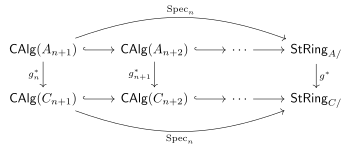
which is assembled from two squares: (i) the assertion that module categories base change, i.e.\ the square involving $\mathsf{CAlg}(A_{n+1}) \to \mathsf{CAlg}(\mathsf{Mod}_{A_{n+1}}(1\mathsf{Pr}))$ and its $C$-analogue; and (ii) the square involving $\mathsf{Mod}_{A_{n+1}}(1\mathsf{Pr}) \to A_{n+2}$ and its $C$-analogue, whose commutativity follows from the datum of the map $g$ of Stefanich rings.
Part (3). If $B$ is $n$-affine over $A$, then $\mathsf{StRing}_{B/}$ maps isomorphically to
$$ \mathsf{StRing}_{A/} \times_{\mathsf{CAlg}(A_{n+1})} \mathsf{CAlg}(A_{n+1})_{(B/A)_n/}. $$In other words, a $B$-algebra $C$ is fully determined by the map $A \to C$ plus a map $(B/A)_n \to (C/A)_n$ in $\mathsf{CAlg}(A_{n+1})$. By part (1), the category of $n$-affine $C$ over $B$ is $\mathsf{CAlg}(B_{n+1})$, while the category of $B$-algebras $C$ that are $n$-affine over $A$ is $\mathsf{CAlg}(A_{n+1})_{(B/A)_n/}$, and these are equivalent.
$\square$Affineness as a condition on maps
Warning. The converse to condition (1) is violently false. Consider the map $f \colon * \to B^2\mathbb{G}_m$ over a field $k$, and let $A \to B$ be the corresponding map of Stefanich rings. Because $f$ is a torsor for a 1-stack, it is 1-affine, so condition (1) holds perfectly for $m \geq 1$.
Dangerously, condition (1) also appears to hold for $m = 0$. By standard pulling back, we have $A_1 = B_1 = D(k)$, and the relative global sections give $(B/A)_0 = k$. Consequently, the external equivalence holds: $\mathsf{Mod}_k(D(k)) \simeq D(k) = B_1$.
However, $f$ is absolutely not 0-affine! Since $(B/A)_0 = k$ is merely the trivial unit object in $\mathsf{CAlg}(A_1)$, the space freely generated by it is just the base space itself: $\operatorname{Spec}_0(k) = A$. But obviously $A \neq B$ ($*$ is not $B^2\mathbb{G}_m$).
The warning above perfectly exposes the vulnerability of lower-level truncations. It is the exact categorical analogue of the classical fact that $\Gamma(\mathbb{P}^1, \mathcal{O}) = k$ but $\mathbb{P}^1$ is undeniably not affine. The extraction functor $\Gamma_0$ acts like a blunt “decategorification” filter: it simply cannot see the highly twisted, non-trivial 2-stacky geometry of $B^2\mathbb{G}_m$ that lurks at higher categorical levels.
Crucially, the equivalence $\mathsf{Mod}_k(D(k)) \simeq D(k) = B_1$ at $m = 0$ is genuinely induced by the map $f$ — there is no mathematical error there. The catch is that checking external equivalence level-by-level is a weak test. The functor $\Gamma_0$ loses so much hidden structural information that attempting to rebuild the space via the counit $\operatorname{Spec}_0(\Gamma_0(B)) \to B$ completely fails to capture the higher stacky “ghosts”.
This intuitive picture also elegantly situates Gaitsgory’s 1-affineness within the broader framework. Gaitsgory’s classical condition asks for a single, isolated equivalence $\mathsf{ShvCat}(\mathcal{Y}) \simeq \mathsf{QCoh}(\mathcal{Y})\text{-}\mathsf{mod}$. This amounts to merely checking that the underlying external $(\infty,1)$-category of our reconstructed $\operatorname{Spec}_1(\Gamma_1(B))$ matches that of the target $B$ at level $m = 1$. Definition 5 is strictly and purposefully stronger: by demanding that the entire generated tower $\operatorname{Spec}_1(\Gamma_1(B)) \to B$ is an equivalence of Stefanich $A$-algebras, it acts as a ruthless filter, guaranteeing that absolutely no higher stacky anomalies can survive in the tower. (Fortunately, the standard examples of 1-affine maps found in the literature do, in fact, satisfy this robust stronger condition.)
Proper map
Étale map
Reference
- [ACS] The Algebra of Categorical Spectra. PDF/Record.
- [Aok25] Ko Aoki. Higher presentable categories and limits. 2025. arXiv:2510.13503.
- [Lur17] Jacob Lurie. Higher Algebra. 2017. PDF.