This note is not part of the original lecture course; it grew out of discussions about understanding sheaf cohomology from a derived / animated perspective. The treatment follows Lurie’s Spectral Algebraic Geometry ([lurie-sag] ) and Mathew’s work on Galois groups in stable homotopy theory ([mathew-galois] ).
Conventions
Throughout we work in the derived setting and drop the $\mathrm{R}$-prefix on all functors. Concretely:
- All limits, colimits, and tensor products are derived. The symbol $\otimes$ denotes derived tensor product; the classical tensor product is recovered as $\pi_0(- \otimes -)$.
- $\Gamma(X, \mathcal{F})$ denotes derived global sections; the classical $\Gamma$ is $H^0(X, \mathcal{F}) \coloneqq \pi_0\,\Gamma(X, \mathcal{F})$.
- $\Hom_R(M, N)$ denotes derived $\Hom$, so $\operatorname{Ext}^i_R(M, N) = \pi_{-i}\Hom_R(M, N)$.
- $\mathrm{Mod}_R$ denotes the $\infty$-category of (left) module spectra over a connective $\mathbb{E}_\infty$-ring $R$ (equivalently, $\mathsf{D}(R)$ when $R$ is discrete).
- Presheaves take values in a stable presentable category $\mathcal{D}$ — typically $\mathsf{D}(\mathbb{Z})$, $\mathsf{Sp}$, or $\mathrm{Mod}_R$ for a base ring.
The classical $1$-categorical theory is recovered by passing to $\pi_0$ at the end.
The thesis: cohomology = sheafification + global sections
The core observation is captured in a single line. For a scheme $X$ and a presheaf $\mathcal{F} \in \mathrm{Fun}(\mathsf{Sch}^{\mathrm{op}}, \mathcal{D})$, set
\[ \boxed{\,\Gamma(X, \mathcal{F}) \coloneqq (L\mathcal{F})(X),\,} \]where $L\colon \mathrm{PShv}(\mathsf{Sch}, \mathcal{D}) \to \mathrm{Shv}_\tau(\mathsf{Sch}, \mathcal{D})$ is sheafification with respect to a Grothendieck topology $\tau$ (we focus on the Zariski topology). All cohomological information about $\mathcal{F}$ is packed into this single derived object. Three immediate consequences illustrate the formalism.
Mayer–Vietoris. For an open cover $X = U \cup V$, the sheaf condition is
exactly the fibre square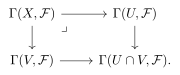
Čech cohomology. For an open cover $\mathfrak{U} = (U_i \to X)_{i \in I}$, write
\[ U_n \coloneqq \coprod_{(i_0, \dots, i_n) \in I^{n+1}} U_{i_0} \cap \cdots \cap U_{i_n}. \]The sheaf condition along $\mathfrak{U}$ unfolds into the equivalence
\[ \Gamma(X, \mathcal{F}) \xrightarrow{\;\sim\;} \lim_{[n] \in \mathbf{\Delta}} \Gamma(U_n, \mathcal{F}). \]We call the right-hand side the derived Čech complex of $\mathfrak{U}$.
Pushforward and base change. For $f\colon Y \to X$, the pushforward $f_*\colon \mathrm{Shv}_\tau(Y, \mathcal{D}) \to \mathrm{Shv}_\tau(X, \mathcal{D})$ is determined by $\Gamma(X, f_* \mathcal{F}) \simeq \Gamma(Y, \mathcal{F})$. Higher direct images are $H^i(X, f_*\mathcal{F}) = \pi_{-i} f_*\mathcal{F}$ in the appropriate $t$-structure.
These are the standard cohomological tools, derived without spectral sequences, injective resolutions, or flabby/soft sheaves: everything is encoded in the sheaf condition together with the universal property of sheafification.
Quasi-coherent sheaves are sheaves
For a scheme $X$, recall that the category of quasi-coherent modules is the limit
\[ \mathrm{Mod}_X = \lim_{(R,\, x\colon \Spec(R) \to X)} \mathrm{Mod}_R \]with derived base change as transition functors. For an $R$-module $M$, the associated presheaf on $\mathrm{CAlg}_R$ is
\[ \mathcal{F}_M\colon \mathrm{CAlg}_R \to \mathcal{D}, \qquad A \mapsto M \otimes_R A. \]The main theorem of this note is:
For any ring $R$ and any $R$-module $M$, the presheaf $\mathcal{F}_M$ is a Zariski sheaf on $\mathrm{CAlg}_R$. Equivalently, $L\mathcal{F}_M \simeq \mathcal{F}_M$, and consequently
\[ \Gamma(\Spec(R), \mathcal{F}_M) \simeq \mathcal{F}_M(R) = M. \]Since $M$ is concentrated in degree zero (for $M \in \mathrm{Mod}_R^{\heartsuit}$), the higher cohomology vanishes:
For an affine scheme $X = \Spec(R)$ and a discrete quasi-coherent module $M$,
\[ H^i(X, \mathcal{F}_M) = 0 \quad \text{for all } i > 0. \]The strategy for Theorem 1 is to establish the stronger statement that $\mathcal{F}_M$ satisfies faithfully flat descent. This is the content of the next section, via Mathew’s framework of descendable algebras.
Faithfully flat descent
Throughout this section $\mathcal{C}$ is a stable presentable symmetric monoidal category. In our application $\mathcal{C} = \mathrm{Mod}_R$.
Descendable algebras
$A \in \mathrm{CAlg}(\mathcal{C})$ is descendable if $\mathbf{1}_{\mathcal{C}} \in \langle A \rangle$.
The cobar construction associated to $A$ is the cosimplicial algebra
\[ A^{\otimes \bullet}\colon \mathbf{\Delta} \to \mathrm{CAlg}(\mathcal{C}), \qquad [n] \mapsto A^{\otimes(n+1)}. \]A cosimplicial object $M^{\bullet}\colon \mathbf{\Delta} \to \mathcal{C}$ is pro-constant if its filtered diagram of partial totalisations
\[ n \mapsto \mathrm{Tot}_{\le n}(M^{\bullet}) \coloneqq \lim_{m \in \mathbf{\Delta}_{\le n}} M^m \]is pro-equivalent (in $\mathsf{Pro}(\mathcal{C})$) to a constant pro-system.
In any stable symmetric monoidal category where $\otimes$ preserves limits in each variable, tensoring with a pro-constant cosimplicial object remains pro-constant, and the limit commutes with the tensor:
\[ \Big(\lim_{\mathbf{\Delta}} M^{\bullet}\Big) \otimes X \simeq \lim_{\mathbf{\Delta}} (M^{\bullet} \otimes X). \]This is automatic for $\mathcal{C} = \mathrm{Mod}_R$, since $\otimes_R$ is exact.
Two theorems of Mathew connect descendability with pro-constancy.
$A \in \mathrm{CAlg}(\mathcal{C})$ is descendable iff the cobar $A^{\otimes \bullet}$ is pro-constant with limit $\mathbf{1}_{\mathcal{C}}$.
Proof.
($\Rightarrow$). Let $\mathcal{X} \subset \mathcal{C}$ be the full subcategory of those $X$ such that $X \otimes A^{\otimes \bullet}$ is pro-constant with limit $X$. Example 7 shows $\mathcal{X}$ is closed under finite (co)limits, retracts, and tensor products. By Example 6 , $A \in \mathcal{X}$ — the cosimplicial object $A \otimes A^{\otimes \bullet}$ is split via the obvious extra degeneracy. Hence $\langle A \rangle \subset \mathcal{X}$; in particular $\mathbf{1} \in \mathcal{X}$.
($\Leftarrow$). If $A^{\otimes \bullet}$ is pro-constant with limit $\mathbf{1}$, some $\mathrm{Tot}_{\le n}(A^{\otimes \bullet})$ admits $\mathbf{1}$ as a retract. But $\mathrm{Tot}_{\le n}(A^{\otimes \bullet})$ is a finite limit of $A, A^{\otimes 2}, \dots$, hence lies in $\langle A \rangle$.
$\square$If $A \in \mathrm{CAlg}(\mathcal{C})$ is descendable, then the canonical functor
\[ \mathcal{C} \xrightarrow{\;\sim\;} \lim_{\mathbf{\Delta}} \mathrm{Mod}_{A^{\otimes(\bullet+1)}}(\mathcal{C}) \]is an equivalence.
Proof.
The adjunction $- \otimes A\colon \mathcal{C} \rightleftarrows \mathrm{Mod}_A(\mathcal{C}) \colon F$ satisfies the Barr–Beck–Lurie criterion.
Conservativity of $- \otimes A$. If $X \otimes A \simeq 0$, the subcategory $\mathcal{Y} = \{Y : X \otimes Y \simeq 0\}$ contains $A$ and is closed under finite (co)limits, retracts, and tensor products, so $\mathbf{1} \in \langle A \rangle \subset \mathcal{Y}$, giving $X \simeq 0$.
Limit-exchange for split cosimplicial objects. Similar, via Example 7 and Theorem 8 .
$\square$Faithfully flat maps are descendable
We specialise to $\mathcal{C} = \mathrm{Mod}_R$ with $A = S$ for a connective ring map $R \to S$.
A connective $R$-module $M$ is flat if $- \otimes_R M$ is $t$-exact; equivalently, $\pi_0 M$ is a flat $\pi_0 R$-module and the canonical map $\pi_n R \otimes_{\pi_0 R} \pi_0 M \to \pi_n M$ is an isomorphism for every $n$.
A connective ring map $R \to S$ is faithfully flat if $S$ is a flat $R$-module and $\pi_0 R \to \pi_0 S$ is faithfully flat in the classical sense (equivalently, $\Spec \pi_0 S \to \Spec \pi_0 R$ is surjective).
The technical engine is a flat-Ext vanishing lemma due to Lurie:
Let $R$ be a connective ring and $M$ a flat $R$-module such that $\pi_0 M$ is $\aleph_n$-presentable as a $\pi_0 R$-module. Then for any connective $N \in \mathrm{Mod}_R$ and any $k > n$,
\[ \operatorname{Ext}^k_R(M, N) = 0. \]Let $R \to S$ be a faithfully flat connective ring map, with the cardinality bound that $\pi_0 S$ is $\aleph_n$-presentable over $\pi_0 R$ for some $n$ (e.g. $\aleph_{\omega}$ — automatic for finitely or countably presented algebras). Then $S$ is descendable as an $R$-algebra, and consequently
\[ \mathrm{Mod}_R \xrightarrow{\;\sim\;} \lim_{\mathbf{\Delta}} \mathrm{Mod}_{S^{\otimes(\bullet+1)}}. \]Proof.
By Theorem 9 , descendability of $S$ implies the equivalence; we show $S$ is descendable.
Set $K \coloneqq \mathrm{fib}(R \to S)$ and $C \coloneqq \mathrm{cofib}(R \to S)$, related by $K \simeq C[-1]$. The structure map $\rho\colon K \to R$ assembles, for each $m \ge 1$, into the $m$-fold tensor power
\[ \rho^{(m)}\colon K^{\otimes m} \xrightarrow{\;\rho \otimes \cdots \otimes \rho\;} R. \]Claim. $\rho^{(m)}$ is null-homotopic for $m$ large enough.
By the shift $K \simeq C[-1]$,
\[ \rho^{(m)} \in [K^{\otimes m}, R]_{\mathrm{Mod}_R} = [C^{\otimes m}[-m], R]_{\mathrm{Mod}_R} = \operatorname{Ext}^m_R(C^{\otimes m}, R). \]Flatness of $S$ makes $C = \mathrm{cofib}(R \to S)$ flat too (long exact sequence on $\pi_*$), so $C^{\otimes m}$ is flat. The cardinality assumption makes $\pi_0(C^{\otimes m})$ $\aleph_n$-presentable, and Lemma 11 gives $\operatorname{Ext}^m_R(C^{\otimes m}, R) = 0$ for $m > n$.
Concluding descendability. The factorisation $\rho^{(m+1)}\colon K^{\otimes(m+1)} \xrightarrow{\mathrm{id} \otimes \rho^{(m)}} K \xrightarrow{\rho} R$ produces a cofibre sequence
\[ K^{\otimes m} \otimes_R S \to \mathrm{cofib}(\rho^{(m+1)}) \to \mathrm{cofib}(\rho^{(m)}). \]Inductively, $\mathrm{cofib}(\rho^{(m)}) \in \langle S \rangle$ for every $m$, since $K^{\otimes m} \otimes_R S \in \langle S \rangle$ and $\langle S \rangle$ is closed under cofibres. When $\rho^{(m)}$ is null-homotopic,
\[ \mathrm{cofib}(\rho^{(m)}) \simeq R \oplus K^{\otimes m}[1], \]exhibiting $R$ as a retract of an object in $\langle S \rangle$. Thus $R \in \langle S \rangle$, i.e. $S$ is descendable.
$\square$Proof of the main theorem
Proof of Theorem on quasi-coherent modules.
Set $S \coloneqq \prod_i R_{f_i}$ for a Zariski cover $(f_i)_{i \in I}$ — i.e. elements generating the unit ideal of $R$. (We may reduce to finite $I$, since the unit ideal is generated by finitely many of the $f_i$.) The ring map $R \to S$ is faithfully flat: each $R_{f_i}$ is flat over $R$, and $\Spec(S) = \coprod_i \Spec(R_{f_i}) \to \Spec(R)$ is surjective by the unit-ideal hypothesis. The cardinality bound of Theorem 12
is automatic.
Theorem 12 gives an equivalence
\[ \mathrm{Mod}_R \xrightarrow{\;\sim\;} \lim_{\mathbf{\Delta}} \mathrm{Mod}_{S^{\otimes_R(\bullet+1)}}. \]Tracing $M$ through this equivalence: the unit of the adjunction sends $M$ to the cosimplicial $S^{\otimes_R(\bullet+1)}$-module $[n] \mapsto M \otimes_R S^{\otimes_R(n+1)}$, and the equivalence reads
\[ M \xrightarrow{\;\sim\;} \lim_{[n] \in \mathbf{\Delta}} \bigl(M \otimes_R S^{\otimes_R(n+1)}\bigr). \]This is exactly the Zariski sheaf condition for $\mathcal{F}_M$ along the cover $(\Spec R_{f_i})_i$: at level $n$, $S^{\otimes_R(n+1)} = \prod_{i_0, \dots, i_n} R_{f_{i_0} \cdots f_{i_n}}$, so the displayed limit is the equaliser (in the appropriate cosimplicial sense) corresponding to $\mathcal{F}_M$ on the cover. Hence $\mathcal{F}_M$ is a Zariski sheaf, and $L\mathcal{F}_M \simeq \mathcal{F}_M$.
$\square$Naïve Čech as a special case
Theorem 1 immediately clarifies the relationship between derived and classical Čech cohomology.
Derived Čech is sheaf cohomology, always. Let $\mathcal{F}$ be a sheaf on $X$ and $\mathfrak{U} = (U_i \to X)_{i \in I}$ any cover. The sheaf condition along $\mathfrak{U}$ is the equivalence
\[ \Gamma(X, \mathcal{F}) \xrightarrow{\;\sim\;} \lim_{[n] \in \mathbf{\Delta}} \Gamma(U_n, \mathcal{F}). \]No truncation, no spectral sequence, no acyclicity hypothesis. The right-hand side is the derived Čech complex.
Naïve Čech recovers derived Čech when intersections are acyclic. The classical naïve Čech complex is the cosimplicial discrete abelian group $[n] \mapsto H^0(U_n, \mathcal{F})$ — the degree-zero truncation of $\Gamma(U_n, \mathcal{F})$. By Corollary 2 , this truncation loses nothing precisely when each $U_n$ is affine (so $\Gamma(U_n, \widetilde{M})$ is concentrated in degree zero). By the affine intersection property of separated schemes (diagonal is a closed immersion), this is automatic for affine covers of separated schemes:
Let $X$ be a separated scheme, $\mathfrak{U}$ an affine open cover, and $\mathcal{F}$ a quasi-coherent sheaf on $X$. Then naïve and derived Čech cohomology along $\mathfrak{U}$ coincide, and both equal sheaf cohomology:
\[ \check{H}^i(\mathfrak{U}, \mathcal{F}) \xrightarrow{\;\sim\;} H^i(X, \mathcal{F}) \qquad \text{for all } i \ge 0. \]Proof.
Cartan–Leray, reinterpreted. The classical Cartan–Leray spectral sequence
\[ E_2^{p,q} = \check{H}^p(\mathfrak{U}, \mathcal{H}^q(\mathcal{F})) \Longrightarrow H^{p+q}(X, \mathcal{F}) \]is precisely the spectral sequence associated to the Bousfield–Kan filtration on $\lim_{\mathbf{\Delta}} \Gamma(U_{\bullet}, \mathcal{F})$. The Cartan–Leray hypothesis — vanishing of higher $H^q$ on the cover — collapses the spectral sequence to its $E_2^{p,0}$ row, recovering naïve Čech.
Connection with the locally ringed space picture
The category $\mathrm{Mod}_X$ defined as a limit
\[ \mathrm{Mod}_X = \lim_{(R,\, x\colon \Spec R \to X)} \mathrm{Mod}_R \]agrees, when $X$ is a scheme, with the classical category of quasi-coherent $\mathcal{O}_X$-modules on the locally ringed space $(|X|, \mathcal{O}_X)$. Under this identification, the derived global sections $\Gamma(X, \mathcal{F})$ defined here match the classical $\mathrm{R}\Gamma$ of an $\mathcal{O}_X$-module computed via injective resolutions. All the classical formalism (injective resolutions, derived $\Hom$, hypercohomology, …) gives an equivalent answer; the derived viewpoint adopted here is simply a way to skip the resolution machinery and work directly with the universal property.
References
- J. Lurie. Spectral Algebraic Geometry. Book draft. PDF.
- A. Mathew. The Galois group of a stable homotopy theory. Adv. Math. 291 (2016), 403–541. arXiv:1404.2156.
- J. Lurie. Higher Topos Theory. Ann. Math. Stud. 170, Princeton Univ. Press, 2009.
- J. Lurie. Higher Algebra. PDF.