Introduction
Throughout this talk, we adopt the following conventions:
- Implicit ∞-categories: For the sake of readability, we systematically omit the prefix “∞-” from our terminology. Thus, unless stated otherwise, the term category always refers to an ∞-category.
- 1-categories: To avoid confusion, we refer to ordinary categories (i.e., those enriched over sets) explicitly as 1-categories.
- Homological indexing: We use homological indexing for chain complexes. In particular, the differential on any chain complex, $\partial_n: C_n \to C_{n-1}$, lowers the degree by $1$.
- Simplex category: We use $\Delta$ to denote the standard simplex category.
Overview and Structure
These notes accompany a talk given at the Goodwillie Calculus Seminar, held in the Winter Term 2025 at the University of Regensburg.
Our primary objective is two-fold:
- To provide a self-contained introduction to and proof of the stable Dold–Kan correspondence.
- To demonstrate its power by applying it to descent theory, specifically relating descendable algebras to nilpotent Adams towers.
The notes are organized as follows:
- Section “Classical Dold–Kan”: We begin by warming up with the classical story. We review the correspondence between simplicial objects and chain complexes in additive 1-categories.
- Section “The stable setup”: We shift to the stable categorical setting. We explain why, in this context, the natural analogue of a chain complex is a $\mathbb{Z}_{\ge 0}$-filtration.
- Chapter “The proof”: This is the technical heart of the talk. We construct the “bridge categories” $\mathcal{J}$ and $\mathcal{J}_+$ to prove that simplicial objects are equivalent to filtrations.
- Appendix “Application to descent”: Finally, we reap the rewards of our hard work. We apply the stable Dold–Kan correspondence to the theory of descendable algebras. We will show how this correspondence translates the difficult problem of descent (convergence of the cobar construction) into a manageable problem of nilpotence (vanishing of the Adams tower), culminating in the descendable Barr–Beck theorem.
Review of the Classical Dold–Kan Correspondence
We begin with a motivating example from topology.
This defines a functor
\[ \operatorname{Sing} \colon \mathsf{Top} \to \mathsf{sSet}. \]This functor induces an equivalence between classical homotopy theory and simplicial homotopy theory:
\[ \mathsf{Top}[\text{weak homotopy equivalence}^{-1}] \simeq \mathsf{An}. \]However, for computational purposes, we often want to “linearize” this homotopy data. We can form the free abelian group generated by the $n$-simplices, denoted $\mathbb{Z} \operatorname{Sing}_n (X)$, obtaining a simplicial abelian group $\mathbb{Z} \operatorname{Sing}_{\bullet} (X)$. While this object captures the homology of $X$, it contains redundant information: the degeneracy maps merely repeat lower-dimensional data, and the full collection of face maps is unwieldy.
To extract the homological data efficiently, we pass to the singular chain complex $\operatorname{C}_*(X)$:
- For each $n \ge 0$, let $\operatorname{C}_n(X) \coloneqq \mathbb{Z} \operatorname{Sing}_n(X)$.
- The differential $\partial_n \colon \operatorname{C}_n(X) \to \operatorname{C}_{n-1}(X)$ is defined as the alternating sum of the face maps: \[ \partial_n \coloneqq \sum_{i=0}^n (-1)^i d_i^n, \] where $d_i^n$ is the $i$-th face map.
This yields a functor
\[ \operatorname{C}_* \colon \mathsf{sAb} \to \mathsf{Ch}_{\geq 0}(\mathsf{Ab}). \]While this functor captures the correct homology, it is not an equivalence of categories because it retains the degenerate simplices in its object definition. However, if we quotient out the degenerate simplices, we obtain the normalized chain complex $\operatorname{N}_*(X)$. The celebrated Dold–Kan correspondence asserts that this normalization functor is an equivalence of categories. Thus, in a very precise sense, singular homology theory is the linearization of the homotopy theory of topological spaces.
More formally, this correspondence establishes a fundamental relationship between connective chain complexes1 and simplicial objects in an idempotent-complete additive 1-category $\mathcal{A}$.
Given a simplicial object $X_{\bullet}$ in $\mathcal{A}$, one can construct its unnormalized chain complex (or Moore complex), denoted $\operatorname{C}_*(X)$, as follows:
- The object in degree $n$ is simply $\operatorname{C}_n(X) \coloneqq X_n$.
- The differential $\partial_n \colon \operatorname{C}_n(X) \to \operatorname{C}_{n-1}(X)$ is the alternating sum of face maps: \[ \partial_n \coloneqq \sum_{i=0}^n (-1)^i d_i^n. \]
This complex is “too large” as it contains redundant information from degenerate simplices. Let $\operatorname{D}_n(X)$ be the subobject of $X_n$ generated by all degenerate $n$-simplices. A more efficient representation is given by the normalized chain complex, denoted $\operatorname{N}_*(X)$, defined by $\operatorname{N}_n(X) \coloneqq \bigcap_{i=1}^{n} \ker(d_i^n)$. A fundamental result states that there is a canonical isomorphism $\operatorname{N}_n(X) \xrightarrow{\sim} \operatorname{C}_n(X)/\operatorname{D}_n(X)$, and the inclusion $\operatorname{N}_*(X) \hookrightarrow \operatorname{C}_*(X)$ is a quasi-isomorphism.
Conversely, we can construct a simplicial object from a connective chain complex $C_* \in \operatorname{Ch}(\mathcal{A})_{\geq 0}$. First, we form a semi-simplicial object $C_{\bullet,\operatorname{inj}}$:
We then obtain the corresponding simplicial object via the left Kan extension along the inclusion $\Delta_{\operatorname{inj}} \hookrightarrow \Delta$:
Let $\mathcal{A}$ be an additive 1-category. The functor
\[ \operatorname{DK} \colon \operatorname{Ch}(\mathcal{A})_{\geq 0} \to \operatorname{Fun}(\Delta^{\operatorname{op}},\mathcal{A}) \]is fully faithful. Furthermore, if $\mathcal{A}$ is idempotent-complete, then $\operatorname{DK}$ and the normalization functor $\operatorname{N}_*$ constitute an equivalence of categories.
Proof.
We verify this by reducing it to the abelian case. Recall that for $\mathcal{A} = \mathsf{Ab}$, the classical Dold–Kan correspondence holds (c.f. [HA, Lemma 1.2.3.13] ).
Now, let $\mathcal{A}$ be a general additive 1-category. Consider the category of additive presheaves $\mathcal{A}' = \operatorname{Fun}(\mathcal{A}^{\operatorname{op}},\mathsf{Ab})$. Via the additive Yoneda embedding $y \colon \mathcal{A} \to \mathcal{A}'$, we can embed $\mathcal{A}$ into an abelian category. Since $y$ preserves finite limits and colimits, the following diagram commutes up to canonical isomorphism:
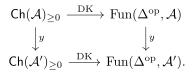
Now consider the bottom map. By the exponential law (or currying), we have $\mathsf{Ch}(\mathcal{A}')_{\geq 0} \cong \operatorname{Fun}(\mathcal{A}^{\operatorname{op}}, \mathsf{Ch}(\mathsf{Ab})_{\geq 0})$. Thus, the bottom functor corresponds to post-composition with the classical equivalence $\operatorname{DK}_{\mathsf{Ab}}$. Since post-composition with an equivalence is an equivalence, the bottom map is an equivalence.
Since $y$ is fully faithful, it follows that the top $\operatorname{DK}$ functor is fully faithful. The essential surjectivity in the idempotent-complete case follows from the splitting of $\operatorname{N}_n$ as a direct summand.
$\square$What is the Stable Dold–Kan Correspondence?
We now shift our focus to the setting of higher category theory. In modern homotopy theory, stable categories serve as the higher categorical analogue of abelian categories.
Consider the homotopy category $\operatorname{h}\mathcal{C}$ of a stable category $\mathcal{C}$. While $\operatorname{h}\mathcal{C}$ is typically not abelian, it carries a triangulated structure. This implies two key properties:
- $\operatorname{h}\mathcal{C}$ is an additive 1-category.
- It satisfies the following splitting property:
- $(*)$ If $f \colon X \to Y$ is a morphism in $\operatorname{h}\mathcal{C}$ which admits a left inverse, then there is an isomorphism $Y \simeq X \oplus X'$ such that $f$ is identified with the inclusion into the first factor.
This property guarantees that the classical Dold–Kan correspondence applies perfectly to $\operatorname{h}\mathcal{C}$ (allowing us to identify chain complexes in $\operatorname{h}\mathcal{C}$ with simplicial objects).
However, the stable correspondence is a much deeper statement at the full categorical level. The key insight is to relate simplicial objects to $\mathbb{Z}_{\geq 0}$-filtrations. A functor $F_{\star} \colon \mathbb{Z}_{\geq 0} \to \mathcal{C}$ represents a tower of objects:
\[ F_0 \to F_1 \to F_2 \to \cdots \]Let $F_{\star}$ be a filtration in stable category $\mathcal{C}$, then for $s \in \Z$, one can define the $s$-th associative graded piece of $F_{\star}$ to be the cofiber
\[ \operatorname{gr}_{F}^{s} \coloneqq \operatorname{cofib}(F_{s} \to F_{s+1}) = \frac{F_{s+1}}{F_s}. \]In [HA, Remark 1.2.2.3] , one can find that if $F_{\star}$ is a filtration, then the graded objects form a kind of chain complex. Specifically, each fiber sequence
\[ \operatorname{gr}^{s} \to \frac{F_{s+2}}{F_s} \to \operatorname{gr}^{s+1} \]gives rise to a ‘differential’ $d \colon \operatorname{gr}^{s+1} \to \operatorname{gr}^s[1]$.
Thus, one obtain a chain complex
\[ \cdots \to \operatorname{gr}^{2}[-2] \to \operatorname{gr}^1[-1] \to \operatorname{gr}^0 \to \operatorname{gr}^{-1}[1] \to \operatorname{gr}^{-2}[2] \to \cdots \]Using the classical Dold–Kan correspondence on $\operatorname{h}\mathcal{C}$, this chain complex determines a simplicial object. The stable Dold–Kan correspondence asserts that this relationship lifts to an equivalence of $\infty$-categories:
Let $\mathcal{C}$ be a stable category. Then there exists an equivalence of categories:
\[ \operatorname{Fun}(\Delta^{\operatorname{op}},\mathcal{C}) \simeq \operatorname{Fun}(\mathbb{Z}_{\geq 0},\mathcal{C}). \]Acknowledgements
I would like to express my sincere gratitude to the organizer, Prof. Marc Hoyois, for the opportunity to give this talk at the Goodwillie Calculus Seminar. I am also indebted to Yuchen Wu for providing the key insight regarding the model-independent proof of , which greatly clarified the combinatorial arguments. Finally, I thank Gemini for assisting with grammatical corrections and polishing the text.
Technical Lemmas
In the proof of the stable Dold–Kan correspondence (Chapter “Stable-DK”), we relied on a crucial identification between left and right Kan extensions. The goal of this chapter is to provide a rigorous, model-independent proof of this fact.
Let $\mathcal{C}$ be a stable category, let $n \geq 0$, and let $F \colon \Delta_{+,\leq n}^{\operatorname{op}} \to \mathcal{C}$ be a functor. The following conditions are equivalent:
- The functor $F$ is a left Kan extension of its restriction $F|_{\Delta_{\leq n}^{\operatorname{op}}}$.
- The functor $F$ is a right Kan extension of its restriction $F|_{\Delta_{+,\leq n-1}^{\operatorname{op}}}$.
To prove this, we need to analyze the combinatorics of the simplex category. We adopt the strategy of Yuchen Wu, which avoids the use of topological barycentric subdivisions.
Coinitial
We first establish a general lemma regarding the contractibility of unions of posets.
Let $V$ be a poset and let $\mathcal{F} = \{U_1, \dots, U_m\}$ be a non-empty finite collection of subposets of $V$. Suppose that:
- Covering: $V = U_1 \cup \cdots \cup U_m$.
- Downward Closure Compatibility: For any $a, b \in V$ with $a \le b$, if $a \in U_i$ and $b \in U_j$, then either $a, b \in U_i$ or $a, b \in U_j$. (This holds in particular if each $U_i$ is a downward closed subposet).
- Intersection Contractibility: Any non-empty intersection of elements in $\mathcal{F}$ is a weakly contractible subposet of $V$.
Then $V$ itself is weakly contractible.
Proof.
We proceed by induction on $m$. The case $m=1$ is trivial. Assume the statement holds for $m \le k$. Let $W_k = \bigcup_{i=1}^k U_i$. Consider the pushout $P$ in $\mathsf{Cat}$ of the span:
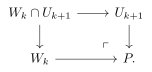
We claim that $P$ is equivalent to $V$. By condition (2), the inclusion functors in the span are fully faithful. As shown in [haine2025fullyfaithfulfunctorspushouts] , fully faithful inclusions ensure that the categorical pushout behaves well:
- By condition (1) and (2), the pushout $P$ has the same underlying set (anima) as the union $V = W_k \cup U_{k+1}$.
- The mapping animae in $P$ agree with those in $V$: for $a, b \in V$, if $a \le b$, the mapping space is contractible; otherwise, it is empty.
Thus, $P \simeq V$.
Now, by the inductive hypothesis, $W_k$ is weakly contractible. The intersection $W_k \cap U_{k+1} = \bigcup_{i=1}^k (U_i \cap U_{k+1})$ satisfies the conditions of the lemma for the collection $\{U_i \cap U_{k+1}\}$, so it is also weakly contractible. Since $U_{k+1}$ is contractible by (3), $V$ (being the homotopy pushout of contractible spaces) is weakly contractible.
$\square$Now we apply this to the specific geometry of the simplex category.
Let $\Delta^{\operatorname{inj}}$ be the subcategory of $\Delta$ consisting of injective maps. The functor
\[ \iota \colon \Delta^{\operatorname{inj}}_{/[n]} \to \Delta_{\leq n} \]defined by sending $([m], [m] \hookrightarrow [n])$ to $[m]$ is coinitial.
Proof.
By Quillen’s Theorem A, it suffices to show that for any $[k] \in \Delta_{\leq n}$, the slice category
\[ Q_{n,k} \coloneqq \Delta^{\operatorname{inj}}_{/[n]} \times_{\Delta_{\leq n}} (\Delta_{\leq n})_{/[k]} \]is weakly contractible.
Explicitly, objects in $Q_{n,k}$ are pairs $(\beta, f)$, where $\beta \colon [m] \hookrightarrow [n]$ is an injective map and $f \colon [m] \to [k]$ is a map in $\Delta_{\leq n}$. Since $\beta$ is injective, it is uniquely determined by its image $I \subseteq [n]$. Thus, we can identify objects of $Q_{n,k}$ with pairs $(I, f)$ where $I \subseteq [n]$ is a subset and $f \colon I \to [k]$ is an order-preserving map (where we identify $I$ with $[|I|-1]$ via the unique order isomorphism).
Let $O_{n,k}$ be the set of all maps $[n] \to [k]$. We equip $O_{n,k}$ with the alphabetic order $\le$ (a reverse lexicographical order): we say $g < h$ if there exists some $i \in [n]$ such that
\[ g(n)=h(n), \dots, g(i+1)=h(i+1) \quad \text{and} \quad g(i) < h(i). \]This defines a total order on $O_{n,k}$.
For each $\phi \in O_{n,k}$, let $U_{\phi} \subseteq Q_{n,k}$ be the subposet of elements $(I, f)$ such that the composite map $([n] \twoheadrightarrow I \xrightarrow{f} [k])$ is $\le \phi$ in the pointwise order. Each $U_{\phi}$ has a terminal object (the pair corresponding to the largest subset $I$ compatible with the constraints) and is thus contractible.
We filter $Q_{n,k}$ by the subposets $V_{\phi} \coloneqq \bigcup_{\psi \le \phi} U_{\psi}$. We prove that each $V_{\phi}$ is contractible by induction on the alphabetic order.
- Base case: $V_{(0,\dots,0)}$ is contractible.
- Inductive step: Let $\phi$ be a map and $\phi' = \phi + 1$ be its successor in the alphabetic order. We have a pushout square:
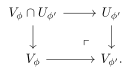
It suffices to show the intersection $V_{\phi} \cap U_{\phi'}$ is contractible.
Analyzing the intersection:
Let $i$ be the largest index such that $\phi(i) < k$ (the pivot for the successor). Then the successor $\phi'$ is given by:
The intersection $V_{\phi} \cap U_{\phi'}$ consists of pairs $(I, f)$ compatible with $\phi'$ that are also pointwise $\le \psi$ for some $\psi \le \phi$. As shown in Wu, this intersection decomposes nicely as a union of principal ideals:
\[ V_{\phi} \cap U_{\phi'} = \bigcup_{c \in S(\phi)} P_{\le ([n] \setminus \{c\})}, \]where $S(\phi) \subseteq [n]$ is a specific set of indices determined by the descent of $\phi'$. An index $c$ belongs to $S(\phi)$ if and only if $c=i$, or $c > i$ and $\phi'(c-1) < \phi'(c)$.
Crucially, since $k \le n$, the set $S(\phi)$ is not the entire set $[n]$. Thus, the total intersection of these principal ideals corresponds to the ideal generated by $[n] \setminus S(\phi)$, which is non-empty.
Therefore, the collection of ideals $\{ P_{\le ([n] \setminus \{c\})} \}_{c \in S(\phi)}$ satisfies the conditions of Lemma “Union of Contractible Posets” (any intersection is a principal ideal, hence contractible). We conclude that $V_{\phi} \cap U_{\phi'}$ is contractible, and by induction, $Q_{n,k}$ is contractible.
$\square$The Cube Lemma in Stable Categories
Let $\mathcal{C}$ be a stable category. A cube is a functor $D \colon \mathcal{P}(S) \to \mathcal{C}$ for some finite set $S$.
- We say $D$ is cartesian (or a limit diagram) if the object $D(\emptyset)$ is the limit of $D|_{\mathcal{P}(S) \setminus \{\emptyset\}}$.
- We say $D$ is cocartesian (or a colimit diagram) if the object $D(S)$ is the colimit of $D|_{\mathcal{P}(S) \setminus \{S\}}$.
Let $\mathcal{C}$ be a stable category and $D \colon \mathcal{P}(S) \to \mathcal{C}$ a cube. The following are equivalent:
- $D$ is cartesian.
- $D$ is cocartesian.
Proof.
This is a standard result in higher algebra. The core idea is to define the total fiber (denoted $\operatorname{tfib}(D)$) and the total cofiber (denoted $\operatorname{tcof}(D)$).
- $D$ is cartesian $\iff \operatorname{tfib}(D) \simeq 0$.
- $D$ is cocartesian $\iff \operatorname{tcof}(D) \simeq 0$. In a stable category, there is a natural equivalence $\operatorname{tfib}(D) \simeq \operatorname{tcof}(D)[-|S|]$, where $|S|$ is the cardinality of $S$. Thus, the vanishing of one implies the vanishing of the other.
Proof of Lemma “Kan extension equivalence”
Proof.
Let $F \colon \Delta_{+,\leq n}^{\operatorname{op}} \to \mathcal{C}$ be the functor. We interpret the two conditions:
1. Analysis of the Left Kan Extension.
Condition (1) states that $F$ is a left Kan extension at the object $[-1]$. By definition, this means
where the colimit is over the slice category $\Delta_{\le n}^{\operatorname{op}}$. By Lemma “Coinitiality of the Injective Slice”, the inclusion $\Delta^{\operatorname{inj}}_{/[n]} \to \Delta_{\leq n}$ is coinitial. Note that $\Delta^{\operatorname{inj}}_{/[n]}$ is isomorphic to $\mathcal{P}([n]) \setminus \{\emptyset\}$. Thus, condition (1) is equivalent to saying that the restriction of $F$ to the $(n+1)$-cube $\mathcal{P}([n])$ is a cocartesian (where the colimit cone is the value at $\emptyset \subseteq [n]$, corresponding to $[-1]$).
2. Analysis of the Right Kan Extension.
Condition (2) states that $F$ is a right Kan extension at the object $[n]$. The relevant index category is the slice of $\Delta_{+, \le n-1}^{\operatorname{op}}$ under $[n]$, which essentially corresponds to $\Delta_{\leq n}$ (mapping into $[n]$).
Using Lemma “Coinitiality of the Injective Slice” again (in the dual or shifted context), we can identify this limit with a limit over the same combinatorial structure $\Delta^{\operatorname{inj}}_{/[n]} \cong \mathcal{P}([n])$.
Thus, condition (2) is equivalent to saying that the restriction of $F$ to the cube is a limit diagram (where the limit cone is the value at $[n]$).
3. Conclusion.
We have identified both conditions with properties of a single cube diagram formed by restricted values of $F$.
- Left Kan Extension $\iff$ The cube is cocartesian.
- Right Kan Extension $\iff$ The cube is cartesian. By the Cube Lemma (stability), these two conditions are equivalent.
The Proof of the Stable Dold–Kan Correspondence
In this chapter, we provide a complete proof of the stable Dold–Kan correspondence.
Our proof strategy relies on constructing a “bridge” between the two worlds. Specifically, we will:
- Construct a chain of functors connecting the category of simplicial objects, $\operatorname{Fun}(\Delta^{\operatorname{op}}, \mathcal{C})$, with the category of filtered objects, $\operatorname{Fun}(\mathbb{Z}_{\geq 0}, \mathcal{C})$.
- Show that every functor in this chain is an equivalence of categories.
Preliminaries: The Skeletal Filtration
Before diving into the formal construction of the bridge categories, let us ground our intuition in the geometry of simplicial objects. This will explain why the proof takes the form it does.
Recall that for any simplicial object $X_{\bullet} \in \operatorname{Fun}(\Delta^{\operatorname{op}}, \mathcal{C})$, we can define its $n$-skeleton $\operatorname{sk}_n X$. Categorically, this is the Left Kan Extension of the restriction of $X$ to the truncated category $\Delta_{\le n}^{\operatorname{op}}$ along the inclusion:
\[ \operatorname{sk}_n X \coloneqq \operatorname{Lan}_{\Delta_{\le n}^{\operatorname{op}} \hookrightarrow \Delta^{\operatorname{op}}} (X|_{\Delta_{\le n}^{\operatorname{op}}}). \]The sequence of skeletons provides a natural filtration of $X$:
\[ \operatorname{sk}_0 X \to \operatorname{sk}_1 X \to \operatorname{sk}_2 X \to \cdots \to \operatorname{colim}_n \operatorname{sk}_n X \simeq X. \]The Geometric Intuition
Why is this relevant to Dold–Kan? In the classical case (e.g., simplicial sets), $\operatorname{sk}_n X$ is obtained from $\operatorname{sk}_{n-1} X$ by attaching non-degenerate $n$-simplices via a pushout square: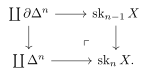
Step 1: Building the Bridge Categories
To make the skeletal intuition precise, we introduce two index categories: $\mathcal{J}$ and $\mathcal{J}_+$.
The Category $\mathcal{J}_+$
We define $\mathcal{J}_+$ as the full subcategory of $\mathbb{Z}_{\geq 0} \times \Delta^{\operatorname{op}}_+$ spanned by pairs $(n,[m])$ satisfying $m \leq n$. Here, $\Delta^{\operatorname{op}}_+$ is the augmented simplex category (including $[-1]$).
- The first coordinate $n \in \mathbb{Z}_{\ge 0}$ represents the filtration stage (related to the $n$-skeleton).
- The second coordinate $[m] \in \Delta^{\operatorname{op}}_+$ represents the simplicial degree.
Intuitively, an object $(n,[m])$ corresponds to the term $(X_m)$ sitting inside the $n$-skeleton. The condition $m \leq n$ reflects that the $n$-skeleton is determined by simplices of dimension up to $n$.
The picture to have in mind is a large commutative diagram: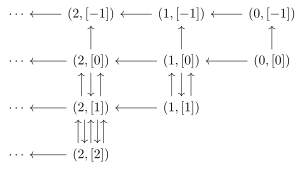
The Category $\mathcal{J}$ and the Functor Chain
In parallel, we define $\mathcal{J}$ as the full subcategory of $\mathcal{J}_+$ spanned by pairs $(n,[m])$ where $0 \leq m \leq n$ (excluding the bottom row $m=-1$). This encodes the skeleton data without the geometric realization.
We define $\operatorname{Fun}^0(\mathcal{J},\mathcal{C})$ to be the full subcategory of $\operatorname{Fun}(\mathcal{J},\mathcal{C})$ spanned by functors $F$ satisfying the following stability condition:
- For every $s \leq m \leq n$, the image of the natural map $(m,[s]) \to (n,[s])$ is an equivalence in $\mathcal{C}$.
Similarly, we define $\operatorname{Fun}^0(\mathcal{J}_+,\mathcal{C})$ for functors $F_+ \colon \mathcal{J}_+ \to \mathcal{C}$ satisfying the same stability condition. Additionally, we require that $F_+$ is a Left Kan Extension of its restriction to $\mathcal{J}$. This condition formally encodes that the bottom row objects $(n, [-1])$ are geometric realizations (colimits) of the columns above them.
This setup yields a diagram of categories:
\[ \operatorname{Fun}(\Delta^{\operatorname{op}},\mathcal{C}) \xrightarrow{G} \operatorname{Fun}^0(\mathcal{J},\mathcal{C}) \xleftarrow{G'} \operatorname{Fun}^0(\mathcal{J}_+,\mathcal{C}) \xrightarrow{G''} \operatorname{Fun}(\mathbb{Z}_{\geq 0},\mathcal{C}). \]Here:
- $G$ is induced by the projection $p \colon \mathcal{J} \to \Delta^{\operatorname{op}}$.
- $G'$ is the restriction functor.
- $G''$ is the restriction to the bottom row $\mathbb{Z}_{\geq 0} \hookrightarrow \mathcal{J}_+$ via $n \mapsto (n,[-1])$.
Our goal is to show that $G$, $G'$, and $G''$ are equivalences.
Step 2: Proving the Equivalences
The Functor $G$ is an equivalence
We first show that $G$ is an equivalence. The strategy is to express $G$ as a limit of equivalences $G_k$.
Define the “truncated” index categories:
- $\mathcal{J}^{\leq k}$: the full subcategory of $\mathcal{J}$ spanned by pairs $(n,[m])$ where $m \leq n \leq k$.
- $\mathcal{J}^{k}$: the full subcategory of $\mathcal{J}$ spanned by pairs $(n,[m])$ where $m \leq n = k$.
Note that the projection $p$ restricts to an equivalence $\mathcal{J}^k \simeq \Delta_{\leq k}^{\operatorname{op}}$.
We aim to show an equivalence:
\[ \operatorname{Fun}^0(\mathcal{J}^{\leq k},\mathcal{C}) \xrightarrow{\sim} \operatorname{Fun}(\mathcal{J}^k,\mathcal{C}). \]Consider the right Kan extension along the fully faithful inclusion $\iota \colon \mathcal{J}^{k} \hookrightarrow \mathcal{J}^{\leq k}$:
For any $s \leq m \leq n \leq k$, observe that the under-categories satisfy $\mathcal{J}^k_{(m,[s])/} \simeq \mathcal{J}^k_{(n,[s])/}$. Consequently, the limit diagrams defining the right Kan extension at $(m,[s])$ and $(n,[s])$ are isomorphic. Since $\mathcal{C}$ is stable (and thus admits finite limits), the pointwise formula for the Right Kan Extension implies that the map
\[ \operatorname{Ran}_{\iota}H ((m,[s])) \to \operatorname{Ran}_{\iota}H ((n,[s])) \]is an equivalence. Thus, the image of $\iota_*$ lies in $\operatorname{Fun}^0(\mathcal{J}^{\leq k},\mathcal{C})$. Conversely, for any $F \in \operatorname{Fun}^0(\mathcal{J}^{\leq k},\mathcal{C})$, one can check that $F \simeq \operatorname{Ran}_{\iota}(F|_{\mathcal{J}^k})$.
Thus, we obtain a sequence of equivalences:
\[ G_k \colon \operatorname{Fun}(\Delta_{\leq k}^{\operatorname{op}},\mathcal{C}) \xrightarrow{\sim} \operatorname{Fun}(\mathcal{J}^{k},\mathcal{C}) \xrightarrow{\sim} \operatorname{Fun}^0(\mathcal{J}^{\leq k},\mathcal{C}). \]Taking the limit as $k \to \infty$, we have $G \simeq \lim_{k} G_k$. Since a limit of equivalences is an equivalence, $G$ is an equivalence.
The Functor $G'$ is an equivalence
The inclusion $\mathcal{J} \hookrightarrow \mathcal{J}_+$ is fully faithful. For any $(n, [-1]) \in \mathcal{J}_+$, the slice category $\mathcal{J}_{/(n,[-1])}$ is finite. Since $\mathcal{C}$ admits finite colimits, the Left Kan Extension exists. By definition, $\operatorname{Fun}^0(\mathcal{J}_+,\mathcal{C})$ consists precisely of those functors which are Left Kan extensions of their restriction to $\mathcal{J}$. Since fully faithful embeddings induce fully faithful restriction functors onto the subcategory of Kan extensions, $G'$ is an equivalence.
The Functor $G''$ is an equivalence
Finally, we show that $G''$ is an equivalence. This is the subtlest part, which relies on our Technical Lemma.
Let $\mathcal{J}_+^{\leq k}$ be the full subcategory of $\mathcal{J}_+$ spanned by $(n,[m])$ where either $m \leq n \leq k$ or $m = -1$. Let $\mathcal{D}(k) \coloneqq \operatorname{Fun}^0(\mathcal{J}_+^{\leq k}, \mathcal{C})$ be the category of functors satisfying the standard stability condition and the Left Kan Extension condition at $(n,[-1])$ for $n \le k$.
We have a limit decomposition:
\[ \operatorname{Fun}^0(\mathcal{J}_+,\mathcal{C}) \simeq \lim \left( \cdots \to \mathcal{D}(k) \to \mathcal{D}(k-1) \to \cdots \to \mathcal{D}(-1) \right), \]where $\mathcal{D}(-1) \simeq \operatorname{Fun}(\mathbb{Z}_{\geq 0}, \mathcal{C})$. It suffices to show that the restriction map $\mathcal{D}(k) \to \mathcal{D}(k-1)$ is an equivalence for all $k \geq 0$.
We decompose this restriction into two steps:
\[ \mathcal{D}(k) \xrightarrow{\theta} \mathcal{D}'(k) \xrightarrow{\theta'} \mathcal{D}(k-1). \]Here, $\mathcal{D}'(k)$ is defined on the domain $\mathcal{J}_{0}^{\leq k} \coloneqq \mathcal{J}_+^{\leq k} \setminus \{(k,[k])\}$.
- The map $\theta'$: A functor in $\mathcal{D}'(k)$ is determined by its restriction to $\mathcal{J}_+^{\leq k-1}$ plus the Left Kan extension condition at $(k,[-1])$. Since the Kan extension is unique, $\theta'$ is an equivalence.
- The map $\theta$: This restricts a functor from $\mathcal{J}_+^{\leq k}$ to $\mathcal{J}_0^{\leq k}$. To show this is an equivalence, we need to show that the value at the missing point $(k,[k])$ is uniquely determined.
By definition of $\mathcal{D}(k)$, any $F \in \mathcal{D}(k)$ is a Left Kan Extension of $F|_{\mathcal{J}^{\leq k}}$. Observe that $\mathcal{J}^k \simeq \Delta_{\leq k}^{\operatorname{op}}$ is coinitial in the diagram computing this Kan extension at $(k,[-1])$.
Crucially, we invoke our Technical Lemma (“Kan extension equivalence”): Since $\mathcal{C}$ is stable, being a Left Kan Extension from $\Delta_{\leq k}^{\operatorname{op}}$ is equivalent to being a Right Kan Extension from $\Delta_{+,\leq k-1}^{\operatorname{op}} \simeq \mathcal{J}_+^{k-1}$.
Note that $\mathcal{J}_+^{k-1} \subseteq \mathcal{J}_0^{\leq k}$. This means the value at $(k,[k])$ is determined by a Right Kan extension from data we already possess in $\mathcal{D}'(k)$. Thus, $\theta$ is an equivalence.
Since both steps are equivalences, $G''$ is an equivalence.
Alternative Perspective on $G$
There is a more high-level way to see that $G$ is an equivalence using the language of localizations.
We can regard $\operatorname{Fun}^0(\mathcal{J},\mathcal{C})$ as the functor category $\operatorname{Fun}(\mathcal{J}[W^{-1}],\mathcal{C})$, where $W$ is the set of morphisms $\{(m,[s]) \to (n,[s]) \mid s\leq m \leq n\}$ that we require to be inverted.
Consider the forgetful functor $p' \colon \mathcal{J} \to \mathbb{Z}_{\geq 0}$ given by $(m,[n]) \mapsto m$. Observe that $p'$ is a cocartesian fibration, and $W$ is precisely the collection of $p'$-cocartesian morphisms. By the fundamental theorem of $\infty$-categorical colimits (or the description of localizations of cocartesian fibrations), we have an equivalence:
\[ \mathcal{J}[W^{-1}] \simeq \operatorname{colim}_{n \in \mathbb{Z}_{\ge 0}} (\mathcal{J}_n), \]where $\mathcal{J}_n$ is the fiber over $n$. Since each fiber $\mathcal{J}_n \simeq \Delta_{\leq n}^{\operatorname{op}}$, the colimit is precisely $\Delta^{\operatorname{op}}$. Thus, $\operatorname{Fun}^0(\mathcal{J},\mathcal{C}) \simeq \operatorname{Fun}(\Delta^{\operatorname{op}}, \mathcal{C})$.
Application: Descent and Comonadicity
In the final part of this talk, we apply the stable Dold–Kan correspondence to prove a fundamental result in stable homotopy theory: the descendable Barr–Beck theorem. This result provides a powerful criterion for recovering a category $\mathcal{C}$ from the category of modules over a “nice” algebra $A$.
Unless otherwise specified, let $\mathcal{C}$ be a stable symmetric monoidal category where the tensor product preserves colimits.
The Descent Problem
Let $A \in \mathsf{CAlg}(\mathcal{C})$ be a commutative algebra. We have a standard adjunction: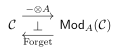
According to the Lurie–Barr–Beck theorem, this equivalence holds if and only if two conditions are met:
- Conservativity: The functor $-\otimes A$ is conservative (i.e., it reflects equivalences).
- Convergence: For any cosimplicial object split by $-\otimes A$, the totalization converges to the original object.
Descendable Algebras
We focus on a broad class of algebras where “convergence” is guaranteed by “nilpotence”.
For every object $A \in \mathcal{C}$, we denote by $\langle A \rangle \subseteq \mathcal{C}$ (or $\operatorname{Thick}^{\otimes}(A)$) the smallest full subcategory containing $A$ which is stable under:
- Finite limits and colimits (cofiber sequences),
- Retracts,
- Tensor products with arbitrary objects of $\mathcal{C}$. We say that a commutative algebra $A$ is descendable if $\mathbb{1}_{\mathcal{C}}$ is in $\langle A \rangle$.
Key Tool: Stable Dold–Kan
The convergence condition involves the cobar construction $\operatorname{CB}^{\bullet}(A)$:
However, the stable Dold–Kan correspondence allows us to translate this cosimplicial problem into a much simpler filtration problem.
Let $A \in \mathsf{Alg}(\mathcal{C})$ be an associative algebra of $\mathcal{C}$.
Let $M \in \mathcal{C}$ be an object. We can form a tower in $\mathcal{C}$
\[ \cdots \to T_2(A,M) \to T_1(A,M) \to T_0(A,M) \simeq M \]as follows:
- $T_1(A,M)$ is the fiber of the morphism $M \to M \otimes A$ induced by $\mathbb{1}_{\mathcal{C}} \to A$, so that $T_1(A,M)$ admits a natural morphism to $M$.
- More generally, $T_i(A,M) \coloneqq T_1(A,T_{i - 1}(A,M))$, which admits a natural morphism to $T_{i-1}(A,M)$. Inductively, this defines the functors $T_i$ and the desired tower. We will call this the $A$-Adams tower of $M$. Observe that the $A$-Adams tower of $M$ is simply the tensor product of $M$ with the $A$-Adams tower of $\mathbb{1}_{\mathcal{C}}$.
We can write the construction of the Adams tower in another way. Let $I = \operatorname{fib}(\mathbb{1}_{\mathcal{C}} \to A)$, so that $I$ is a nonunital associative algebra in $\mathcal{C}$ equipped with a morphism $I \to \mathbb{1}_{\mathcal{C}}$. In fact, we can get a tower
\[ \cdots \to I^{\otimes n} \to I^{\otimes (n-1)} \to \cdots \to I^{\otimes 2} \to I \to \mathbb{1}_{\mathcal{C}}, \]and this is precisely the $A$-Adams tower $\{T_i(A,\mathbb{1}_{\mathcal{C}})\}_{i \geq 0}$. The $A$-Adams tower for $M$ is obtained by tensoring this with $M$.
Let $I = \operatorname{fib}(\mathbb{1} \to A)$ be the fiber of the unit map. The cobar construction corresponds to the Adams tower via the stable Dold–Kan correspondence. Specifically, we have a natural equivalence:
\[ \operatorname{Tot}_n(\operatorname{CB}^{\bullet}(A)) \simeq \operatorname{cofib}\left(I^{\otimes(n+1)} \to \mathbb{1}\right), \]where $\operatorname{Tot}_n(\operatorname{CB}^{\bullet}(A)) \coloneqq \operatorname{Tot}(\operatorname{CB}^{\bullet}(A)\mid_{\Delta_{\leq n}})$.
This translation implies a crucial fact: The totalization converges ($\operatorname{Tot} \simeq \mathbb{1}$) if and only if the Adams tower vanishes (i.e., is contractible).
From Descendability to Nilpotence
We now establish the link between our algebraic definition (descendability) and the geometric convergence (Adams tower).
Sketch.
Let’s check the two implications separately.
($\Rightarrow$) Descendability implies Nilpotence:
Let $\mathcal{C}_{\text{nil}}$ be the class of objects $M$ for which the $A$-based Adams tower vanishes (i.e., acts like zero).
- First, observe that $A \otimes I \simeq 0$. As we discussed, the unit map $A \to A \otimes A$ is a split monomorphism (via the multiplication map), so its fiber $A \otimes I$ is contractible. Consequently, $A \in \mathcal{C}_{\text{nil}}$.
- One can verify that $\mathcal{C}_{\text{nil}}$ forms a thick tensor-ideal. Since $A$ is descendable, we know that the unit lies in the thick ideal generated by $A$, i.e., $\mathbb{1} \in \langle A \rangle \subseteq \mathcal{C}_{\text{nil}}$.
- Therefore, the Adams tower for $\mathbb{1}$ itself must be pro-zero.
($\Leftarrow$) Nilpotence implies Descendability:
Suppose the tower is nilpotent. This means there exists some large $N$ such that the map $I^{\otimes N} \to \mathbb{1}$ is null-homotopic.
Let’s look at the cofiber sequence associated with this map:
Since the first map is null, the sequence splits (a standard property in triangulated categories), giving us an equivalence:
\[ \operatorname{cofib}(I^{\otimes N} \to \mathbb{1}) \simeq \mathbb{1} \oplus \left(I^{\otimes N}[1]\right). \]In particular, $\mathbb{1}$ is a retract of $\operatorname{cofib}(I^{\otimes N} \to \mathbb{1})$.
By Theorem “DK translation: cobar ↔ Adams”, this cofiber is precisely the partial totalization $\operatorname{Tot}_{N-1}(\operatorname{CB}^{\bullet}(A))$. This object is built from finite limits of $A, A^{\otimes 2}, \dots, A^{\otimes N}$, all of which live in $\langle A \rangle$.
Since $\langle A \rangle$ is closed under retracts, we conclude that $\mathbb{1} \in \langle A \rangle$. Thus, $A$ is descendable.
$\square$Geometric interpretation: Nilpotent thickening
This result offers a profound geometric intuition for descent in stable homotopy theory. Classically, for a map to satisfy effective descent (like a faithfully flat map in algebraic geometry), we usually require the cobar construction to be acyclic. However, in the stable setting, descendability is a relaxation of this condition.
- It asserts that the error term (the ideal $I$) is not necessarily zero, but it is nilpotent (the tower $\{I^{\otimes s}\}$ is pro-zero).
- Geometrically, this means the map $\operatorname{Spec}(A) \to \operatorname{Spec}(\mathbb{1})$ behaves like a nilpotent thickening.
In classical algebraic geometry, a scheme and its reduction share the same underlying topological space; nilpotent elements only add “infinitesimal” structure without changing the topology. Similarly, a stable category $\mathcal{C}$ is essentially unchanged if we thicken the unit by a nilpotent ideal. The stable Dold–Kan correspondence is the essential dictionary that allows us to see this “nilpotence” hidden inside the simplicial structure of descent.
The Main Result: Descendable Barr–Beck
Finally, combining these insights, we prove the main theorem.
Let $A \in \mathsf{CAlg}(\mathcal{C})$ be a descendable commutative algebra. Then the adjunction $-\otimes A : \mathcal{C} \rightleftarrows \mathsf{Mod}_A(\mathcal{C})$ exhibits $\mathcal{C}$ as comonadic over $\mathsf{Mod}_{A}(\mathcal{C})$. In particular, for any $M \in \mathcal{C}$, we have a canonical equivalence:
\[ M \xrightarrow{\sim} \operatorname{Tot}\left( M \otimes \operatorname{CB}^{\bullet}(A) \right). \]Proof.
We verify the conditions of Lurie–Barr–Beck Theorem ([HA, Theorem 4.7.3.5] ):
Conservativity: Suppose $M \otimes A \simeq 0$. Let $\mathcal{Z} = \{X \in \mathcal{C} \mid M \otimes X \simeq 0\}$. One can verify that $\mathcal{Z}$ is stable under finite limits/colimits, retracts, and tensor products. Since $A \in \mathcal{Z}$ (by assumption) and $A$ is descendable, we have $\mathbb{1} \in \langle A \rangle \subseteq \mathcal{Z}$. Thus $M \simeq M \otimes \mathbb{1} \simeq 0$.
Convergence: We need to show that for any $M$, the natural map $M \to \operatorname{Tot}(M \otimes \operatorname{CB}^{\bullet}(A))$ is an equivalence. By the Dold–Kan translation, the fiber of this map is the limit of the Adams tower: $\lim_s (M \otimes I^{\otimes s})$. Since $A$ is descendable, the nilpotence theorem ensures that the tower $\{I^{\otimes s}\}$ is pro-zero. Thus, the inverse limit of the tower is zero. Consequently, the map to the totalization is an equivalence.
References
- Jacob Lurie. Higher Algebra. (2017). Link.
- Jacob Lurie. Higher Topos Theory (AM-170). (2009). Link.
- Jacob Lurie. Kerodon. (2018). Link.
- Peter J. Haine; Maxime Ramzi; Jan Steinebrunner. Fully faithful functors and pushouts of ∞-categories. (2025). Link.
- Claudius Heyer; Lucas Mann. 6-Functor Formalisms and Smooth Representations. (2024). Link.
- Akhil Mathew; Niko Naumann; Justin Noel. Nilpotence and descent in equivariant stable homotopy theory. (2017). Link.
- Akhil Mathew. The Galois group of a stable homotopy theory. (2016). Link.
A chain complex $C_*$ in an additive category $\mathcal{A}$ is called connective if it is concentrated in non-negative degrees, i.e., $C_n = 0$ for all $n < 0$. ↩︎