This page aims to explain how type theory can be understood within the framework of synthetic category theory.
The content of this page is derived from my questions to Tashi during the second exercise class and Tashi’s responses. I would like to express my gratitude to Tashi here.
We focus on the following two questions:
- Question I. How should we understand the notion of isofibration (hereafter referred to as a fibration) in synthetic category theory?
- Question II. Do we still have a weak factorization system in this context?
Next, we will answer these questions through the lens of type theory and the categorical perspective of synthetic category theory.
\tableofcontents
Type Theory
(More precisely, dependent type theory.)
I have not formally studied type theory, so the definitions here may differ significantly from those of a type theory expert. Please feel free to correct me if there are any issues.
Context
First, let us discuss what a context is.
Definition
A context $\Gamma$ is a finite sequence of typed variables
\[ x_1 : X_1,\; x_2 : X_2(x_1),\; \dots,\; x_n : X_n(x_1,\dots,x_{n-1}), \]satisfying the following condition: for any $1 \le k \le n$, we can form the judgment
\[ x_1 : X_1,\dots,x_{k-1} : X_{k-1}(x_1,\dots,x_{k-2}) \;\vdash\; X_k(x_1,\dots,x_{k-1})\ \mathrm{Type}. \]The Empty Context
A context of length $0$ is denoted by $[0]$ (sometimes also written as $()$) and is called the empty context.
This means that at this stage we have no prior assumptions or restrictions. Hence, for any type $X$ (in particular, a constant type not depending on undefined variables), we have the judgment
\[ [0] \vdash X \ \mathrm{Type}. \]This also implies that any sequence of length $1$, $(x_1 : X_1)$, forms a valid context if and only if $X_1$ is a type in the empty context.
Intuitive Interpretation
Intuitively, a context is a value-dependent iterative structure:
- First, we have a type $X_1$ in the empty context, which may be viewed as a base space.
- Given a variable $x_1 : X_1$, we can specify $X_2(x_1)$. Strictly speaking, $X_2(x_1)$ is not a single type but a family of types over $X_1$, depending on the value of $x_1$. This is why it is called a dependent type.
- Fixing $x_1 : X_1$ and then $x_2 : X_2(x_1)$, we may specify $X_3(x_1,x_2)$.
- This process continues inductively.
If for a context $\Gamma$ we can form the judgment
\[ \Gamma \vdash A \ \mathrm{Type}, \]then $A$ is called a type (or dependent type) in the context $\Gamma$.
Example
Consider the natural number type $\mathbb{N}$ and the context
\[ \Gamma = (x : \mathbb{N}). \]In this context, we would like to discuss the object “integers modulo $x$”, denoted $\mathbb{Z}/x$. Clearly, its structure depends on the specific value of $x$. Therefore, $\mathbb{Z}/x$ is a dependent type in the context $\Gamma$, and we have the judgment
\[ x : \mathbb{N} \vdash \mathbb{Z}/x \ \mathrm{Type}. \]Geometrically, this corresponds to a fiber bundle over the discrete base space $\mathbb{N}$:
- when $x = 2$, the fiber is $\mathbb{Z}/2$;
- when $x = 0$, the fiber is $\mathbb{Z}$ (if we define $\mathbb{Z}/0 \cong \mathbb{Z}$).
Context Extension
Given a context $\Gamma$ and a type $A$ in the context $\Gamma$, we may form a new context $(\Gamma, a : A)$.
If $\Gamma$ has the form
\[ x_1 : X_1,\dots,x_n : X_n, \]then the extended context encodes the data
\[ x_1 : X_1,\dots,x_n : X_n,\ a : A(x_1,\dots,x_n). \]This is called the extension of $\Gamma$ by $A$, and is also written as $\Gamma.A$.
Geometrically:
- $\Gamma$ corresponds to the base space;
- $A$ corresponds to a fiber bundle over the base;
- $\Gamma.A$ corresponds to the total space.
Context Induction
Contexts in dependent type theory are generated inductively by the following rules:
- Base: the empty context $[0]$ is valid.
- Induction: if $\Gamma$ is a valid context and $\Gamma \vdash A \ \mathrm{Type}$, then the extension $\Gamma.A$ is also a valid context.
Contexts as $\Sigma$-Types
Once $\Sigma$-types (dependent sums) are available, every context can be encoded as a single type:
- the empty context corresponds to the unit type $\mathbf{1}$;
- a context $(x : X)$ corresponds to $X$;
- a context $(x : X, y : Y(x))$ corresponds to $\sum_{x:X} Y(x)$;
- in general, contexts correspond to iterated $\Sigma$-types.
Terms
A term of type $A$ in a context $\Gamma$ is expressed by the judgment
\[ \Gamma \vdash a : A. \]From various perspectives:
- in type theory, $a$ is a term of $A$;
- in set theory, $a$ is an element of $A$;
- in homotopy theory or geometry:
- in the empty context, $a$ is a point of $A$;
- in a non-empty context, $a$ is a section of the bundle corresponding to $A$.
Concretely, $a$ is a rule assigning to each choice of context variables a point in the corresponding fiber.
(Synthetic) Category Theory
We now consider a category $\mathcal{C}$, often referred to as the syntactic category or the category of contexts.
- Objects: contexts $\Gamma$.
- Morphisms: given contexts $\Gamma$ and $\Delta$, a morphism $\Gamma \to \Delta$ is a tuple of terms representing substitution.
- Composition: substitution of substitutions.
Display Maps and Isofibrations
Given a context $\Gamma$ and a type $A$ over it, the extension $\Gamma.A$ comes with a canonical projection
\[ p : \Gamma.A \to \Gamma. \]In type theory, this is called a display map.
In synthetic category theory, such maps are called isofibrations.
Base Change and Substitution
Let $A \twoheadrightarrow B$ be an isofibration corresponding to a dependent type $A(b)$ over $B$,
\[ A \twoheadrightarrow B \quad\Longleftrightarrow\quad \sum_{b:B} A(b) \to B. \]Given any morphism $f : B' \to B$, substitution in type theory corresponds to pullback in synthetic category theory. Explicitly, the following diagrams describe the same construction:

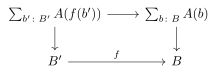
Thus, pullback corresponds to substitution, and the object $A'$ is precisely the total space of the substituted dependent type.
Path Objects
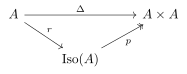
For any object $A$, consider the diagonal morphism $\Delta : A \to A \times A$. This admits a factorization
Here:
- $p : \operatorname{Iso}(A) \twoheadrightarrow A \times A$ is an isofibration;
- $r : A \xrightarrow{\sim} \operatorname{Iso}(A)$ is a weak equivalence.
The object $\operatorname{Iso}(A)$ is called the path object of $A$.
Type-Theoretic Semantics
In type-theoretic terms:
- The isofibration $p$ corresponds to the identity type \[ x : A,\ y : A \vdash (x \simeq y)\ \mathrm{Type}. \]
- The path object is the total space \[ \operatorname{Iso}(A) = \sum_{x:A} \sum_{y:A} (x \simeq y). \]
- The map $r$ corresponds to reflexivity, \[ x \mapsto (x,x,\mathrm{refl}_x). \]
Mapping Path Spaces and Weak Factorization
For any morphism $f : A \to B$, we obtain a factorization
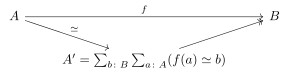
The intermediate object carries the type-theoretic meaning
\[ b : B \vdash \sum_{a:A} (f(a) \simeq b)\ \mathrm{Type}, \]which is precisely the homotopy fiber of $f$ over $b$.
This shows that synthetic category theory admits a weak factorization system, directly mirroring the situation in model categories.